Mastering Piano Notation and Sight Reading
Grand Staff Navigation
The Grand Staff as One System
Think of the grand staff not as two separate staves, but as one large, 11-line system with the middle line removed. This missing line is where Middle C lives. The treble staff handles the notes above Middle C, and the bass staff handles the notes below. They are two halves of a whole, seamlessly connected.
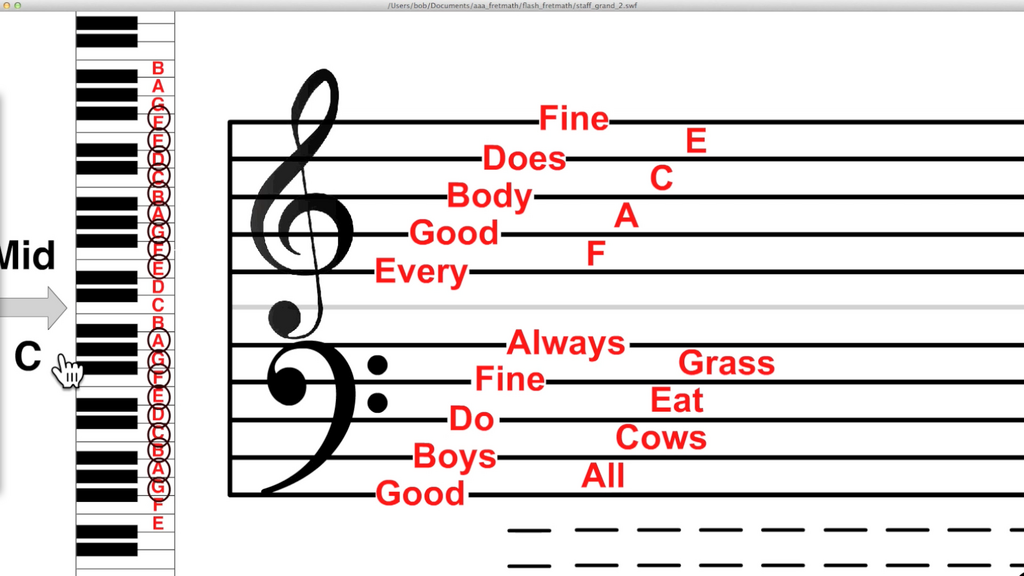
The gap between the staves can be misleading. It’s just empty space to make reading easier. The real connection is the pitch progression. The note just below the treble staff is D, and the note just above the bass staff is B. What comes between them? Middle C. It’s the anchor that locks the two staves together.
Vertical movement on the page corresponds directly to left-right movement on the keyboard. Moving up the staff means moving right on the keys; moving down means moving left.
Beyond the Five Lines
A piano has 88 keys, but the grand staff only has 10 lines and 8 spaces. To write notes outside this range, we use ledger lines, which are short lines extending the staff higher or lower. Each ledger line and the space it creates represents the next note in the musical alphabet.
Ledger Line
noun
A short line added above or below a musical staff to notate pitches outside the standard five lines.
For example, the C one octave above Middle C sits on the third space of the treble staff. The next C above that, sometimes called “High C,” is written on the second ledger line above the treble staff. The same logic applies below the bass staff. The C one octave below Middle C is in the second space of the bass staff, and the next C down sits on the second ledger line below it.
While you can technically add as many ledger lines as you need, it becomes hard to read after about five or six. For notes in extreme registers, composers use a simpler method.
Jumping Octaves
To avoid a clutter of ledger lines, composers use octave displacement symbols. The symbol (ottava alta) written above a passage means to play everything one octave higher than written. Similarly, (ottava bassa) written below a passage means to play one octave lower. A dashed line shows how long the instruction applies.
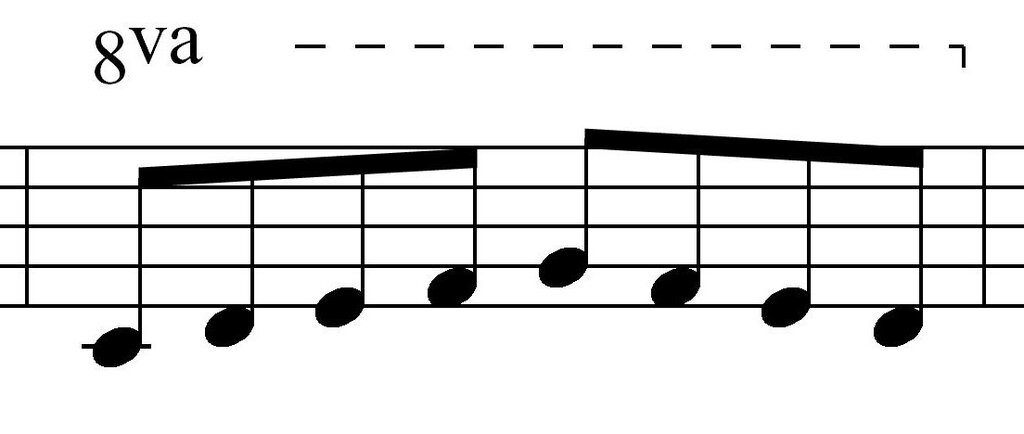
This trick keeps the notes centered on the staff, where they are easiest to read quickly. When you see an 8va or 8vb, you read the note as if the symbol wasn't there, and then simply shift your hand position up or down an octave on the keyboard.
With the grand staff, ledger lines, and octave symbols, you now have the tools to locate any of the 88 keys on a piano. The goal is to move past thinking of the clefs separately and see the entire system as a single, continuous map of the keyboard.
Time to check your understanding.
How is the grand staff best understood conceptually?
Where is Middle C located in the grand staff system?
By mastering this visual language, you can translate written music into physical motion on the keys without hesitation.