Mastering Photography
Advanced Composition
Beyond the Rule of Thirds
You've already mastered the rule of thirds, which is a fantastic tool for creating balanced images. But to truly elevate your photography, you need to explore more nuanced compositional techniques. These methods move beyond simple grids to create images with greater flow, dynamism, and visual interest.
Understanding how to compose images beyond basic rules like thirds is vital for elevating your photography.
The Golden Ratio
The golden ratio is a mathematical concept, approximately 1.618, that appears frequently in nature, art, and architecture. When applied to photography, it creates compositions that feel organic and naturally pleasing. Unlike the static grid of the rule of thirds, the golden ratio provides a more dynamic structure.
Two common ways to apply it are the Phi Grid and the Golden Spiral. The Phi Grid is similar to the rule of thirds, but its central lines are closer together, creating a tighter and more focused core. The Golden Spiral is a logarithmic spiral that draws the viewer's eye inward in a sweeping, natural motion.
Try placing your main subject at the tightest point of the spiral, or align key elements along its curve. For the Phi Grid, position important features along the lines or at their intersections. This will guide the viewer’s eye through the frame in a balanced, flowing way.
Guiding the Viewer's Eye
Effective compositions often create a path for the viewer. Leading lines are powerful tools for this, using elements within the scene to draw attention towards the main subject. These lines can be obvious, like roads, paths, or fences, or more subtle, like the curve of a shoreline or the direction of a person's gaze.
- Straight lines create a sense of order and directness.
- Curved lines feel more gentle, natural, and flowing.
- Diagonal lines add energy and a sense of dynamic movement.
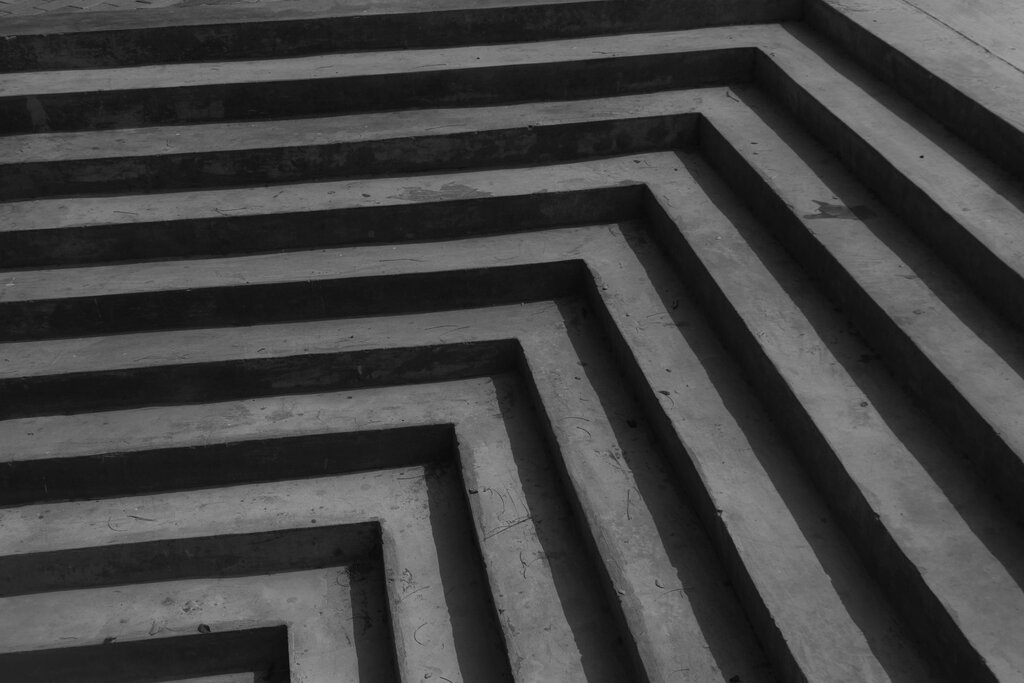
The key is to position your subject at the end of the line, or along its path, giving the viewer a clear journey to follow. This technique adds depth and makes your image more engaging.
Balance and Tension
Symmetry creates a sense of harmony, stability, and calm. A symmetrical composition is balanced, often with the two halves of the image mirroring each other. This is common in architecture photography or when using reflections in water. While it can be very powerful, it can also feel static if not used carefully.
Asymmetry, on the other hand, creates a sense of tension and dynamism. Instead of a mirror image, an asymmetrical composition balances elements of different visual weights. A large, dark object on one side might be balanced by a smaller, brighter object on the other. This creates a more complex and often more interesting image, as the viewer's eye moves between the elements to find equilibrium.
Symmetry brings peace, while asymmetry creates energy. Choose the one that best fits the story you want to tell.
Adding Depth
Two excellent techniques for creating a sense of depth are using a frame within a frame and managing negative space.
A frame within a frame involves using elements in the foreground to frame your subject. This could be a doorway, a window, an archway, or even overhanging tree branches. This technique naturally draws the viewer's eye to the main subject and adds context and layers to your image, making a two-dimensional photo feel more three-dimensional.

Negative space is the empty area around your subject. While it might seem unimportant, it's a critical compositional element. A lot of negative space can create a feeling of minimalism, isolation, or freedom. A lack of it can make an image feel busy and claustrophobic.
By intentionally using negative space, you give your subject room to breathe and direct the viewer's focus exactly where you want it. It simplifies the composition and strengthens the impact of your main subject.
Ready to test your knowledge on these advanced techniques?
How does the Phi Grid, based on the golden ratio, differ from the standard rule of thirds grid?
If a photographer wants to add a sense of energy and dynamic movement to an image, which type of leading line would be most effective?
Mastering these techniques will give you a more sophisticated toolkit for composing your images. Don't just follow rules; use them to tell more compelling visual stories.