Mastering Persuasive Debate Tactics
Advanced Argument Construction
From Opinion to Argument
In everyday conversation, opinions are cheap. Anyone can have one. But in competitive debate, an opinion is just a starting point. To win a round, you need to transform that opinion into a structured, resilient argument. The key is moving from simply stating what you believe to proving why it's true and why it matters.
The most effective way to do this is with the ARE model. It’s a simple but powerful framework for building a complete argumentative point. ARE stands for Assertion, Reasoning, and Evidence.
| Component | Question it Answers | Role |
|---|---|---|
| Assertion | What's your point? | The clear, concise claim you are making. |
| Reasoning | Why is it true? | The logical link that connects your claim to your proof. |
| Evidence | How do you know? | The data, statistic, or expert quote that supports your reasoning. |
Think of it like building a bridge. The Assertion is one side of the canyon (your claim), and the Evidence is the other (your proof). The Reasoning is the bridge itself, creating a logical pathway that connects the two. Without the reasoning, or the warrant as it's formally known, your evidence is just a disconnected fact, and your assertion is an unsubstantiated claim. The warrant is where most weak arguments fall apart.
The Anatomy of a Sound Argument
Let’s break it down with a simple example. Imagine your starting opinion is, "School uniforms are a good idea."
1. Assertion: First, sharpen that opinion into a debatable claim. Instead of a vague statement, make a specific point. "Mandatory school uniforms reduce bullying based on socioeconomic status."
2. Reasoning: Now, build the logical bridge. Why would uniforms have this effect? "Uniforms create a level playing field by removing designer labels and expensive clothing as markers of social status. When all students are dressed similarly, it diminishes a key source of peer-to-peer judgment and harassment, making it harder for cliques to form around wealth."
3. Evidence: Finally, anchor your reasoning with proof. "A 2013 study from the University of Nevada, Reno, surveyed schools in the Washoe County School District and found that after the first year of implementing a uniform policy, there was a 15% drop in discipline referrals and a 63% decrease in police log reports."
Suddenly, you have a complete, defensible argument—not just an opinion.
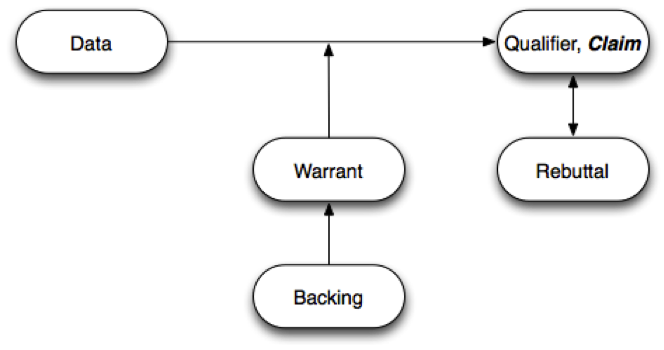
This structure is fundamental. It forces you to think critically about the why behind your claims, ensuring there's a logical foundation for every point you make. Models like this help you visualize the architecture of your argument, making it stronger and easier for a judge to follow.
Making Your Argument Matter
A logically sound argument is great, but it's not enough to win. You also have to answer the judge's silent, nagging question: "So what?" This is where the 'I' for Impact comes in, transforming ARE into AREI.
Impact is the significance of your argument within the context of the debate. It explains the consequences if your argument is true. Who is helped? Who is harmed? What larger principle is at stake? Impact is what creates urgency and persuades the judge that your argument should be the deciding factor in the round. Without it, even a well-structured argument can feel trivial and unimportant.
A strong impact shows the judge a clear, tangible outcome. It connects your argument to real-world consequences or the core values of the debate.
Let's add an impact to our school uniform argument.
Impact: "By reducing bullying, school uniforms create a safer and more inclusive learning environment. This isn't just about feelings; it's about educational outcomes. When students feel safe, they are more likely to participate in class, perform better academically, and have improved mental health. Therefore, the implementation of school uniforms is a critical step towards fulfilling the fundamental goal of our education system: to provide a safe space where every student has an equal opportunity to succeed."
This final step connects your point to a larger, more compelling goal. You've shown that uniforms aren't just about clothes; they're about safety, equity, and academic success. This makes your argument far more persuasive.
In the context of competitive debate, what does the acronym ARE stand for?
According to the text, what is the primary function of the 'Reasoning' component in an argument, also known as the 'warrant'?
By mastering the AREI structure, you ensure every point you make is not only logical and supported but also meaningful. This transforms you from someone with opinions into a debater with powerful, persuasive arguments.