Mastering Persuasive Arguments with the Toulmin Model
Introduction to Argumentation
What's an Argument?
The word “argument” might bring to mind a heated disagreement. But in persuasion and critical thinking, it’s something much more constructive. An argument is a way of presenting a specific point of view and backing it up with support. The goal isn't to fight, but to persuade someone that your point is valid and worth considering.
We use arguments all the time, whether we’re deciding with friends which movie to see, explaining to a boss why a project needs more time, or even just convincing ourselves to go to the gym. It's a fundamental skill for clarifying ideas and making decisions.
The Building Blocks
A strong argument isn't just a statement of opinion. It's a well-supported structure built from three key components: the claim, the evidence, and the reasoning.
- Claim: This is the main point you are trying to prove. It’s a statement that is debatable, not a fact. "The sky is blue" is a fact; "Our city needs more bike lanes" is a claim.
- Evidence: This is the proof you offer to support your claim. Evidence can be data, statistics, expert opinions, or specific examples. It's the factual foundation of your argument.
- Reasoning: This is the crucial link that connects your evidence to your claim. It explains why the evidence you provided actually proves your point. It's the logical explanation that makes the argument hold together.
Let's see how these parts work together in a simple scenario. Imagine you're trying to convince your roommate to start composting.
| Component | Example |
|---|---|
| Claim | We should start a compost bin for our apartment. |
| Evidence | The city's waste management report says that 30% of household trash is food waste. |
| Reasoning | By composting our food scraps, we can reduce our contribution to landfill waste by nearly a third, which is better for the environment. |
Notice how the reasoning connects the fact about food waste directly to the claim about starting a compost bin. Without that link, the evidence is just an interesting statistic. With it, the argument becomes persuasive.
Why Structure Matters
A jumble of facts and opinions doesn't make a convincing case. The power of an argument comes from its logical structure. When your claim is clearly stated, your evidence is relevant, and your reasoning provides a solid connection, your argument is easy for others to follow and accept.
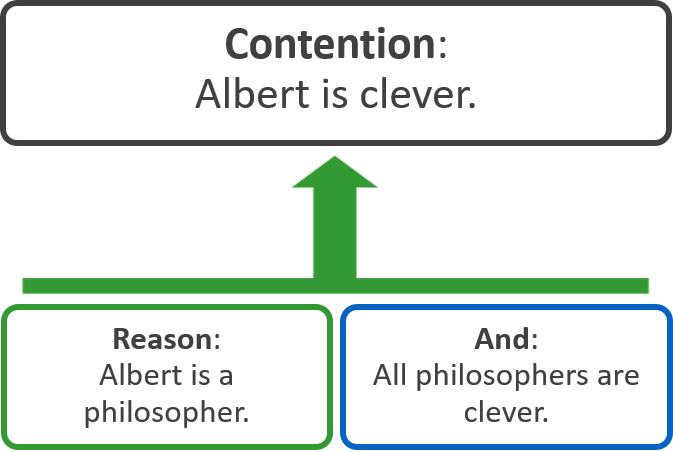
Think of it like building a bridge. The claim is the destination you want to reach. The evidence forms the pillars, and the reasoning is the road that connects them, allowing your audience to travel from the support to the conclusion. If any piece is missing or weak, the whole structure can fall apart.
Now, let's test your understanding of these core components.
In the context of persuasion, what is the primary goal of an argument?
Which of the following is NOT one of the three core components of a well-structured argument?
Mastering these basics is the first step toward building more complex and powerful arguments.