Mastering Persuasive Arguments with the Toulmin Model
Introduction to Argumentation
What Makes an Argument?
An argument isn’t just a disagreement or a shouting match. In logic and critical thinking, it’s a structured attempt to persuade someone of something. It has a point to make and provides reasons to believe that point is true.
Argument
noun
A set of one or more statements, called premises, intended to support another statement, the conclusion.
Think of it like building something. The conclusion is what you're trying to build, and the premises are the materials you use to support it. A statement on its own, like “e-books are better than paper books,” is just an opinion. To turn it into an argument, you need to add reasons.
For example: “E-books are better than paper books because they are more portable and environmentally friendly.”
Here, the claim is supported by two premises, turning an opinion into a basic argument.
The goal isn't to be loud, but to be logical. A strong argument uses clear reasons and solid evidence to guide a listener or reader to the conclusion. It’s a key part of how we share ideas, make decisions, and understand the world.
Two Paths of Reasoning
Arguments generally follow one of two paths: deductive or inductive reasoning. They look similar, but they lead to different kinds of conclusions.
Deductive reasoning starts with a general rule and applies it to a specific case. If the initial statements (premises) are true, the conclusion is guaranteed to be true. It’s a top-down approach that offers certainty.
Premise 1: All squares have four equal sides. Premise 2: This shape is a square. Conclusion: Therefore, this shape has four equal sides.
You can't argue with that conclusion, as long as you accept the premises. The logic is airtight.
Inductive reasoning, on the other hand, works from the bottom up. It takes specific observations and uses them to form a broader, general conclusion. This is the kind of reasoning we use most often in everyday life and in science.
Observation 1: Every swan I have ever seen is white. Observation 2: My friend in another city has only ever seen white swans. Conclusion: Therefore, all swans are probably white.
Notice the word “probably.” Inductive conclusions are about likelihood, not certainty. The argument is strong, but the discovery of a single black swan (which do exist!) would prove the conclusion false. It's powerful but open to new information.
| Feature | Deductive Reasoning | Inductive Reasoning |
|---|---|---|
| Direction | General to specific | Specific to general |
| Conclusion | Guaranteed if premises are true | Probable but not guaranteed |
| Strength | Based on validity and soundness | Based on the quality of evidence |
| Example | Mathematical proofs, syllogisms | Scientific theories, predictions |
The Core Components
Whether it's deductive or inductive, every solid argument needs two things: evidence and logic. They are the pillars that hold up any claim.
Evidence (or premises) are the facts, statistics, examples, or observations you present as support. It's the “what you know” part of the argument. Weak or inaccurate evidence leads to a weak argument, no matter how clever your reasoning is.
Logic is the connection between your evidence and your claim. It’s the “how you know” part. Logic ensures that your conclusion follows reasonably from the evidence you've provided. You can have great evidence, but if the logical link is broken, the argument falls apart.
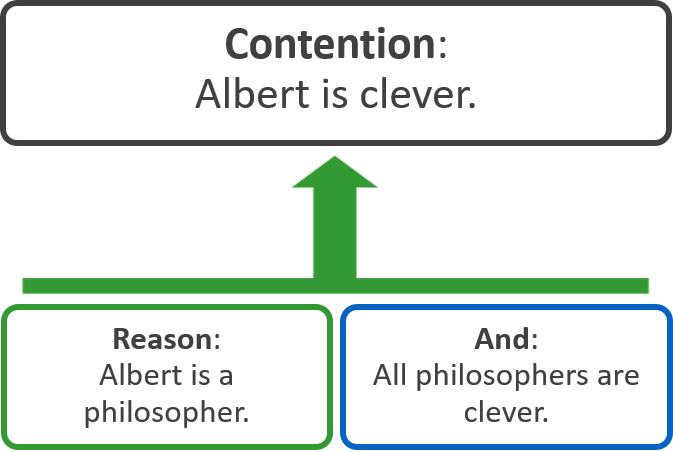
Imagine you’re a detective at a crime scene. The muddy footprint, the open window, and the missing wallet are your evidence. The logical leap is connecting these clues to conclude that a robbery occurred. Without good evidence (clear footprints, a confirmed missing item), your conclusion is just a guess. And without logic, the evidence is just a random collection of facts.
Building a strong argument is a skill. It requires finding good information and weaving it together in a way that makes sense. It’s about creating a clear path from a set of facts to a compelling conclusion.
Which of the following best defines an 'argument' in the context of logic?
Consider this line of reasoning: 'All humans are mortal. Socrates is a human. Therefore, Socrates is mortal.' What type of reasoning is being used?
Let's see what you've learned about the fundamentals of argumentation.