Mastering Persuasion with the Toulmin Model
Introduction to Argumentation
More Than Just a Fight
When we hear the word "argument," most of us picture a heated disagreement. But in communication and critical thinking, an argument is something more structured. It’s the process of presenting reasons to support an idea or point of view. The goal isn't to win a fight, but to persuade others that your position is logical and worth considering.
Think of it like being a detective. You don’t just accuse a suspect without proof. You build a case. You present a clear conclusion and back it up with clues and logical connections. A strong argument works the same way. It leads your audience to a conclusion by showing them the evidence and explaining how it all fits together.
The Three Building Blocks
Every solid argument, whether it’s a single sentence or a whole book, is built on three essential components: the claim, the evidence, and the reasoning.
Claim
noun
The main point or conclusion of your argument. It's the statement you want your audience to accept.
A claim is a statement that is debatable. It's not a fact, like "the sky is blue," but an assertion that needs support. For example, a simple claim could be: "Public libraries are essential for a community’s health."
A claim is the "what" of your argument: What are you trying to prove?
A claim is weak by itself. To make it convincing, you need evidence.
Evidence
noun
The facts, data, statistics, examples, or expert opinions you use to support your claim.
Evidence makes your argument concrete. For our library claim, we could use evidence like: "A recent study found that communities with well-funded libraries have higher literacy rates and more engaged citizens." This is a specific piece of data that gives the claim credibility.
Evidence is the "why" of your argument: Why should I believe your claim?
But just presenting evidence isn't enough. You have to connect it to your claim. That’s where reasoning comes in.
Reasoning
noun
The logical connection that explains how the evidence supports the claim. It's the bridge between your evidence and your claim.
Reasoning is the explanation. It makes your thought process clear to your audience. For our example, the reasoning might be: "Higher literacy and civic engagement are key indicators of a healthy community. Since libraries boost these factors, they are essential."
This final piece ties the evidence (the study) directly to the claim (libraries are essential), completing the argument.
Reasoning is the "how" of your argument: How does your evidence prove your claim?
Putting It All Together
An argument is only as strong as its weakest link. A great claim with no evidence is just an opinion. Powerful evidence is useless if the reasoning doesn't connect it back to the claim.
Imagine building a stool. The claim is the seat—the part you want people to rest on. The evidence and reasoning are the legs. Without them, the stool collapses. A logical structure ensures your argument can stand on its own and support the weight of scrutiny.
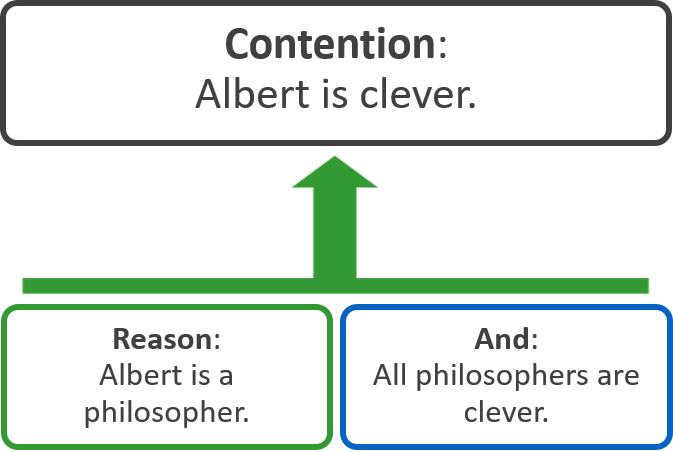
This structure is the foundation of persuasive communication. Whether you are writing an essay, debating a topic, or even just trying to convince a friend to see a movie, understanding how to build a clear, well-supported argument is key.
Let’s try a quick check to see how these concepts are landing.
In the context of communication and critical thinking, what is the main goal of an argument?
What are the three essential components of a well-structured argument?
Mastering these three basic components is the first step toward building more complex and powerful arguments. In the next section, we'll explore a model that helps break down arguments even further.