Mastering Persuasion with the Toulmin Model
Introduction to Argumentation
What is an Argument?
When we hear the word “argument,” we often think of a heated disagreement. In the world of logic and communication, however, an argument is something different. It’s a structured way of making a point and backing it up. The goal isn’t to fight, but to persuade, explore ideas, or make a decision based on sound reasoning.
Think of it as building a case. You have a central idea you want others to accept. To do that, you can't just state your opinion. You need to present a logical structure that leads your audience to the same conclusion you've reached. A good argument invites discussion and helps people understand a topic from a new perspective.
The Three Key Ingredients
Every solid argument is built from three core components: a claim, evidence, and reasoning. Getting these three parts right is the foundation of making a convincing point.
1. The Claim This is the main point you are trying to make—your thesis or conclusion. It should be a clear, debatable statement. A claim isn't a fact (like "the sky is blue") or a personal preference (like "I like blue"). It's a statement that requires proof.
Example Claim: All public parks should provide free Wi-Fi.
2. The Evidence This is the information you use to back up your claim. Evidence comes in many forms: facts, statistics, expert opinions, or concrete examples. The stronger and more relevant your evidence, the more credible your claim becomes.
Example Evidence: A recent city survey showed 80% of park visitors carry a Wi-Fi-enabled device. Additionally, cities that have implemented free public Wi-Fi saw a 15% increase in park usage.
3. The Reasoning Reasoning is the logical glue that connects your evidence to your claim. It’s where you explain why your evidence proves your point. This is often the most critical part of an argument because it shows your thought process. It answers the question, “So what?”
Example Reasoning: Since most people in our parks have devices that could use Wi-Fi, and other cities have successfully used this to increase park visits, providing free Wi-Fi would be a valuable public service that encourages more people to enjoy our city's green spaces.
When you are writing your paper, focus on creating a clear argument through the thesis, and developing a flowing defensive of that argument using supporting points / evidence / examples.
Putting It All Together
Let's look at a simple visualization of how these parts work together. The claim is the conclusion, which rests on the support provided by the evidence and reasoning.
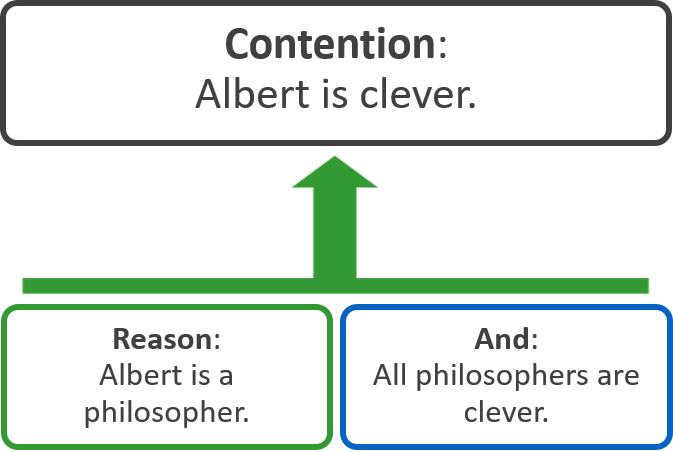
In this diagram, "Albert is clever" is the claim. The statements "Albert is a philosopher" and "All philosophers are clever" are the evidence and reasoning that lead to that conclusion. Without both supporting pieces, the claim is just an opinion. Together, they form a logical argument.
Why Clarity is King
An argument can have a strong claim and good evidence, but if the reasoning is unclear or the language is confusing, it will fail. Persuasion requires clarity.
Imagine you're trying to convince a friend to try a new restaurant. You could just say, “We should go there.” That's a claim, but it’s not very convincing.
Instead, you might say: “We should try that new restaurant on Main Street (claim) because it has amazing reviews online for its pasta (evidence), and we’re both always looking for great Italian food (reasoning).”
This second version is clear, logical, and much more persuasive. By breaking your argument down into its core components, you make it easier for others to follow your logic and, ultimately, agree with your point of view.
This foundational structure of claim, evidence, and reasoning is the starting point for all effective arguments.