Mastering Percentage Grades
Understanding Percentages
What is a Percentage?
The word "percent" comes from the Latin phrase per centum, which means "per hundred." A percentage is simply a fraction where the denominator is always 100. It's a way to talk about a part of a whole in a standardized way.
If you have 50%, you have 50 out of 100. If you have 7%, you have 7 out of 100.
Think of a pizza cut into 100 tiny, equal slices. If you eat 25 slices, you've eaten 25% of the pizza. This concept of a standard whole (100) makes it easy to compare different quantities. Knowing you ate 25% of a pizza is easier to picture than saying you ate 1/4 of it, especially when comparing it to, say, 1/5 of another pizza.
From Fractions to Percentages
To convert any fraction to a percentage, the goal is to find an equivalent fraction with a denominator of 100. The numerator of that new fraction is your percentage.
For a fraction like $1/2$, you can ask: what do I multiply the denominator (2) by to get 100? The answer is 50. To keep the fraction's value the same, you must also multiply the numerator by 50.
The same logic applies to other fractions. For $3/4$, you would multiply the top and bottom by 25.
But what if the denominator doesn't divide evenly into 100, like in the fraction $1/8$? The universal method is to first convert the fraction to a decimal by dividing the numerator by the denominator. Then, multiply the result by 100 and add a percent sign (%).
Step 1: Divide the numerator by the denominator. Step 2: Multiply the decimal by 100. Step 3: Add the % symbol.
Let's try it with :
- The answer is .
From Decimals to Percentages
Converting a decimal to a percentage is even simpler. Since a percentage is a part of 100, you just need to multiply the decimal by 100.
A handy shortcut is to move the decimal point two places to the right and add a percent sign.
| Decimal | Move Decimal Two Places Right | Percentage |
|---|---|---|
| 0.85 | 85. | 85% |
| 0.07 | 07. | 7% |
| 1.25 | 125. | 125% |
| 0.4 | 40. | 40% |
Notice that with 0.4, we had to add a zero to move the decimal point two places. And yes, you can have percentages greater than 100%. If a company's profits grew to 1.25 times their original size, that's a 125% increase.
Percentages in Real Life
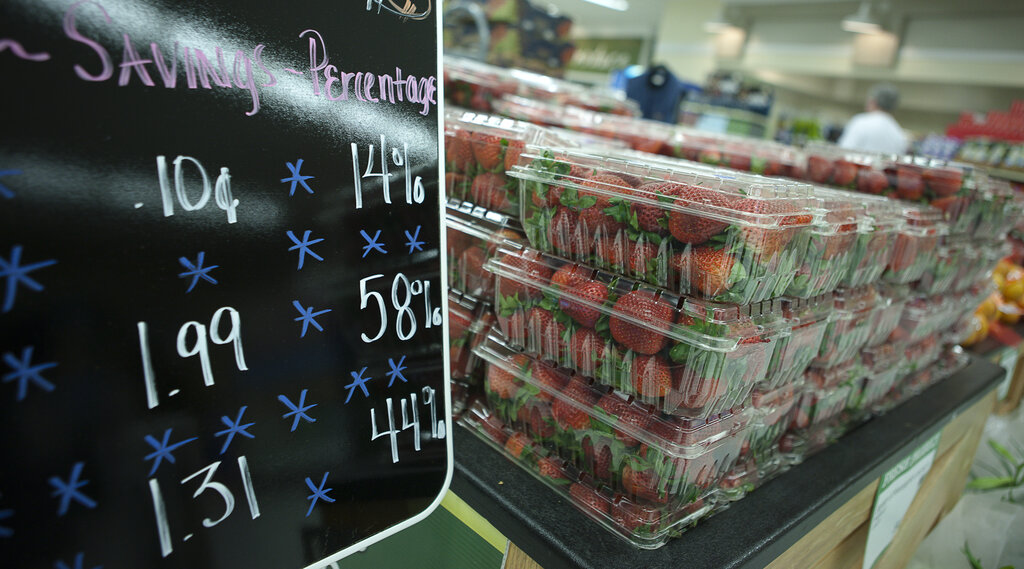
You see percentages everywhere, from the store to the news. They provide a common language for understanding data and making decisions.
Some common examples include:
- Shopping: A "20% off" sale tells you the discount on an item. A 5% sales tax tells you how much extra you'll pay.
- Finance: Interest rates on savings accounts, credit cards, and loans are all expressed as percentages.
- Statistics: News reports use percentages to describe everything from election results to scientific studies (e.g., "65% of participants saw improvement").
- Nutrition: Food labels show the percentage of your recommended daily intake of various nutrients.
Understanding how percentages work is a basic skill for navigating the modern world.
Equivalent fractions, decimals, and percentages are all just different ways of representing the same thing, so you can convert between them to compare.
Let's review the key ideas before you go.
Ready to check your understanding?
The word "percent" is derived from the Latin phrase per centum. What does this phrase mean?
Which of the following represents the correct way to convert the fraction to a percentage?
Being able to move smoothly between fractions, decimals, and percentages is a powerful mathematical skill that simplifies many everyday tasks.