Mastering Pentatonic Fluency
Intervallic Logic and Connections
The Logic of Five Notes
You already know pentatonic scales as shapes on a fretboard or keys on a piano. But to truly unlock their power, you need to hear them not as a sequence of notes, but as a collection of specific intervallic colors. The magic of these scales lies in what they leave out.
The major pentatonic scale is built from the root (1), a major second (2), a major third (3), a perfect fifth (5), and a major sixth (6). It deliberately skips the fourth and seventh degrees of the standard major scale. This isn't random. Those two notes, the 4th and the 7th, form the most dissonant interval in the major scale: the tritone. By removing them, the pentatonic scale eliminates all half-step intervals, creating a smooth, open, and universally consonant sound. It’s a sonic cheat code. It simply can't sound wrong.
Think of it like a painter choosing a limited palette. With only five specific colors, it's much harder to create a muddy, clashing picture. Every combination works.
Let's map this out. The major pentatonic formula is a blueprint for stability and brightness.
| Interval | Formula | Sonic Role |
|---|---|---|
| Root | 1 | The anchor, our point of reference. |
| Major Second | 2 | A step away, adds movement without tension. |
| Major Third | 3 | The 'happy' sound, defines the major quality. |
| Perfect Fifth | 5 | The most stable harmony, reinforces the root. |
| Major Sixth | 6 | Adds a sweet, melodic lift. |
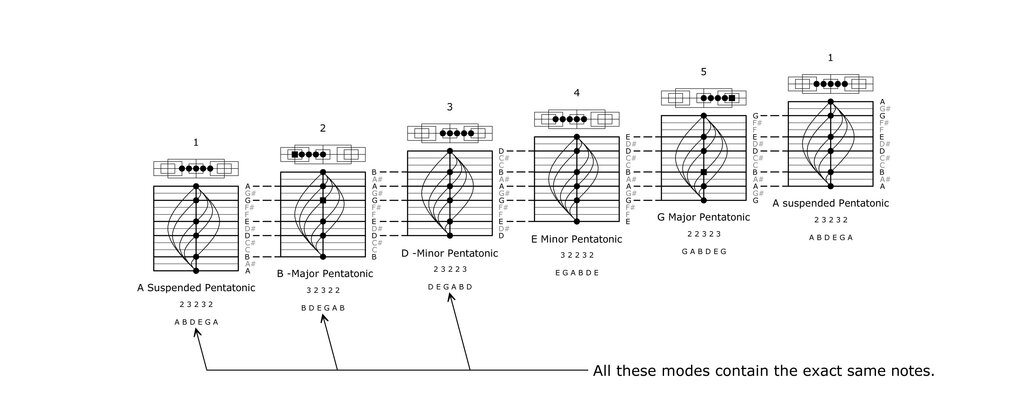
The Minor Mood
The minor pentatonic scale follows the same logic of removal, but it starts from the natural minor scale. Its formula is root (1), minor third (♭3), perfect fourth (4), perfect fifth (5), and minor seventh (♭7). Here, we've removed the second and the minor sixth degrees. This again removes the two half-step intervals present in the natural minor scale, smoothing out the sound.
The result is a sound that's bluesy, soulful, and a bit more solemn than its major counterpart. The key interval defining this mood is the minor third (♭3). That single flattened note is the essential color that shifts the entire emotional landscape from bright to somber.
| Interval | Formula | Sonic Role |
|---|---|---|
| Root | 1 | The anchor, the tonal center. |
| Minor Third | ♭3 | The 'sad' or 'bluesy' sound, defines the minor quality. |
| Perfect Fourth | 4 | A stable, but darker sound than the major third. |
| Perfect Fifth | 5 | The ultimate support for the root. |
| Minor Seventh | ♭7 | Adds a 'cool' tension, crucial for blues and rock. |
The goal is to stop thinking about these as abstract formulas or fretboard shapes. You need to internalize the sound and feel of each interval's distance from the root. This is where ear training comes in. Put on a drone of a single note (the root) and try singing or playing each of the other four notes of the scale against it. Don't just play the scale up and down. Jump between the intervals.
Try this: from the root, jump to the fifth. Then back to the root, and up to the third. Then root to sixth. Feel the physical distance on your instrument and connect it to the sonic leap in your ear.
Visualizing Intervals
The final step is to build a mental map. No matter where you are on your instrument, if you're on a root note, you should be able to instantly visualize where its major third, minor third, and perfect fifth are located. These three notes form the basic major or minor triad and are your most important signposts. The other notes of the pentatonic scale are just connectors.
This intervallic awareness is what separates mechanical playing from true musical expression. Once you hear and see these relationships instinctively, the entire instrument opens up. You're no longer trapped in a single scale pattern; you can create melodies based on the colors you want to hear, pulling notes from your mental map of intervals relative to any root.
Ready to test your understanding of these intervallic functions?
Which two scale degrees from the standard major scale are omitted to create the major pentatonic scale?
What is the primary musical reason for removing specific notes from the major scale to form the major pentatonic scale?
By focusing on the why behind the notes, you transform scales from something you memorize into something you understand.