Mastering Pareto Analysis
Introduction to Pareto Principle
The Vital Few
Have you ever felt that most of your results come from just a fraction of your effort? It’s not just a feeling. It’s a pattern that shows up almost everywhere, from business to biology. This observation is known as the Pareto Principle, or more famously, the 80/20 rule.
The Pareto Principle. This principle, often summarized as the 80/20 rule, suggests that 80% of your results come from 20% of your efforts.
The principle is named after Italian economist Vilfredo Pareto. In 1896, Pareto noticed that about 80% of the land in Italy was owned by just 20% of the population. He then observed a similar pattern in his garden, where 20% of his pea pods produced 80% of the peas. This sparked the idea that in many systems, the relationship between inputs and outputs is unevenly distributed.
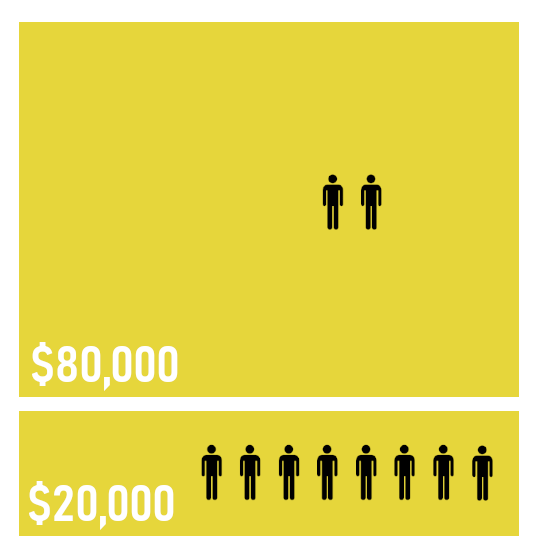
The 80/20 ratio is not a rigid law. The actual numbers might be 70/30 or 95/5. The core idea is that a small percentage of causes, the “vital few,” drive a large percentage of the effects, leaving the rest as the “trivial many.”
A Mathematical Pattern
The Pareto Principle isn't just a quirky observation; it's a reflection of a specific mathematical pattern called a Pareto distribution. This type of distribution is common in phenomena where a few elements hold a disproportionately large share of a resource.
Pareto distribution
noun
A statistical distribution where a small number of items accounts for a large share of the total, and a large number of items accounts for the small remaining share.
Pareto distributions are a type of power-law distribution. The probability density function for a Pareto distribution helps describe this relationship mathematically. A simplified version looks like this:
Here, is the probability that a random variable (like income or city population) is greater than some number . The term is the minimum possible value of , and is a positive parameter that shapes the curve. In simple terms, this formula describes a situation where very large events are rare, but not as rare as you might think, and they contribute massively to the total.
Think of it this way: In a system following a power law, a few giants dominate a landscape of many dwarfs.
The 80/20 Rule in Action
Once you know about the Pareto Principle, you start seeing it everywhere. It provides a useful lens for identifying what's most important in any given situation.
| Field | The "Vital Few" (20%) | The Outcome (80%) |
|---|---|---|
| Business | 20% of customers | 80% of revenue |
| Software Dev | 20% of bugs | 80% of system crashes |
| Time Management | 20% of tasks | 80% of results |
| Quality Control | 20% of defects | 80% of complaints |
For example, a company might find that a handful of its products generate most of its profits. By identifying these key products, the company can focus its marketing and development resources where they'll have the biggest impact. Similarly, a software team can prioritize fixing the few critical bugs that cause the majority of user issues.
Principle vs. Efficiency
It’s easy to confuse the Pareto Principle with another concept named after Vilfredo Pareto: Pareto Efficiency. While they share a name, they describe very different ideas.
The Pareto Principle is an observation about the unbalanced distribution of inputs and outputs.
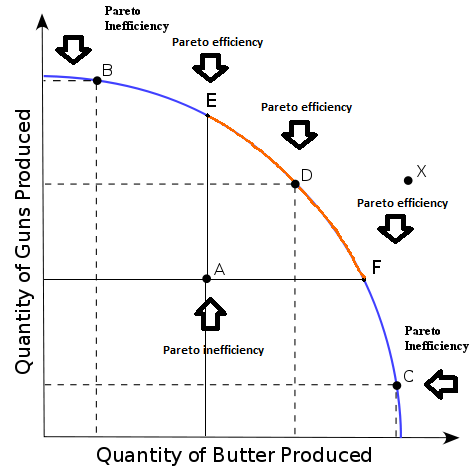
Pareto Efficiency is a definition of an optimal state where no one can be made better off without making someone else worse off.
Imagine two people sharing a pizza. An outcome is Pareto efficient if there's no way to give one person another slice without taking a slice from the other. It doesn't say anything about whether the pizza is split fairly, just that no slices are being wasted.
The Pareto Principle, on the other hand, might observe that 20% of the pizza toppings account for 80% of its flavor. One is about resource allocation, the other is about cause and effect.
Understanding the Pareto Principle helps you focus on what truly matters. It's a simple but powerful tool for thinking about where to direct your energy to achieve the best results.