Mastering OutSystems Low-Code Development
Introduction to OutSystems
What is OutSystems?
Think of building a house. You could start by making your own bricks, mixing your own mortar, and forging your own nails. Or, you could use high-quality, pre-fabricated walls and components that snap together. Both methods can build a solid house, but the second one is dramatically faster.
OutSystems is like the second approach, but for building software. It's a low-code platform, which means it gives you a visual environment to create complex, powerful applications with minimal hand-coding. Instead of writing thousands of lines of code from scratch, you drag and drop pre-built blocks of functionality, design user interfaces visually, and model your business logic in flowcharts.
This doesn't mean it's for simple projects. OutSystems is designed to build and manage serious, enterprise-grade applications that can handle complex business needs and scale to millions of users.
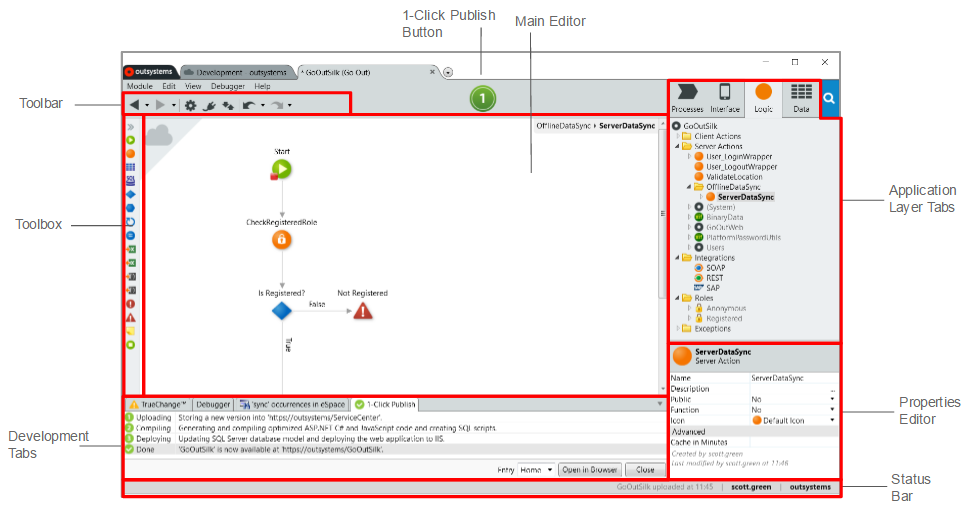
The environment, called Service Studio, is where you assemble your application. You can see your app's screens, logic, and data models all in one place. This visual approach makes it easier to understand how everything connects and to make changes quickly.
Why Go Low-Code?
The core promise of low-code is speed. Businesses need to adapt faster than ever, but traditional software development can be slow and expensive. Low-code platforms dramatically shorten the time it takes to get from an idea to a working application.
This speed also makes it easier to experiment and iterate. If a feature isn't working as expected, you can change it in hours or days, not weeks or months. This agility is a massive advantage in a fast-moving market.
Low-code platforms empower a broad spectrum of users, even those with minimal coding expertise, to actively participate in the development process.
Low-code also breaks down barriers. It allows people with deep business knowledge, sometimes called "citizen developers," to build their own solutions or collaborate more effectively with professional developers. This closes the gap between what the business needs and what the IT department can deliver.
| Feature | Traditional Coding | Low-Code Development |
|---|---|---|
| Development Speed | Slow | Fast |
| Skill Required | Deep programming expertise | Broader, visual skills |
| Collaboration | Often siloed | Easier for business/IT teams |
| Maintenance | Complex | Simpler, more visual updates |
An Entire Ecosystem
OutSystems isn't just a piece of software; it's a complete ecosystem designed to help you succeed. One of its biggest strengths is its active and supportive community. If you ever get stuck, chances are someone has faced the same problem and has a solution ready for you on the community forums.
Another key resource is the OutSystems Forge. This is a marketplace filled with thousands of reusable application components, connectors, and templates. Need to connect to a specific payment gateway or integrate with a popular service? There's likely a pre-built component in the Forge that can save you days of work.
component
noun
A pre-built, reusable piece of software, like a widget, connector, or screen template, that can be added to an application to provide specific functionality.
Finally, OutSystems provides extensive documentation and free online courses. These resources guide you from the basics all the way to advanced topics, helping you and your team get up to speed quickly.
Low-Code in the Modern World
In modern software development, the goal is to deliver value to users as quickly and efficiently as possible. Low-code platforms are becoming a critical tool for achieving this. They don't aim to replace professional developers. Instead, they empower them to be more productive.
Developers can use low-code to handle the repetitive, boilerplate parts of application development, freeing them up to focus on the unique, high-value challenges that require their deep technical expertise. It allows for a hybrid approach where the speed of visual development is combined with the power of custom code when needed.
Companies are using low-code to modernize old systems, build new mobile apps for their customers, and automate internal processes. It’s a versatile tool for driving digital transformation across an organization.
By enabling faster development cycles and closer collaboration, low-code platforms like OutSystems are helping businesses build the exact software they need, right when they need it.