Mastering OSPF Routing
OSPF Fundamentals
What is OSPF?
Open Shortest Path First, or OSPF, is a protocol that helps routers decide the best way to send your data across a network. Think of it as a GPS for the internet, but one that operates inside a single, self-contained network, like a university campus or a large company. This type of self-contained network is often called an autonomous system.
OSPF is a link-state routing protocol. This is different from distance-vector protocols you may have learned about. A distance-vector router is like someone who only knows the next turn to take based on directions from a neighbor. In contrast, a link-state router is like having a complete, detailed map of the entire city. It knows about every street, every intersection, and the traffic conditions on each.
With a full map, each router can independently calculate the best route to any destination, making it highly efficient and quick to adapt to network changes, like a downed link.
Building the Network Map
So how do OSPF routers build this comprehensive map? They talk to each other using specific types of messages, called OSPF packets. Each router announces information about its direct connections—its "links"—and this information is shared with every other router until they all have the same complete picture of the network topology.
This process of sharing and synchronizing maps relies on five key packet types.
| Packet Type | Purpose |
|---|---|
| Hello | Discovers neighbors and maintains relationships. |
| Database Description (DBD) | Summarizes a router's link-state database. |
| Link-State Request (LSR) | Asks for more specific information about an entry in a DBD. |
| Link-State Update (LSU) | Provides the detailed link-state information requested. |
| Link-State Acknowledgment (LSAck) | Confirms receipt of an LSU. |
The process starts with routers sending out Hello packets. When two routers on the same link receive each other's Hello packets and agree on certain parameters, they become neighbors. From there, they exchange DBD packets to compare their map versions. If a router sees that its neighbor has more up-to-date information, it sends an LSR. The neighbor replies with an LSU containing the details, and the first router sends back an LSAck to confirm. This constant chatter ensures every router's map stays accurate.
Finding the Best Path
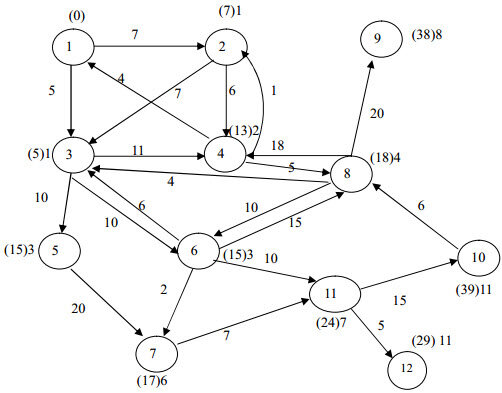
Once a router has a complete map of the network, it needs a way to calculate the shortest path to every possible destination. For this, OSPF uses a powerful algorithm created by Edsger Dijkstra.
Dijkstra's algorithm
noun
An algorithm for finding the shortest paths between nodes in a graph, which may represent, for example, road networks.
The algorithm works by building a tree of the shortest paths from the source router to every other router in the network. The "length" of a path isn't measured in distance, but in a metric called cost. OSPF automatically calculates the cost of a link based on its bandwidth—higher bandwidth means lower cost. The "shortest path" is the one with the lowest total cost.
By running Dijkstra's algorithm, each router can independently determine the most efficient, loop-free path to send data to any destination on its map.
Keeping Things Organized with Areas
In a very large network, having every router maintain a map of every other router can become overwhelming. The constant updates and recalculations would consume a lot of processing power and bandwidth.
To solve this, OSPF allows you to divide a large network into smaller, more manageable sections called areas. Routers within an area have a complete map of their own area but only receive summarized information about other areas. This is like knowing every single street in your own neighborhood but only knowing the main highways to get to other neighborhoods.
This hierarchical design significantly improves efficiency and scalability. All areas must connect to a special central area called the backbone, or Area 0. This backbone area is responsible for routing traffic between all the other areas.
OSPF is classified as which type of routing protocol?
What is the primary role of the OSPF backbone area, also known as Area 0?
OSPF's combination of detailed local knowledge and summarized external information makes it a robust and scalable choice for managing routing within complex networks.