Mastering Organic Reaction Mechanisms and Synthesis
Molecular Orbital Theory
Beyond the Bond
Lewis structures and valence bond theory give us a great picture of where electrons are in a molecule—localized between two atoms. But reality is a bit more complex. Electrons don't just stay put; they exist in orbitals that can span an entire molecule. Molecular Orbital (MO) theory helps us understand this by showing how atomic orbitals combine.
The core idea is the Linear Combination of Atomic Orbitals (LCAO). When two atomic orbitals overlap, they don't just share space; they merge to create two new molecular orbitals. One is a bonding orbital, which is lower in energy than the original atomic orbitals. The other is an anti-bonding orbital, which is higher in energy.
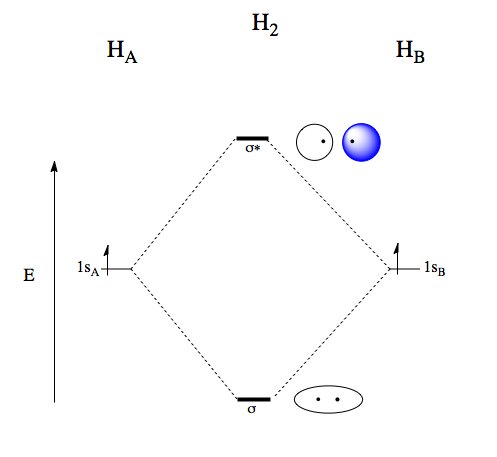
Think of it like two waves interacting. They can add together constructively to create a larger, more stable wave (the bonding orbital), or they can cancel each other out destructively, creating an unstable region with no wave action (the anti-bonding orbital). Electrons naturally fill the lower-energy bonding orbital first, creating a stable chemical bond. The anti-bonding orbital usually remains empty.
Frontier Orbitals
In organic chemistry, we're particularly interested in reactions, which are all about electron movement. The most important orbitals for understanding reactivity are the Highest Occupied Molecular Orbital (HOMO) and the Lowest Unoccupied Molecular Orbital (LUMO). These are collectively known as the frontier orbitals.
The HOMO is the orbital where the molecule's most available, highest-energy electrons reside. The LUMO is the first available empty orbital, representing where the molecule can accept new electrons. Chemical reactions often involve electrons moving from the HOMO of one molecule to the LUMO of another.
Let’s look at ethylene (), the simplest alkene. Its double bond consists of one sigma bond and one pi bond. The pi bond is formed by the sideways overlap of a p-orbital from each carbon atom. This combination creates a pi bonding orbital (π) and a pi anti-bonding orbital (π*).
The two electrons in the pi bond occupy the lower-energy π orbital. This makes the π orbital the HOMO. The π* orbital is empty, making it the LUMO. The energy difference between these two is called the HOMO-LUMO gap. A smaller gap means it's easier to excite an electron from the HOMO to the LUMO, making the molecule more reactive.
Conjugation and Delocalization
Things get more interesting when pi systems are connected, or conjugated. A conjugated system has alternating single and multiple bonds, which allows p-orbitals on adjacent atoms to overlap continuously.
Consider 1,3-butadiene. It has four carbon atoms, each with a p-orbital. Instead of forming two isolated pi bonds like in ethylene, all four p-orbitals combine. This creates four new molecular orbitals that are delocalized—spread out over the entire four-carbon chain. The electrons are no longer confined to the space between just two atoms.
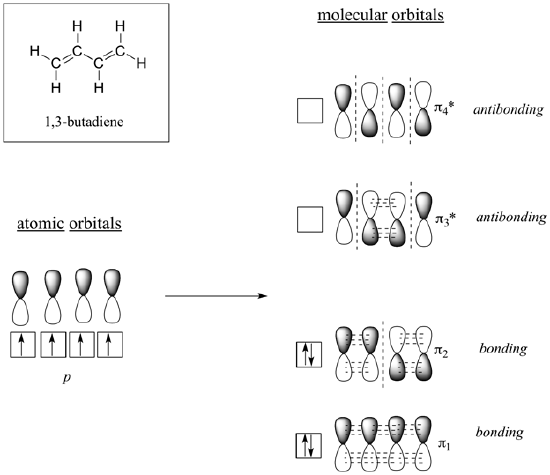
The four molecular orbitals of butadiene are arranged by energy. The four pi electrons fill the two lowest-energy bonding orbitals (π1 and π2). The lowest energy orbital, π1, has no nodes between the carbons, allowing for maximum bonding. The next one up, π2, has one node. The two higher-energy anti-bonding orbitals (π3* and π4*) remain empty.
In this system, π2 is the HOMO, and π3* is the LUMO. Because delocalization spreads the electrons out and lowers their overall energy, conjugated systems are more stable than molecules with isolated double bonds. This increased stability is the physical basis for resonance.
Unlike valence bond theory, which uses hybrid orbitals that are assigned to one specific atom, MO theory uses the combination of atomic orbitals to yield molecular orbitals that are delocalized over the entire molecule rather than being localized on its constituent atoms.
Understanding HOMO, LUMO, and delocalization through MO theory gives you a powerful framework for predicting how and why organic molecules react. It explains why benzene is so stable and why conjugated dienes undergo specific types of addition reactions. It moves beyond simple line drawings to the quantum mechanical reality of electron behavior.
Ready to test your knowledge on these new concepts?
According to Molecular Orbital (MO) theory, what results from the combination of two atomic orbitals?
In the context of chemical reactions, the two most important molecular orbitals are the Highest Occupied Molecular Orbital (HOMO) and the ______ Unoccupied Molecular Orbital (LUMO).
By understanding how atomic orbitals combine to form molecular orbitals, we gain a deeper insight into the stability and reactivity of organic molecules.