Mastering Organic Chemistry Fundamentals
Representation and Isomerism
Drawing Molecules Shorthand
As molecules get larger, drawing every single atom and bond becomes tedious. Chemists developed a shorthand called the bond-line notation, or skeletal structure, to simplify things. It’s clean, fast, and focuses on the carbon backbone where most of the action happens.
The rules are simple:
- Carbon atoms are represented by vertices (corners) and endpoints of lines.
- Carbon-carbon bonds are the lines themselves.
- Hydrogen atoms attached to carbons are not drawn. We assume each carbon has enough hydrogens to satisfy its need for four bonds (its tetravalency).
- Atoms other than carbon and hydrogen (heteroatoms) are explicitly drawn, along with any hydrogens attached to them.
This simple zigzag line instantly communicates a butane molecule to any chemist. It's the standard language of organic chemistry.
Molecules in 3D
Bond-line drawings are great, but they are flat. Molecules exist in three dimensions, and their shape is crucial to how they react. To represent 3D geometry on a 2D surface, we use a convention with wedges and dashes.
- A solid wedge represents a bond coming out of the page, toward you.
- A dashed line represents a bond going into the page, away from you.
- A normal solid line represents a bond lying in the plane of the page.
This method is essential for visualizing the tetrahedral geometry around an hybridized carbon. Another 2D method for showing 3D structure is the , which is especially useful for molecules with many stereocenters, like sugars.
Same Formula, Different Molecule
Now for one of the most important concepts in organic chemistry: isomerism. Isomers are different compounds that have the exact same molecular formula. It's like having the same set of Lego bricks but building two different objects. They are broadly classified into two main types: structural isomers and stereoisomers.
Structural isomers have the same molecular formula but different connectivity—the atoms are connected in a different order.
Think back to butane (). We can arrange those four carbons and ten hydrogens in two different ways. One is a straight chain, and the other is branched. These are structural isomers of each other.
| Type | Description | Example (Formula: ) |
|---|---|---|
| Chain | Carbon skeleton is arranged differently. | Butane vs. Isobutane (2-methylpropane) |
| Positional | A functional group is attached to a different carbon. | Propan-1-ol vs. Propan-2-ol |
| Functional | Atoms are arranged into different functional groups. | Propan-1-ol (an alcohol) vs. Methoxyethane (an ether) |
Stereoisomers have the same molecular formula and the same connectivity, but the atoms are arranged differently in three-dimensional space.
This is a more subtle difference. The atoms are all connected to the same partners, but their spatial orientation is distinct. Stereoisomers come in two flavors: geometrical and optical.
Spatial Arrangements
Geometrical isomerism occurs when there is restricted rotation in a molecule, typically around a carbon-carbon double bond. Because the double bond can't twist freely, the groups attached to the carbons can be locked into different positions relative to each other.
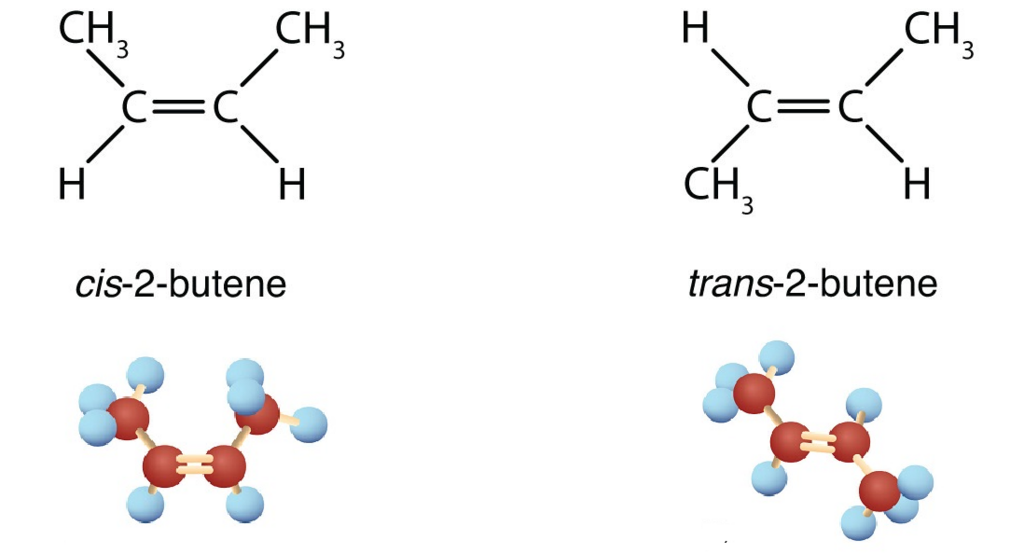
In cis isomers, the high-priority groups are on the same side of the double bond. In trans isomers, they are on opposite sides. This simple difference in geometry can lead to very different physical properties, like boiling points and stability.
Optical isomerism is even more fascinating. It arises when a molecule is —meaning its mirror image is non-superimposable, like your left and right hands. Such molecules are called enantiomers.
The most common source of chirality in organic chemistry is a carbon atom bonded to four different groups. This is called a chiral center or stereocenter. A molecule with one chiral center will have two enantiomers.
With complex molecules that have multiple double bonds or several different groups, simply using 'cis' and 'trans' isn't enough. We need a universal system to assign priority to the groups attached to the carbons. This is where the come in.
The CIP rules allow us to assign an E (from the German entgegen, meaning opposite) or Z (from zusammen, meaning together) configuration to geometrical isomers, and an R (from Latin rectus, right) or S (from sinister, left) configuration to optical isomers.
The basic rule is simple: the higher the atomic number of the atom directly attached to the carbon, the higher its priority.
- For a double bond, we determine the high-priority group on each carbon. If they are on the same side (zusammen), it's the Z-isomer. If they are on opposite sides (entgegen), it's the E-isomer.
- For a chiral center, we assign priorities 1 (highest) through 4 (lowest) to the four groups. We then orient the molecule so the lowest priority group (4) points away. If the path from 1 to 2 to 3 is clockwise, it's R. If it's counter-clockwise, it's S.
Understanding how to represent molecules and identify their isomers is a foundational skill. It allows us to predict properties, understand reactions, and appreciate the subtle but profound ways that structure dictates function in the chemical world.
In a standard bond-line (skeletal) structure, which of the following are NOT explicitly drawn?
When drawing a molecule's 3D structure on a 2D surface, what does a solid wedge line represent?