Mastering Order Flow Analysis for Trading
Introduction to Order Flow
The Why Behind Price
Most traders look at a price chart and see a line wiggling up and down. They see the what—the price moved. But they often miss the why. What actually causes the price to change? The answer is order flow.
Order Flow
noun
The real-time stream of buy and sell orders being executed in a financial market. It represents the collective actions of all market participants.
Think of order flow as the current in a river. The price is like a boat floating on that river. Strong buying pressure is a powerful current pushing the boat upstream (price up). Strong selling pressure is a current pulling it downstream (price down). By watching the current, you can better predict where the boat is headed.
Traditional technical analysis focuses on patterns in the past price. Order flow analysis, on the other hand, is about watching the real-time battle between buyers and sellers as it happens. It’s a look under the hood of the market engine.
This direct cause-and-effect relationship is what makes order flow so powerful. You're not just guessing based on historical patterns; you're observing the actual supply and demand dynamics unfolding right now.
The Market's Players
To understand order flow, you need to know who is creating it. The market isn't a monolithic entity; it's a collection of different participants with different goals, resources, and strategies. Their combined actions create the total order flow.
| Participant | Typical Size | Primary Goal |
|---|---|---|
| Institutional Investors | Very Large | Long-term growth, portfolio management |
| Retail Traders | Small | Short-term profit, speculation |
| Market Makers | Varies | Provide liquidity, profit from the spread |
Institutional investors are the whales of the market. Think pension funds, hedge funds, and large banks. Their massive orders can single-handedly create a strong current in the order flow. Because their trades are so large, they often have to break them into smaller pieces to avoid moving the price against themselves.
Retail traders, like individual investors, are the small fish. A single retail trade has almost no impact, but the collective action of millions of retail traders can create significant momentum.
Market makers are facilitators. They are required by the exchange to be willing to both buy and sell a particular asset at any time. They make their money on the small difference between their buy and sell prices (the bid-ask spread), and their activity ensures there's always someone to trade with.
How Flow Moves Price
A market is essentially an auction. There are buyers bidding on an asset and sellers offering it. The price moves based on the aggression of these two sides.
Imagine an asset is being offered for sale at $101 (the 'ask' price) and the highest bid to buy is $100 (the 'bid' price). For a trade to happen, one of two things must occur:
- A buyer becomes more aggressive and agrees to pay the seller's price of $101. This is a 'market buy' order. It consumes the available supply at that price.
- A seller becomes more aggressive and agrees to accept the buyer's bid of $100. This is a 'market sell' order. It absorbs the available demand at that price.
If a wave of aggressive buyers enters the market, they will quickly buy up all the units available at $101. To continue buying, they have to move to the next available price, say $102. The price has now moved up. This is the core mechanic of order flow. Price moves to find liquidity. When buy orders overwhelm sell orders, the price rises to find more sellers. When sell orders overwhelm buy orders, the price falls to find more buyers.
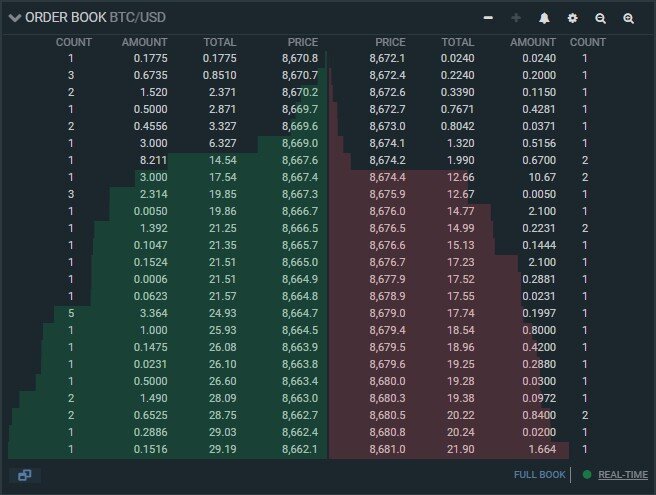
The image above shows a limit order book. The green side represents all the passive buy orders (bids) waiting at different prices, while the red side shows all the passive sell orders (asks). When a market order arrives, it consumes the orders at the best available price, causing the price to tick up or down. By watching the flow of these market orders and how they interact with the limit orders, traders gain insight into the strength of buying and selling pressure.
According to the principles of order flow, what is the direct cause of a market's price moving up?
In the analogy where the market is a river and the price is a boat, what does a strong downstream current represent?
Understanding these foundational concepts is the first step. By seeing the market through the lens of order flow, you begin to see the forces that actually drive price, moving beyond simple patterns to the underlying mechanics of supply and demand.