Mastering Oracle Fusion SCM
Introduction to Supply Chain Management
What Is a Supply Chain?
Think about the smartphone in your pocket or the coffee you drank this morning. Neither just appeared. Each one traveled through a complex network to get to you. That network is a supply chain: the entire system of people, organizations, activities, information, and resources involved in moving a product or service from supplier to customer.
Supply Chain Management (SCM) encompasses the coordinated management of resources, materials, information, and finances as a product or service moves from supplier to manufacturer to wholesaler to retailer to consumer.
In simpler terms, SCM is the art and science of getting the right product to the right place, at the right time, in the right quantity, and at the right cost. When it works well, it's almost invisible. When it breaks down, you notice empty shelves at the grocery store or long delays for an online order.
The Core Components
Every supply chain is different, but most share a few core components that manage the flow of goods from start to finish. We can think of them as key stages in a product's journey.
Let's look at each of these stages.
Procurement
noun
The act of obtaining or buying goods and services. The process includes preparation and processing of a demand as well as the end receipt and approval of payment.
This is the starting point. Procurement involves finding reliable suppliers for raw materials or components, negotiating prices, and purchasing what's needed to create a product. For a car company, this means sourcing everything from steel and rubber to microchips.
Manufacturing is the transformation stage. Here, raw materials are converted into a finished product. This could be as simple as assembling pre-made parts or as complex as a multi-stage chemical process. The goal is to produce goods efficiently without sacrificing quality.
Distribution deals with getting the finished product from the factory to a point of sale. This often involves a network of warehouses and distribution centers. Products are stored, sorted, and then shipped out to retailers or directly to customers.
Logistics
noun
The detailed coordination of a complex operation involving many people, facilities, or supplies. It's the management of the flow of things between the point of origin and the point of consumption.
Logistics is the glue that holds the supply chain together. It oversees the physical movement of goods, including transportation (trucks, ships, planes) and warehousing. It also involves managing inventory to ensure there isn't too much or too little stock at any point in the chain.
The Payoff
So why do companies invest so much in managing their supply chains? It comes down to two main benefits: efficiency and satisfaction.
A well-managed supply chain boosts business efficiency. By optimizing each step, a company can reduce waste, lower transportation and storage costs, and prevent delays. For example, by accurately forecasting demand, a business can avoid making too many products that just sit in a warehouse, tying up money and space.
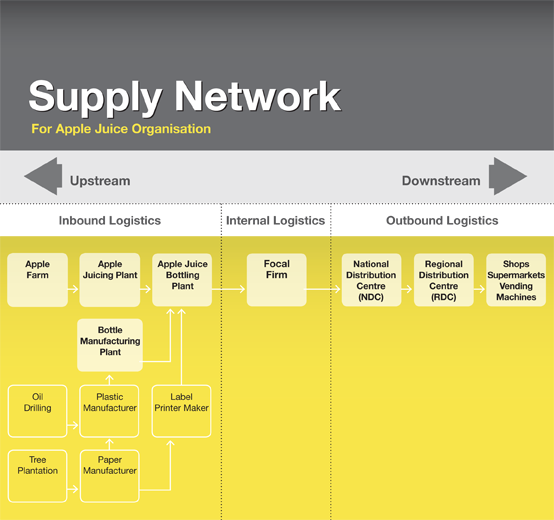
Ultimately, this all leads to better customer satisfaction. An efficient supply chain means products are available when and where customers want them. It ensures orders are fulfilled accurately and delivered on time. A smooth experience turns a one-time buyer into a loyal customer.
The fundamental goal of supply chain management is to enhance customer value and satisfaction.
Understanding these basics is the first step. A great supply chain doesn't just move products; it builds a bridge between a company's potential and its customers' needs.
What is the primary goal of Supply Chain Management (SCM)?
Which stage of the supply chain focuses on finding reliable suppliers and purchasing raw materials?
With these core concepts in mind, you're ready to explore how businesses manage and optimize these complex systems.