Mastering Operating System Architecture
Kernel Architecture Trade-offs
Kernel Architectures
At the heart of every operating system lies the kernel, the bridge between software and hardware. But not all kernels are built the same. The internal design of a kernel dictates how it manages resources, and this architecture has profound effects on performance, stability, and security.
A key concept is the separation between kernel mode and user mode. Kernel mode is a privileged state where code has direct, unrestricted access to all hardware and memory. This is where the core of the OS runs. User mode is a restricted state where applications run. If an application needs to perform a privileged action, like reading a file from a disk, it must ask the kernel to do it on its behalf through a special request.
The Monolithic Approach
A monolithic kernel is the all-in-one approach. The entire operating system, including services for memory management, file systems, device drivers, and networking, runs as a single, large program in kernel mode. The most famous example is the Linux kernel.
The primary advantage is speed. Since all components share the same memory space, communication between them is incredibly fast, it's as simple as a function call. When an application makes a system call, the transition from user mode to kernel mode is quick, and the kernel can directly access all the functions it needs to fulfil the request.
However, this tight integration comes with a significant drawback: a lack of fault isolation. A bug in a single device driver can corrupt memory used by another part of the kernel, potentially crashing the entire system. This makes the kernel less robust and harder to debug.
The Microkernel Philosophy
The microkernel architecture takes the opposite approach. It aims to have the absolute minimum amount of code running in the privileged kernel mode. Typically, this is just enough to manage memory, schedule threads, and handle (IPC).
Everything else—file systems, device drivers, network stacks—runs as separate server processes in user mode. If an application needs to read a file, it sends an IPC message to the file system server. The microkernel's job is simply to pass that message from the application to the server and then pass the reply back. Systems like QNX and Mach are well-known examples of this design.
The main benefit of a microkernel is modularity and stability. If a device driver crashes, it only takes down that one user-space process. The rest of the system, including the kernel, remains unaffected and can often restart the failed service automatically.
Finding a Middle Ground
Both monolithic and microkernel architectures have clear trade-offs. One prioritises performance, the other stability. Modern operating systems like Windows and macOS use a hybrid kernel, which attempts to get the best of both worlds.
A hybrid kernel is structured like a microkernel but keeps more performance-critical services inside the kernel to avoid the overhead of IPC. For example, the Windows NT kernel, which forms the basis of all modern Windows versions, runs core components like the Executive subsystems and key device drivers in kernel mode. However, it moves other, less critical services into user space.
This design also relies heavily on a Hardware Abstraction Layer (HAL). This is a layer of software within the kernel that hides the specific details of the underlying hardware from the rest of the OS. By swapping out the HAL, the same Windows kernel can run on different processor architectures without needing a complete rewrite.
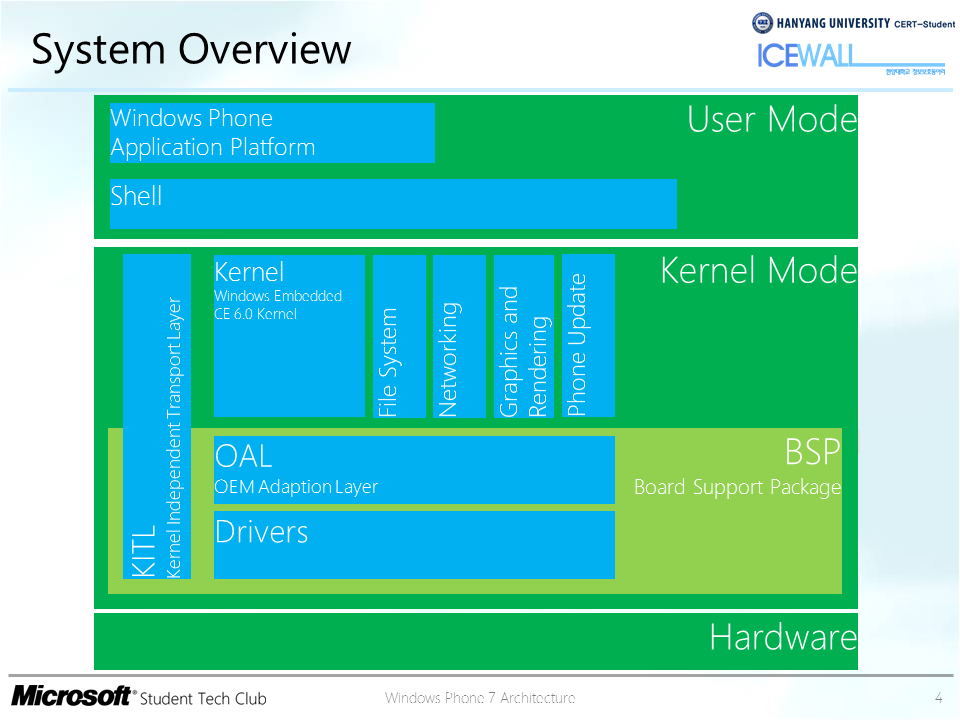
This pragmatic approach allows hybrid systems to achieve performance close to that of a monolithic kernel while gaining some of the modularity and stability benefits of a microkernel. The choice of which components to run in kernel mode versus user mode is a careful balancing act between speed and robustness.
Time to check your understanding of these core architectural trade-offs.
What is the primary architectural advantage of a monolithic kernel, as exemplified by Linux?
In a microkernel architecture, how does an application typically request a service like reading a file?
Ultimately, the choice of kernel architecture depends on the goals of the operating system. There is no single "best" answer, only a series of trade-offs between performance, complexity, and reliability.