Mastering OKRs
Introduction to OKRs
What Are OKRs?
Objectives and Key Results, or OKRs, are a goal-setting framework used by teams to set challenging, ambitious goals with measurable results. Think of it as a way to give work a clear direction and a way to measure progress.
An OKR has two parts:
-
The Objective (O): This is what you want to achieve. It should be significant, concrete, action-oriented, and inspirational. It answers the question, “Where do I want to go?”
-
The Key Results (KRs): These are how you’ll get to the objective. KRs are specific, measurable outcomes that track your progress. They answer the question, “How will I know I’m getting there?” Typically, an objective will have three to five key results.
Objectives are the destination. Key Results are the mile markers along the way.
For example, an objective might be: Launch an amazing new mobile app. This is ambitious and inspirational. But how do you know if the launch was amazing? That's where Key Results come in.
- KR 1: Achieve 10,000 downloads in the first month.
- KR 2: Get an average app store rating of 4.5 stars or higher.
- KR 3: Receive press coverage in three major tech blogs.
A Brief History
The idea behind OKRs started at Intel in the 1970s with its president, Andy Grove. He called his system "Management by Objectives." It was a way to keep his large company focused and aligned.
One of Grove's employees was a young venture capitalist named John Doerr. Doerr saw the power of this goal-setting method firsthand. In 1999, he introduced the framework to a small startup he was advising: Google. They adopted it, and the rest is history. OKRs are now used by thousands of companies, from small startups to large corporations, to drive growth and focus.
Core Principles
OKRs are effective because they are built on a few simple but powerful principles.
Ambitious and Aspirational OKRs are meant to be stretch goals. They should feel a little uncomfortable. If you are consistently hitting 100% of your Key Results, your objectives probably aren't ambitious enough. The sweet spot is often around 70% completion. This encourages teams to push beyond what they think is possible.
Measurable Key Results must be quantifiable. Vague statements like “Improve customer satisfaction” are not good KRs. A better KR would be “Increase the Net Promoter Score (NPS) from 40 to 50.” This leaves no room for doubt about whether the result was achieved.
Transparent In most organizations, OKRs are public for everyone to see. The CEO's OKRs are visible to an intern, and a marketing team's OKRs are visible to the engineering team. This transparency creates alignment, as everyone can see how their work contributes to the bigger picture and how different teams are working together.
Decoupled from Compensation To encourage risk-taking and ambitious goals, OKRs are generally kept separate from salaries and bonuses. If hitting 100% of your KRs meant a big bonus, people would naturally set safer, less ambitious goals to ensure they get it.
How OKRs Differ
You might be familiar with other goal-setting methods like Management by Objectives (MBOs) or Key Performance Indicators (KPIs). While they share some similarities, OKRs have a distinct flavor.
KPIs are ongoing metrics that measure the health of the business, like monthly website traffic or sales revenue. OKRs, on the other hand, are about driving change and improvement in those metrics. An OKR might be created to drastically increase website traffic over a quarter.
Traditional goal setting is often an annual, top-down process where goals are private. OKRs are typically set quarterly and are transparent across the entire organization, fostering a more agile and collaborative environment.
| Feature | OKRs | Traditional Goal Setting |
|---|---|---|
| Cadence | Quarterly or monthly | Annual |
| Transparency | Public across the organization | Private or cascaded by manager |
| Goal Type | Aspirational and ambitious | Typically safe and achievable |
| Alignment | Collaborative and bidirectional | Top-down and hierarchical |
While other frameworks like OGSM (Objectives, Goals, Strategies, Measures) exist, the OKR framework's simplicity and focus on ambitious, measurable outcomes have made it a popular choice for fast-moving organizations.
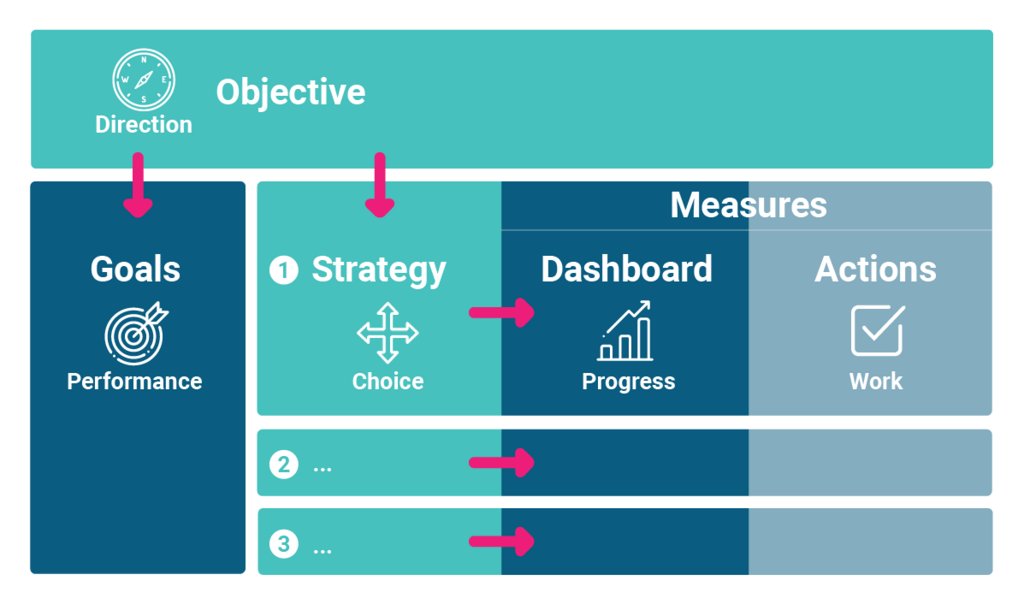
Now, let's test your understanding of these core concepts.
What are the two main components of the OKR framework?
Which of the following is the BEST example of a well-written Key Result?
By focusing on what matters and measuring progress clearly, the OKR framework provides a powerful tool for any team or organization looking to achieve great things.