Mastering Objective Behavioral Deduction
Profiling Strategic Observation
From Logic to People
You already have the tools of deductive and inductive reasoning. Now, let's apply them to one of the most complex systems you'll ever encounter: human behavior. Think of any social environment—a coffee shop, an office meeting, a party—as a living data set. Your goal is to shift from passively seeing what's happening to actively observing it.
Active observation means looking for patterns, anomalies, and the relationships between them. It's about applying a logical framework to the messy, unpredictable world of human interaction. Instead of just noticing that someone is quiet, you'll learn to ask why they are quiet in this specific context and what that might imply.
The Logic of the Situation
Before you can understand an individual, you must first understand their environment. Every social situation has a set of rules, expectations, and physical constraints that shape how people behave. These are the baseline you'll measure everything against.
For example, people act differently in a library than they do at a concert. In a library, quiet, focused behavior is expected. Someone whispering is normal; someone shouting is an anomaly. At a concert, shouting is the norm, and silence would be the anomaly. The environment dictates the expected behavior.
Your first task in social observation is to separate the behavior dictated by the situation from the behavior that reflects individual choice. The person whispering in the library is following the environmental script. The person who starts singing loudly is deviating from it. That deviation is a valuable piece of data. It tells you something unique about them.
Baseline behavior is dictated by the environment. Unique behavior is dictated by the individual. Focus on the unique.
Distinguishing between these two can be difficult. It requires you to constantly assess the context. Is a person's formal attire a personal choice, or is it simply the office dress code? Is their silence a sign of disagreement, or are they just letting the senior manager speak first? Answering these questions is the first step in making sense of what you see.
The OODA Loop
So how do you process all this information in real time without jumping to conclusions? A useful framework is the OODA Loop, a decision-making model developed by military strategist John Boyd. It stands for Observe, Orient, Decide, and Act. While it was designed for combat, it's perfectly adapted for social deduction.
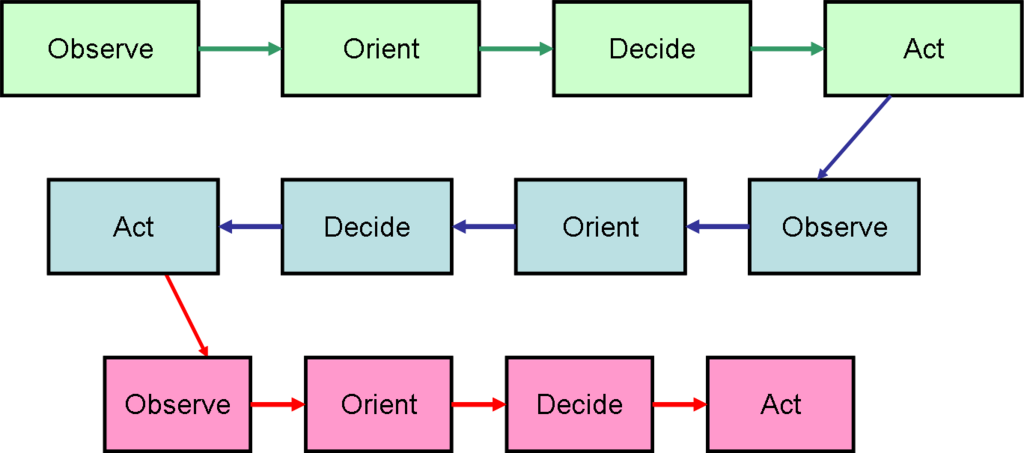
Here's how it works in a social context:
-
Observe: Gather raw data from your surroundings using all your senses. What do you see and hear? Note people's posture, tone of voice, word choice, and interactions with others. At this stage, you are just collecting facts, not interpreting them. For example: "A man at the cafe is looking at the door every few seconds."
-
Orient: This is the most crucial step. You take the raw data and put it in context. This involves your knowledge of social norms, past experiences, and cultural factors. It’s where you form hypotheses. "He's looking at the door. People usually do that when they are expecting someone. The cafe is busy, so he might be saving a seat. Or, he could be anxious and looking for an exit."
-
Decide: Based on your orientation, you choose the most plausible hypothesis. This isn't a final conclusion, but a working theory. You might need more data. "The most likely explanation is that he's waiting for someone to arrive."
-
Act: Your "action" isn't necessarily a physical movement. It could be continuing to observe, testing your hypothesis by asking a question, or simply updating your mental model of the situation. "I will continue to observe. If a person arrives and joins him, my hypothesis is confirmed. If he leaves after 10 minutes without anyone arriving, I need to re-orient with that new data."
The loop is fast and continuous. As soon as you act, you are observing the results of that action, and the cycle begins again. This prevents you from getting stuck on your first impression and allows you to adapt as new information becomes available.
Let’s walk through a practical example. You're in a team meeting where a new project is being announced.
- Observe: Your coworker, Sarah, is silent. She hasn't taken any notes, and her arms are crossed. Another coworker, Ben, is leaning forward, nodding, and has already asked two clarifying questions.
- Orient: The project is a major new initiative. Sarah has been at the company the longest and is usually very engaged. Crossed arms can signal defensiveness. Ben is new and likely eager to make a good impression. Leaning forward shows engagement.
- Decide: Your working theory is that Sarah has reservations about the project, possibly because it conflicts with a system she's familiar with. Ben is enthusiastic and sees an opportunity.
- Act: Your action might be to find a moment after the meeting to casually ask Sarah what she thinks about the new project. This action is designed to gather more data to either confirm or deny your hypothesis.
By using this structured loop, you move beyond simple gut feelings and begin to make more reasoned, evidence-based deductions about the people and situations around you.
Time to test your understanding.
What is the primary goal of "active observation" in a social context?
According to the text, why must you first understand the environment (e.g., a library vs. a concert) before analyzing an individual's behavior?
Mastering this skill takes practice. The next time you're in a social setting, try running the OODA loop. It will help you see the world in a new, more analytical light.