Mastering Numerical Integration Techniques
Introduction to Integration
The Idea of Accumulation
Differentiation is about finding the rate of change at a specific moment. Think of it as looking at a car's speedometer to see how fast it's going right now. Integration, on the other hand, is the opposite. It's about adding things up over time. If you know the car's speed at every moment of a trip, integration helps you figure out the total distance traveled.
Integration is the process of summing up infinite tiny pieces to find a whole.
This idea of accumulation is powerful. It can be used to find the area of an irregular shape, the volume of a curved object, or the total change in a quantity when its rate of change isn't constant. At its heart, calculus gives us two incredible tools: one to break things down (differentiation) and one to build them back up (integration).
Area Under a Curve
The most common way to visualize an integral is by looking at the area under the graph of a function. Imagine a curve plotted on a graph. The integral can tell us the exact area of the region between that curve and the x-axis.
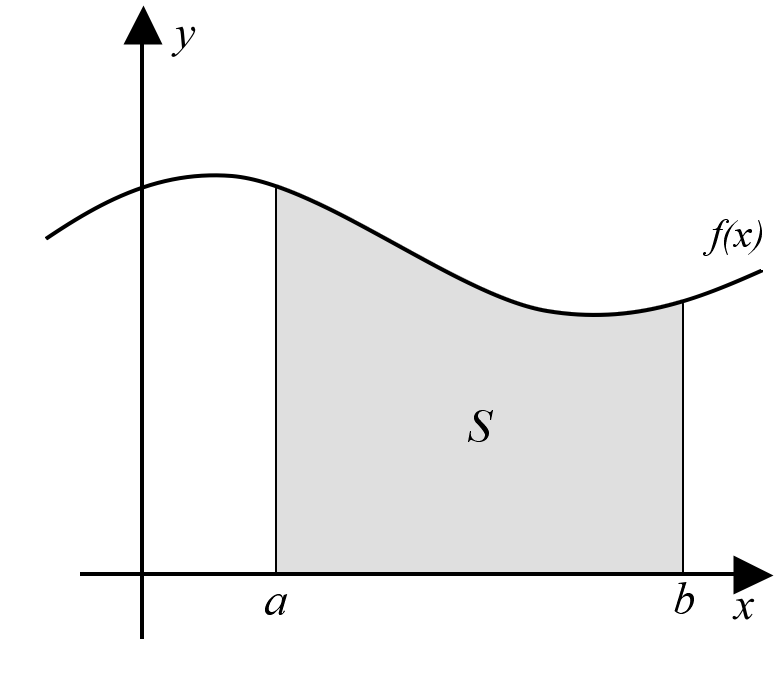
This isn't just a geometric trick. If the function represents a rate, like the rate of water flowing into a tank, then the area under the curve represents the total amount of water that has accumulated over a period of time. This connection between geometry and accumulation is a cornerstone of calculus.
Definite vs. Indefinite Integrals
There are two main flavors of integrals: indefinite and definite. They are related, but they answer different questions.
An indefinite integral is the most general form of an antiderivative. It asks: "What function, when differentiated, gives me the function I started with?"
Antiderivative
noun
A function F is an antiderivative of a function f if F'(x) = f(x).
Because the derivative of a constant is zero, there are infinitely many antiderivatives for any function. For example, the derivative of is , but so are the derivatives of and . We account for this by adding a constant of integration, written as + C.
A definite integral, in contrast, gives you a specific number as an answer. It calculates the net area under a curve between two points, called the limits of integration.
The Fundamental Theorem
So, what’s the connection between finding a rate of change (differentiation) and summing things up (integration)? The link is one of the most important results in all of mathematics: The Fundamental Theorem of Calculus.
The Fundamental Theorem of Calculus links derivatives and integrals in a beautiful symmetry, showing that integration and differentiation are inverse processes.
The theorem has two parts. The first part formalizes the inverse relationship. It says that if you create a function by integrating another function, the derivative of that new function is the original function you started with.
The second part gives us a practical way to calculate definite integrals.
This theorem is incredible. It means we don't have to go through the painstaking process of summing up millions of tiny rectangles to find an exact area. Instead, we can just find an antiderivative and plug in two numbers. It connects the seemingly separate concepts of slope and area into one elegant idea.
Now you have the foundational concepts for understanding what integration is and how it relates to differentiation.
Which of the following scenarios best represents the concept of integration?
What is the primary purpose of the + C (constant of integration) in an indefinite integral?