Mastering Newton Second Law
Vector Force Summation
Forces Are Vectors
You already know that a force is a push or a pull. But to truly understand how forces work, we need to treat them as vectors. This means they have both a magnitude (how strong the push or pull is) and a direction.
Simply adding the magnitudes of forces isn't enough. If two people push a heavy box, the result depends entirely on the direction they push. If they push together, their forces combine. If they push against each other, they might cancel out completely.
This is where the concept of net force becomes critical. The net force is the vector sum of all individual forces acting on an object. It’s this total, combined force that determines an object's acceleration according to Newton's Second Law.
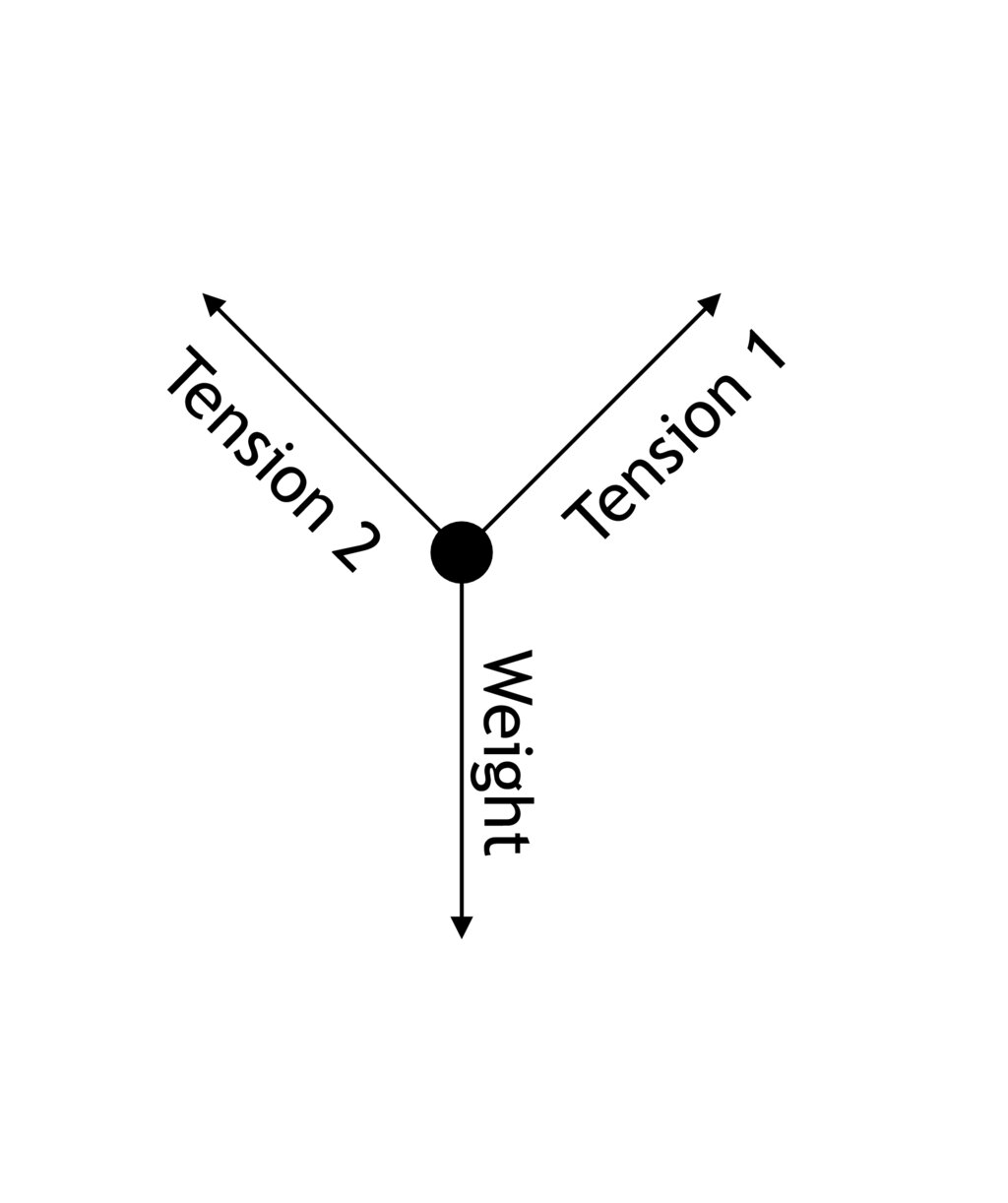
To find this vector sum, we can't just add numbers. We need a systematic way to handle the directions. The most powerful method is to break each force down into components.
Breaking Down Forces
Instead of working with forces at awkward angles, we can resolve them into components that lie along a convenient set of perpendicular axes, usually a standard x-y coordinate system. This process is called vector decomposition.
Any force vector can be expressed as the sum of its horizontal (x) and vertical (y) components. These components are like the shadows the vector would cast on each axis.
Using basic trigonometry, we can find the magnitudes of these components if we know the magnitude of the force and its angle relative to the x-axis.
Summing the Components
The magic of this method comes from a rule called the principle of superposition. It states that the net effect of multiple forces is simply the sum of the effects of each individual force. Once we've broken all forces down into their x and y components, we can add them up independently.
This turns a complex vector problem into two simple scalar problems. You add all the x-components to get the total x-component of the net force, and you add all the y-components to get the total y-component.
Remember to pay attention to signs. A force component pointing left (negative x direction) or down (negative y direction) will be a negative value in your sum.
Finding the Resultant Force
After summing the components, you're left with two perpendicular vectors: and . These are the components of the final net force vector, .
To find the magnitude of this resultant vector, we recombine the components using the Pythagorean theorem.
To find the direction of the net force, we can use the inverse tangent function.
This process—decompose, sum, recombine—is the fundamental strategy for solving almost any problem involving multiple forces.
Let's test your understanding of these steps.
Why is it often necessary to treat forces as vectors instead of just simple numbers (scalars)?
What is the primary advantage of breaking forces down into their x and y components?
By treating forces as vectors and using components, you can analyze complex systems and accurately predict how objects will move.