Mastering Neuroplasticity and Cognitive Resilience
Synaptic Modulation Mechanisms
Strengthening Connections
The brain's ability to learn and remember isn't just a vague concept of 'rewiring.' It's a precise, physical process that happens at the microscopic level of the synapse. The primary mechanism for strengthening these connections is called Long-Term Potentiation, or LTP. Think of it as the cellular basis for Hebb's famous rule: "neurons that fire together, wire together."
Long-term potentiation (LTP) is a persistent increase in synaptic strength that results from repeated or intense stimulation of a synapse
LTP is triggered by high-frequency signals that cause a presynaptic neuron to release a large amount of the neurotransmitter glutamate. This glutamate crosses the synaptic cleft and binds to two key types of receptors on the postsynaptic neuron: AMPA and NMDA receptors.
Initially, only the AMPA receptors open, allowing sodium ions to flow in and depolarize the cell. If this depolarization is strong enough, it dislodges a magnesium ion that normally blocks the NMDA receptor channel. This unblocking is the critical step. Now, with glutamate still present, the NMDA receptor opens, allowing a flood of calcium ions () into the postsynaptic neuron.
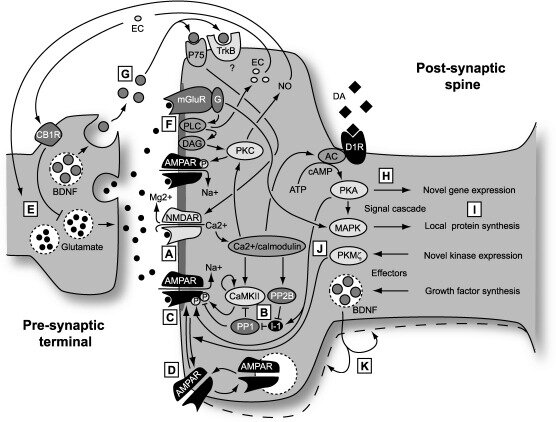
This influx of calcium acts as a powerful second messenger, kicking off a cascade of intracellular signaling. One of the most important players it activates is CaMKII, a protein kinase crucial for memory formation. Activated CaMKII has two main effects. First, it phosphorylates existing AMPA receptors, making them more responsive to glutamate. Second, it triggers the insertion of new AMPA receptors from intracellular stores into the postsynaptic membrane. More receptors mean a stronger response to future glutamate release, solidifying the synaptic connection.
The Art of Forgetting
Learning isn't just about strengthening connections; it's also about weakening or pruning unnecessary ones. This process, known as Long-Term Depression (LTD), is just as important for refining neural circuits. It's the brain's way of making sure that only the most relevant pathways are maintained.
LTD is essentially the inverse of LTP. It’s typically induced by prolonged, low-frequency stimulation. This pattern of activity also leads to a rise in postsynaptic calcium, but it's a much slower and smaller increase compared to the flood seen in LTP. This subtle difference in calcium concentration is key, as it activates a different set of enzymes, primarily protein phosphatases.
While LTP adds AMPA receptors to the synapse, LTD removes them. Phosphatases dephosphorylate AMPA receptors, marking them for removal from the membrane and internalization back into the cell.
Fewer AMPA receptors on the surface mean the postsynaptic neuron becomes less sensitive to glutamate. The synapse is weakened, making it less likely that the presynaptic neuron's signal will be passed on. This dynamic balance between LTP and LTD allows the brain to fine-tune its connections with incredible precision, ensuring that memory storage is both efficient and adaptable.
Building Stable Memories
The initial changes of LTP and LTD last for about an hour. For a memory to become stable, these functional changes must be converted into lasting structural modifications. This requires the synthesis of new proteins and can lead to physical changes in the shape and size of dendritic spines, the tiny protrusions on dendrites where synapses form.
The signaling cascades initiated by calcium, particularly pathways like the MAPK/ERK cascade, travel to the neuron's nucleus and activate transcription factors. These factors turn on genes that produce the proteins needed to build a more robust synapse. Scaffolding proteins are phosphorylated, creating a more stable structure to anchor the new AMPA receptors, effectively creating what researchers call a 'stable synaptic identity.' This molecular construction project is how a fleeting experience becomes an enduring memory.
Now that you've learned about the molecular underpinnings of synaptic change, let's test your knowledge.
What is the critical event that unblocks the NMDA receptor channel, allowing for the influx of calcium () during Long-Term Potentiation (LTP)?
Long-Term Depression (LTD) weakens synapses. What is the primary molecular mechanism responsible for this?