Mastering Networking Fundamentals
Advanced IP Addressing
Smarter Subnetting
You've seen how standard subnetting carves up a large network into smaller, equal-sized pieces. This is a great way to organize and secure a network, but it has a big drawback: it's often wasteful.
Imagine you have to pack for three trips. One requires a large suitcase, another a small backpack, and the last just a fanny pack. If all you own are large suitcases, you'd be forced to use a giant bag for just a wallet and keys. It works, but it's inefficient. Standard subnetting is like having only one size of suitcase.
This is where Variable Length Subnet Masking (VLSM) comes in. VLSM lets you create subnets of different sizes from the same address block, so you can assign addresses based on actual need. You can create a large subnet for your main office LAN, a smaller one for a branch office, and tiny ones for the point-to-point links connecting them.
VLSM allows you to tailor the size of each subnet to its specific host requirements, minimizing wasted IP addresses.
The key to using VLSM is to start with your largest subnets first. Let's say we need to create three subnets from the address block 10.10.0.0/16:
- HQ: Needs 500 hosts
- Sales: Needs 200 hosts
- Admin: Needs 50 hosts
First, we tackle the HQ network. To get 500 hosts, we need 9 host bits ($2^9 = 512$), which leaves $32 - 9 = 23$ bits for the network. So, our first subnet is 10.10.0.0/23.
Next is the Sales network, needing 200 hosts. We need 8 host bits ($2^8 = 256$), leaving $32 - 8 = 24$ network bits. We allocate the next available block, which is 10.10.2.0/24.
Finally, Admin needs 50 hosts. We need 6 host bits ($2^6 = 64$), giving us a /26 mask. The next available block is 10.10.3.0/26.
We've efficiently allocated addresses for all three departments while leaving the rest of the 10.10.0.0/16 block free for future use.
| Department | Hosts Needed | Subnet Address | Subnet Mask | Usable Host Range |
|---|---|---|---|---|
| HQ | 500 | 10.10.0.0/23 | 255.255.254.0 | 10.10.0.1 - 10.10.1.254 |
| Sales | 200 | 10.10.2.0/24 | 255.255.255.0 | 10.10.2.1 - 10.10.2.254 |
| Admin | 50 | 10.10.3.0/26 | 255.255.255.192 | 10.10.3.1 - 10.10.3.62 |
A New Notation
As networks grew and VLSM became necessary, the old class-based system (Class A, B, C) became too rigid. A new, more flexible method was needed. Enter Classless Inter-Domain Routing, or CIDR.
CIDR ditches the idea of address classes entirely. Instead, it uses a simple notation to specify the number of network bits in any subnet mask.
CIDR
noun
An IP addressing method that allows for more flexible allocation of IP addresses than the original classful system. CIDR notation, also known as slash notation, specifies the number of bits in the network portion of an address.
The notation is simple: an IP address followed by a forward slash and a number. That number, called the prefix, represents how many bits are used for the network ID. For example, in 192.168.1.10/24, the /24 tells us that the first 24 bits of the address identify the network.
This is much clearer and more concise than writing out 255.255.255.0. It works for any subnet size, making it perfect for the variable subnets created with VLSM.
# Dotted-Decimal vs. CIDR

# A typical small network
255.255.255.0   ->   /24

# A subnet with 126 usable hosts
255.255.255.128 ->   /25

# A point-to-point link with 2 usable hosts
255.255.255.252 ->   /30
Designing for Growth
Using VLSM and CIDR together is the foundation of modern IP addressing strategy. It's not just about saving addresses today; it's about planning for tomorrow. When designing an IP scheme, you must think about scalability.
Don't just allocate the exact number of addresses a department needs right now. If the sales team has 50 people, don't give them a subnet with only 62 usable IPs. What happens when they hire 20 more people next year? A good rule of thumb is to plan for 25-50% growth over the next few years.
Another key strategy is summarization, or route aggregation. This involves organizing your subnets hierarchically so they can be represented by a single, 'summary' route. For example, if you have these subnets for a region:
10.20.0.0/2410.20.1.0/2410.20.2.0/2410.20.3.0/24
You can advertise a single route, 10.20.0.0/22, to the rest of your network. This simplifies routing tables, reduces router workload, and makes the network more stable. Planning your IP allocation with summarization in mind from the start will save you major headaches later.
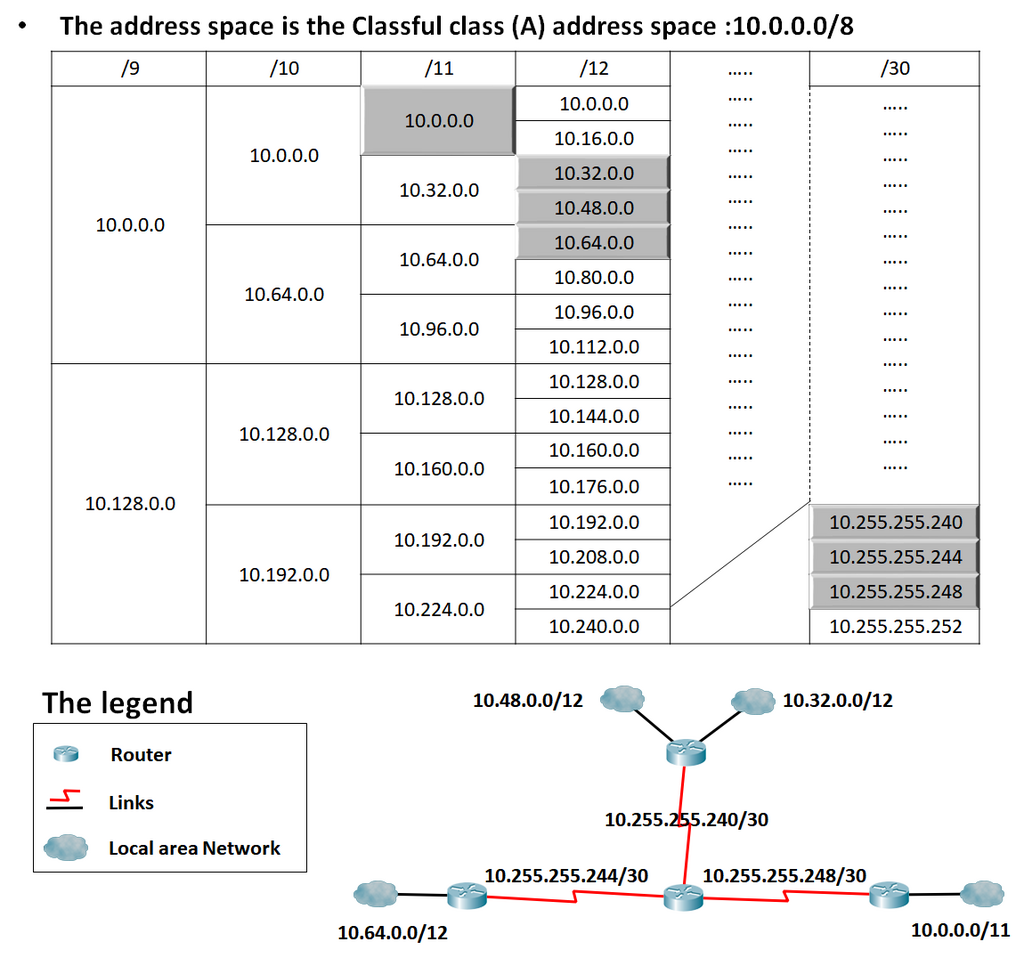
Good design also involves creating standards. Document a clear policy for how addresses are assigned. Maybe you'll reserve certain ranges for specific types of devices, like servers, printers, or voice-over-IP phones. This consistency makes troubleshooting and management much easier.
Ready to test your knowledge on designing efficient networks?
What is the primary advantage of using Variable Length Subnet Masking (VLSM) compared to standard subnetting?
A network administrator is given the address block 172.16.0.0/16. They need to create a subnet that can support 1,000 host devices. What is the most efficient subnet mask to use in CIDR notation?
By mastering VLSM and CIDR, you move beyond simply assigning addresses to strategically engineering a network that is efficient, scalable, and easy to manage.