Mastering Network Essentials
Networking Basics
What Is a Network?
A computer network is a group of devices connected together. The main purpose is to share information and resources. Think of your home Wi-Fi network. Your phone, laptop, and smart TV can all connect to the internet and sometimes to each other. That's a network in action.
Without networks, sharing a file with a friend would mean saving it to a flash drive and physically handing it to them. With a network, you can send it in seconds. This ability to share resources, like an internet connection or a printer, and information, like files and messages, is what makes networks so powerful.
At its core, a network connects devices so they can communicate and share.
Every network, no matter how big or small, is built from the same fundamental parts. Let's look at the different scales networks can operate on.
Networks Big and Small
Networks are categorized based on the geographical area they cover. The three main types are LAN, WAN, and MAN.
A Local Area Network (LAN) is small. It's usually confined to a single room, a building, or a group of nearby buildings. Your home or office network is a perfect example. They are typically fast and privately owned.
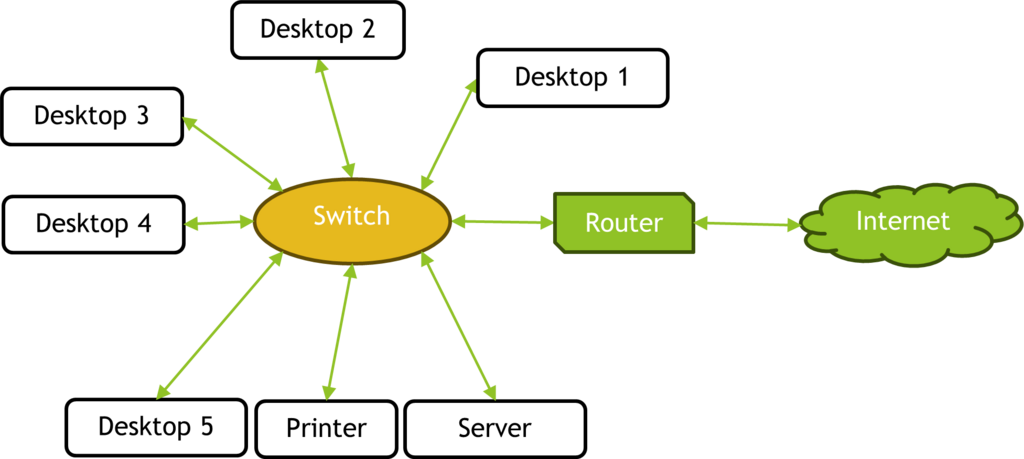
A Wide Area Network (WAN) covers a large geographical area, like a country or even the entire planet. WANs are used to connect different LANs together. The internet is the largest WAN in the world, connecting billions of devices globally.
A Metropolitan Area Network (MAN) sits between a LAN and a WAN. It typically covers a city or a large campus. A university might use a MAN to connect the networks in its various buildings across town.
| Network Type | Scope | Example |
|---|---|---|
| LAN | Single building or campus | Home Wi-Fi, office network |
| MAN | City or large town | A university connecting multiple campuses |
| WAN | Country or global | The Internet |
The Building Blocks
All networks rely on three basic components to function: nodes, links, and protocols.
Node
noun
Any device connected to a network that can send, receive, or forward information. This includes computers, smartphones, printers, and servers.
Links are the transmission media that connect the nodes. They are the pathways for data. Links can be physical, like copper Ethernet cables or fiber optic cables, or they can be wireless, using radio waves like Wi-Fi and Bluetooth.
Protocol
noun
A set of rules or procedures for transmitting data between two electronic devices. It ensures that devices can understand each other.
Think of a protocol as a shared language. If two people want to communicate, they must speak the same language. Similarly, for two devices on a network to exchange information, they must use the same protocols. These rules govern everything from how a connection is started to how errors are handled, ensuring communication is reliable and orderly.
What is the main purpose of a computer network?
The internet, which connects billions of devices globally, is the largest example of which type of network?