Mastering Native English Fluency
English Sound System
The Building Blocks of Sound
Spoken English is built from small units of sound called phonemes. Think of them as the atoms of language. The word "cat" has three phonemes: the 'c' sound, the 'a' sound, and the 't' sound. But here's the tricky part: English spelling doesn't always match its sounds. The letters 'ough' sound different in "through," "tough," and "bough."
To solve this puzzle, linguists created the International Phonetic Alphabet, or IPA. The IPA is a system where one symbol always represents one specific sound. Learning it is like getting a cheat code for English pronunciation. Instead of guessing, you can look up a word and know exactly how to say it.
Phoneme
noun
The smallest unit of sound in a language that can distinguish one word from another.
Using the IPA, the word "tough" is written as /tʌf/ and "through" is /θruː/. The spelling is different, but the IPA shows the sounds clearly.
Making Consonant Sounds
Consonants are sounds we make by partially or completely blocking the flow of air from our lungs. The way we block the air is called articulation. It involves your lips, teeth, tongue, and the roof of your mouth. For example, to make a 'p' sound, you press your lips together and then release a puff of air. For an 's' sound, you place your tongue near the ridge behind your top teeth and force air through the narrow channel.
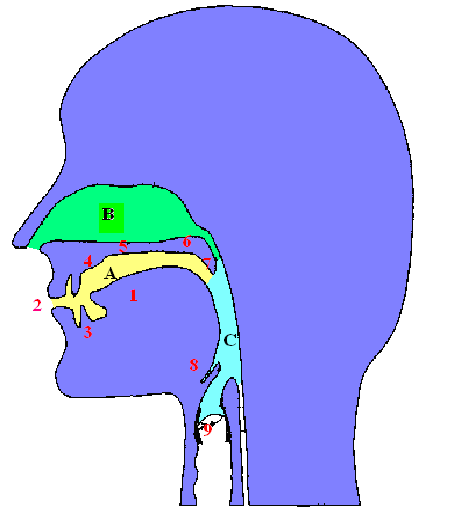
Consonants can be categorized by where and how you block the air. Some sounds, like /p/, /t/, and /k/, are voiceless, meaning your vocal cords don't vibrate. Others, like /b/, /d/, and /g/, are voiced – you can feel a vibration in your throat if you touch it while you say them. Try it now: whisper "pat," then say "bat" out loud. Feel the difference?
| IPA Symbol | Sound As In... | Description |
|---|---|---|
| /p/ | pat | Voiceless; lips together |
| /b/ | bat | Voiced; lips together |
| /θ/ | think | Voiceless; tongue between teeth |
| /ð/ | this | Voiced; tongue between teeth |
| /ʃ/ | she | Voiceless; tongue raised, air flows over it |
The Music of Vowels
Unlike consonants, vowels are made with an open vocal tract. The sound changes based on two things: the position of your tongue and the shape of your lips.
Your tongue can be high in your mouth (like for the 'ee' sound in "see") or low (like for the 'ah' sound in "hot"). It can also be forward or back. Your lips can be rounded (like for the 'oo' in "blue") or unrounded (like for the 'ee' in "see").
Some vowels are actually two sounds blended together. These are called diphthongs. Think of the sound in "boy" (/ɔɪ/) or "house" (/aʊ/). Your mouth starts in one vowel position and glides to another.
Practice and Improvement
Perfecting pronunciation takes practice. Many non-native speakers find certain sounds challenging. For example, the 'th' sounds (/θ/ and /ð/) don't exist in many languages, and the difference between the vowels in "ship" (/ɪ/) and "sheep" (/iː/) can be subtle.
Listen to native speakers, practise key sounds, use phonetic transcriptions, and break words into syllables.
One of the best techniques is to focus on one or two sounds at a time. Find lists of words with your target sound (these are called minimal pairs, like "ship" and "sheep"). Say them out loud. It can feel strange, but it's like exercise for your mouth, building muscle memory for new movements.
Recording yourself and comparing it to a native speaker is another powerful tool. You might not notice small errors until you hear yourself back. Use online dictionaries that provide audio pronunciations and IPA transcriptions.
Ready to test your knowledge? Let's see what you've learned about the sounds of English.
What is the primary purpose of the International Phonetic Alphabet (IPA)?
How are consonant sounds, like /p/ or /s/, fundamentally different from vowel sounds, like /iː/ or /ɑː/?
Understanding how sounds are made is the first step toward clearer communication. With these foundational tools, you can begin to shape your pronunciation with confidence.