Mastering National Income Accounting
Circular Flow Logic
The Economy's Double Entry System
At its core, an economy is a massive network of transactions. For every product made, someone has to buy it, and the money they spend becomes income for the person who made or sold it. This simple, unbreakable link is the foundation of national income accounting.
Every dollar of spending by some buyer is a dollar of income for some seller.
This leads to a fundamental identity in economics. The total value of a nation's output is, by definition, equal to the total amount spent to buy that output. That spending, in turn, must equal the total income generated from producing it.
Think of buying a coffee for $4. Your $4 expenditure is the coffee shop's $4 of revenue. That $4 also represents the market value of the output (the coffee). The shop then uses that income to pay for wages, rent, and supplies, which becomes income for its employees and suppliers. The logic holds for every transaction in the economy, from a single haircut to a multi-billion dollar government contract.
Mapping the Money Flow
To visualize this, economists use the circular flow model. It maps how money moves between the four main agents in an economy: Households, Firms, the Government, and the Rest of the World. Each group receives income and makes expenditures, creating a continuous loop.
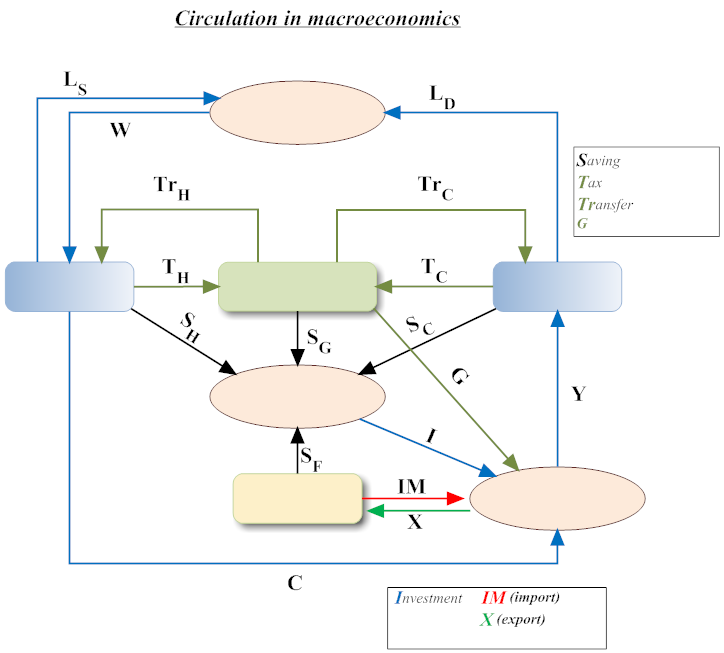
Here's how they interact:
-
Households: We own the factors of production (labor, capital, land). We sell these to firms in exchange for income (wages, rent, profit). We then use this income to consume goods and services, save money, and pay taxes.
-
Firms: They hire factors of production from households to create goods and services. They sell this output to households, the government, and foreign buyers. Their revenue is used to pay for the factors of production.
-
Government: It collects taxes from households and firms. It uses this revenue for government spending on public goods (like roads and defense) and to make transfer payments (like Social Security).
-
Rest of the World (Foreign Sector): This sector accounts for international trade. When we sell domestically produced goods to other countries, it's an export. When we buy foreign-made goods, it's an import.
Leaks and Injections
The simple loop of households earning income and spending it all at firms doesn't capture the whole picture. Some money leaks out of this primary flow, while other money is injected into it. The economy is in equilibrium when these two forces balance out.
A leakage is any use of income that is not spent on domestic goods and services. An injection is any spending that comes from outside the primary income-expenditure flow.
| Leakages (Withdrawals) | Injections (Additions) |
|---|---|
| Savings (S) | Investment (I) |
| Taxes (T) | Government Spending (G) |
| Imports (M) | Exports (X) |
When a household saves money in a bank instead of buying a product, that money leaks out of the immediate spending stream. However, the bank can then lend that money to a firm for Investment—like building a new factory. That investment spending injects the money back into the flow.
Similarly, taxes leak out of the system, but government spending on things like infrastructure injects it back in. Money spent on imports leaks out to other countries, while money from exports is an injection into our economy.
This circular flow logic is why we can measure a country's entire economic activity in three different ways: by adding up the value of everything produced (Output), summing up all spending (Expenditure), or totaling all the income earned (Income). They are three sides of the same coin.
In the circular flow model, which of the following is considered an 'injection' into the economy?
According to the fundamental identity of national income accounting, a nation's total output is equal to its total expenditure and its total income.