Mastering n8n Workflow Automation
Introduction to n8n
What is n8n?
Think of all the repetitive, manual tasks you do every day. Copying data from an email to a spreadsheet, posting social media updates, sending welcome messages to new customers. What if you could connect your apps and have them do this work for you?
That's where n8n comes in. It's a tool that lets you build automated sequences of actions, called workflows, to link different software and services together. You don't need to be a programmer to use it. Instead of writing code, you visually connect building blocks to create your own custom automations.
workflow
noun
A series of automated actions or tasks that pass data from one step to the next. In n8n, it represents the entire process you want to automate.
The main benefit is saving time. By automating routine tasks, you free yourself up to focus on more creative or strategic work. It also reduces human error, since the workflow runs the same way every time. You can connect hundreds of different applications, from common tools like Google Sheets and Slack to specialized business software.
Building a Workflow
Workflows in n8n are built using nodes. Each node is a block that performs a specific action, like reading a file, sending an email, or adding a row to a database. You build a workflow by dragging these nodes onto a canvas and connecting them in the order you want them to run.
A workflow starts with a trigger node, which kicks off the automation. This could be a set schedule (like every Monday at 9 AM) or an event (like receiving a new email).
After the trigger, you add more nodes to perform the rest of the tasks. Data flows from one node to the next, so the information from an earlier step can be used in a later one. For example, the subject line from a trigger email can be used in the content of a Slack message later in the workflow.
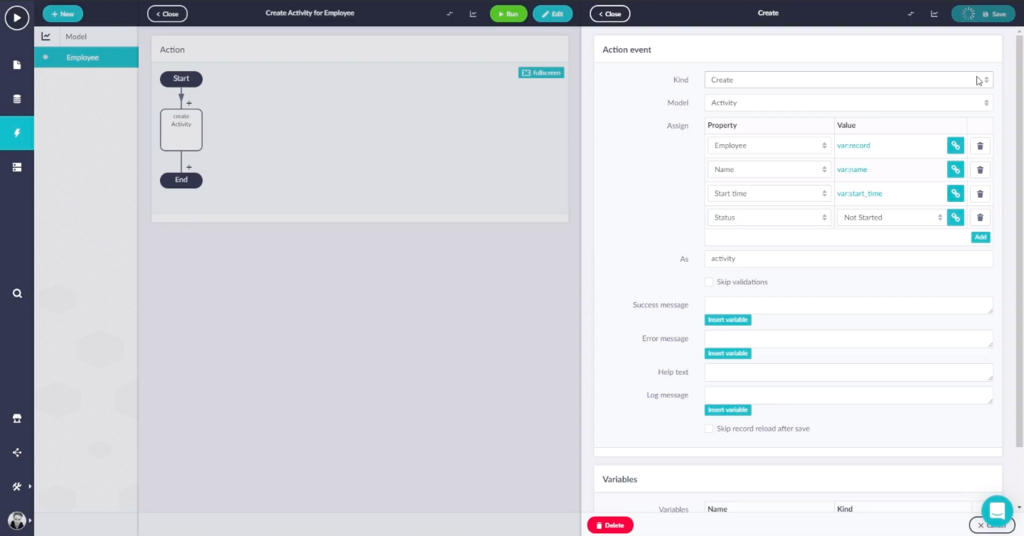
The visual editor is where you bring your automation ideas to life. It gives you a canvas to see your entire process at a glance, making it easy to understand and modify.
Common Automation Examples
The possibilities are vast, but here are a few common scenarios where n8n shines:
| Use Case | Trigger | Actions |
|---|---|---|
| Social Media Management | New blog post published | Create a summary with AI, post to Twitter, and share on LinkedIn. |
| Customer Onboarding | New user signs up in your app | Add the user to a CRM, send a personalized welcome email, and create a task for a team member to follow up. |
| Data Syncing | A new row is added to a Google Sheet | Create or update a corresponding record in a database like Airtable or Notion. |
| Notifications | A project management task is marked as complete | Send a notification to a specific Slack channel and update a progress dashboard. |
These examples just scratch the surface. Any process that involves moving information between different web services is a great candidate for automation with n8n.
What is the primary purpose of n8n?
In an n8n workflow, what is a 'node'?
Now that you understand the basics, you're ready to start thinking about what tasks in your own work could be automated.