Mastering Music Structure and Composition
Functional Diatonic Harmony
Chords with a Purpose
In a piece of music, not all chords are created equal. Just like characters in a story, each chord has a role to play, a specific job or feeling it contributes to the overall narrative. This is the core idea of functional harmony. Instead of seeing a chord progression as a random string of chords, we can understand it as a journey with a beginning, middle, and end.
The three primary roles are Tonic, Subdominant, and Dominant. Think of them as Home, Away, and The Journey Back.
The Tonic chord is your harmonic home base. It feels stable, resolved, and complete. It's the chord where a song feels at rest, like the opening and final chords of a verse.
The Subdominant chord creates a gentle lift, a feeling of moving away from home. It's not tense, but it creates the sense that the music is going somewhere.
The Dominant chord is full of tension. It feels unstable and creates a strong desire to return to the tonic. It's the cliffhanger at the end of a chapter, demanding resolution.
A typical chord progression tells a mini-story using these functions: it starts at home (Tonic), goes on an adventure (Subdominant), builds tension (Dominant), and finally returns home (Tonic).
Roman Numeral Analysis
To keep track of these functions regardless of the key, we use Roman numerals. Each of the seven diatonic chords built from a major scale gets a number. Uppercase numerals mean the chord is major, and lowercase means it's minor. A small circle (°) indicates a diminished chord.
| Chord | C Major Example | Roman Numeral |
|---|---|---|
| 1st (Tonic) | C Major | I |
| 2nd (Supertonic) | D minor | ii |
| 3rd (Mediant) | E minor | iii |
| 4th (Subdominant) | F Major | IV |
| 5th (Dominant) | G Major | V |
| 6th (Submediant) | A minor | vi |
| 7th (Leading Tone) | B diminished | vii° |
Now, we can group these chords by their function:
The iii chord is a bit of a chameleon. It has a weak tonic feel but can sometimes substitute for the vi. The strongest and most common progressions, however, rely on the ii, IV, V, and I chords.
The Circle of Fifths
The is more than just a way to remember key signatures; it's a map of strong harmonic relationships. Moving counter-clockwise around the circle creates a powerful sense of forward motion. Each step is a descending perfect fifth (or an ascending perfect fourth), which our ears find very satisfying.
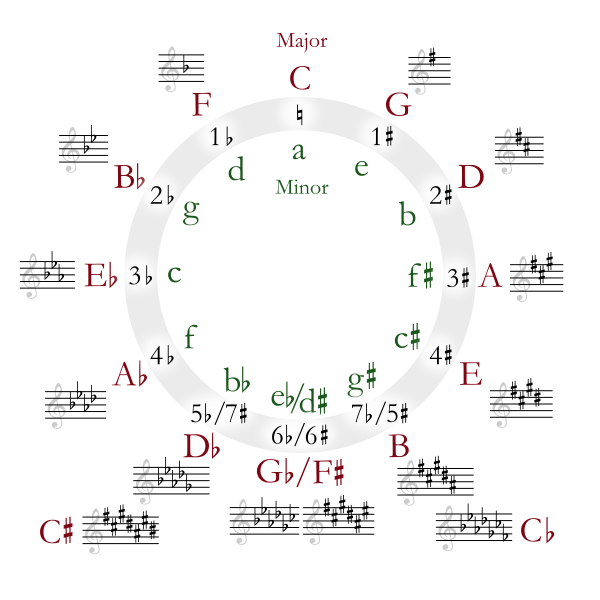
Look at the most common chord progression in jazz and pop music: the ii-V-I. In the key of C Major, this is Dm - G - C. Find D on the circle. Move one step counter-clockwise to G, then another step to C. This movement feels natural and conclusive because it follows the circle.
This pattern is everywhere. The progression I-IV-V-I (C-F-G-C) also uses this relationship. The jump from I to IV is one step counter-clockwise, and the V to I resolution is another.
Smooth Voice Leading
Functional harmony tells us which chords to go to, while tells us how to get there smoothly. The goal is to move the individual notes from one chord to the next with as little motion as possible. Instead of having all the notes in a chord jump up or down together, we try to keep common tones and move the other notes by the smallest possible interval, usually a step.
For example, moving from a C Major chord (C-E-G) to a G Major chord (G-B-D). A clunky way would be to jump the whole shape up. A better way uses inversions to keep the movement small:
- Keep the G, since it's in both chords.
- Move the C down a step to B.
- Move the E down a step to D.
The result is a C major chord (C-E-G) moving to a G major in first inversion (B-D-G). The transition is almost seamless.
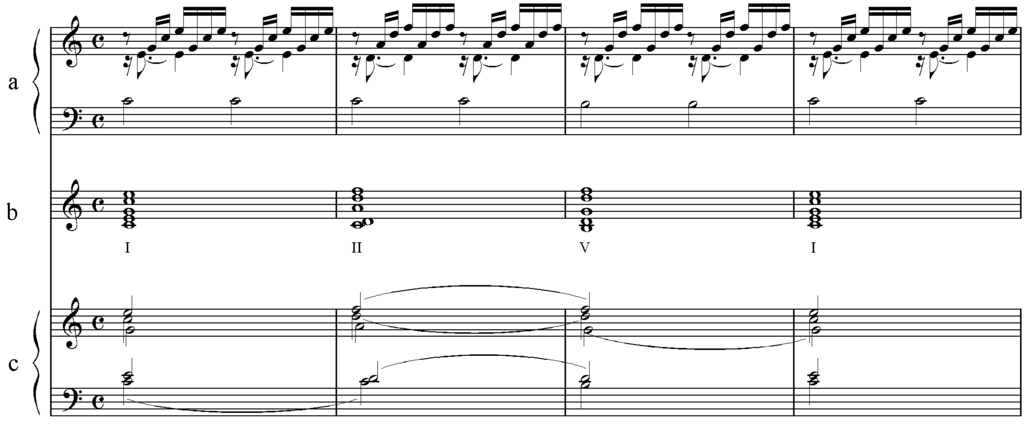
Good voice leading is what separates amateur-sounding progressions from professional ones. It creates a cohesive, flowing sound that guides the listener's ear through the harmonic journey.
What are the three primary roles or functions that chords play in functional harmony?
In a major key, which Roman numeral represents the primary Tonic chord, the point of rest or 'home'?