Mastering mRNA Splicing
Introduction to Gene Expression
From Blueprint to Building
Every cell in your body contains a complete set of instructions for building you. This master blueprint is your DNA, a long, complex molecule that resides safely inside a special compartment called the nucleus. But DNA doesn't build anything directly. It holds the information, like a rare book in a library's special collections. To use the information, the cell needs to make a working copy that can leave the nucleus and go to the cellular construction sites.
This entire process of turning genetic information into a functional product, like a protein, is called gene expression. It's how a cell reads a gene and uses it to build something. The process happens in two main stages: transcription and translation.
Transcription: Copying the Code
The first step is to create a portable copy of a gene's instructions. This is transcription. The DNA double helix unwinds just enough to expose the specific gene that's needed. An enzyme called RNA polymerase then moves along the DNA, reading the sequence of nucleotide bases (A, T, C, and G) and building a complementary single-stranded molecule.
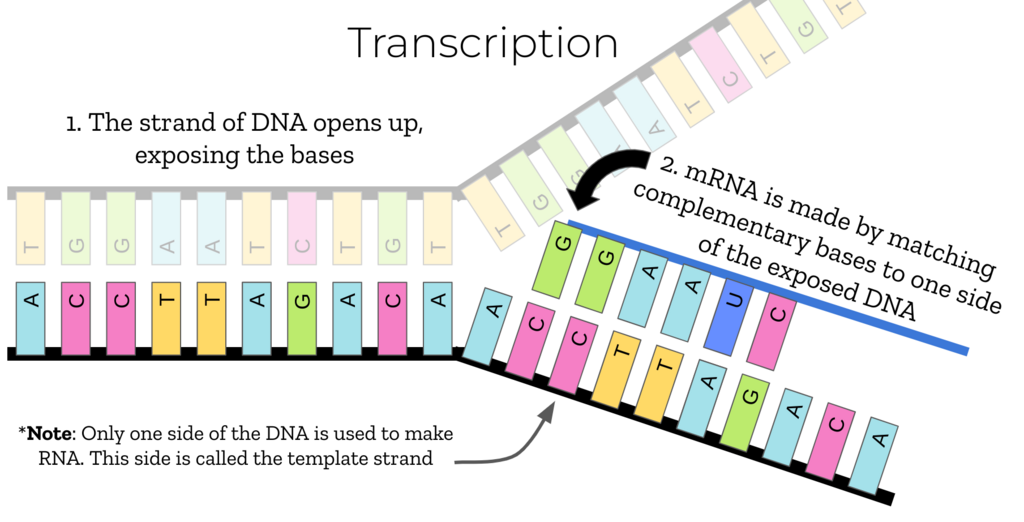
This new molecule is called messenger RNA, or mRNA. It's very similar to DNA, but with a couple of key differences. First, it's single-stranded, making it more flexible. Second, it uses a slightly different sugar in its backbone. Most importantly, it uses a base called uracil (U) instead of thymine (T). Every place a T would be in the DNA sequence, a U appears in the mRNA copy.
In the language of RNA, the base Uracil (U) replaces Thymine (T).
Once the mRNA strand is complete, it detaches from the DNA. This freshly minted message is now ready to carry its instructions out of the nucleus and into the main part of the cell, the cytoplasm.
Translation: Building the Protein
Once the mRNA arrives in the cytoplasm, it’s time for translation, the process of turning the genetic message into a protein. This job is handled by cellular machines called ribosomes. A ribosome clamps onto the mRNA strand and starts reading its sequence of bases.
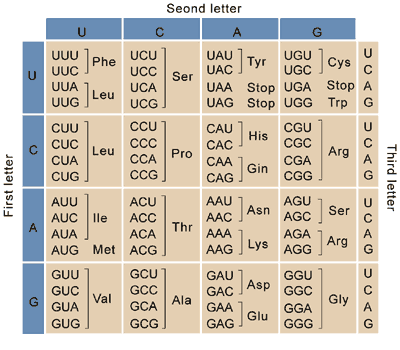
The ribosome reads the mRNA message in three-letter "words" called codons. Each codon specifies a particular amino acid, the building block of proteins. For example, the codon AUG signals the ribosome to start building and also codes for the amino acid methionine. The codon GCC codes for the amino acid alanine. There are 64 possible codons, but only 20 common amino acids, so some amino acids are coded for by more than one codon.
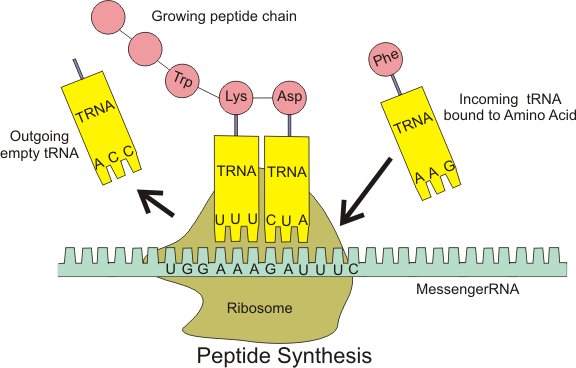
To build the protein, another type of RNA called transfer RNA (tRNA) is needed. Each tRNA molecule is like a specialized delivery truck. It has a three-base sequence (an anticodon) on one end that matches a specific mRNA codon, and it carries the corresponding amino acid on the other end.
As the ribosome moves along the mRNA, it reads each codon. The correct tRNA molecule arrives, matching its anticodon to the mRNA's codon and delivering its amino acid. The ribosome then links this amino acid to the previous one, forming a growing chain. This continues, codon by codon, until the ribosome reaches a "stop" codon, which signals that the protein is complete.
This two-step flow of information, from DNA to RNA to protein, is a fundamental concept in biology. The initial mRNA copy made during transcription is often a "pre-mRNA" that needs a bit of editing before it can be translated. This editing process, called splicing, is the next crucial step in expressing a gene correctly.