Mastering Molecular Tautomerism
Tautomerism Versus Resonance
Molecules in Motion
In organic chemistry, we often draw a single, static structure to represent a molecule. But molecules are not static. Some exist as a rapid equilibrium between two different structures, while others are a single entity that our drawing conventions can't quite capture. This leads to two important, and often confused, concepts: tautomerism and resonance.
Understanding the difference is crucial. One describes a genuine chemical reaction where atoms move, while the other describes how electrons are distributed within a single, unchanging molecule.
Tautomers: A Quick Change Act
Tautomers are constitutional isomers that rapidly interconvert. This isn't just a different way of drawing the same thing; it's a real chemical equilibrium. In this process, an atom—most commonly a proton (a hydrogen ion)—physically moves from one position to another within the molecule. This migration is accompanied by a shift in the position of a pi bond.
The most common example is where a ketone or aldehyde (the keto form) interconverts with a structure containing a double bond and an alcohol group (the enol form). Because this involves a proton moving between atom 1 (a carbon) and atom 3 (an oxygen), it's specifically called a 1,3-prototropic shift.
Tautomers are distinct molecules residing in separate, shallow potential energy wells. A real, though typically small, energy barrier separates them. This means you can, in principle, isolate them, though they will quickly re-establish equilibrium.
Resonance: A Drawing Problem
Resonance, on the other hand, is not a chemical reaction. A molecule with resonance doesn't flicker between different forms. Instead, it exists as a single, stable structure called a resonance hybrid. The problem is that our system of drawing single and double bonds (Lewis structures) sometimes fails to accurately represent the true electronic structure.
Resonance structures are not real. The resonance hybrid is real.
When we draw multiple resonance structures, also known as canonical forms, we are showing the different ways that pi electrons are distributed, or delocalized, across the molecule. Only electrons move, never atoms. The actual molecule is a weighted average of these contributing structures, existing in a single, deep potential energy well. There is no energy barrier to cross because there's no journey to make.
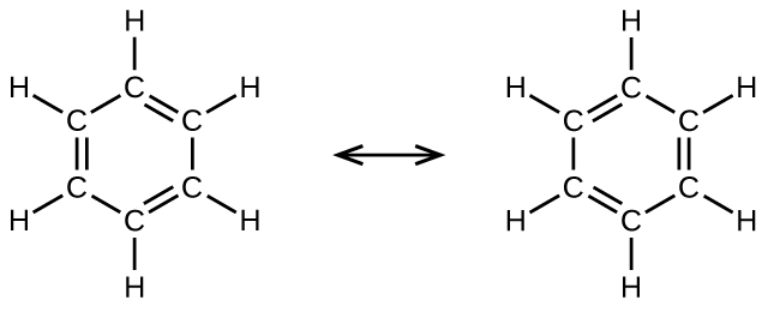
Think of a nectarine. It isn't a peach one moment and a plum the next. It is a hybrid of the two. Similarly, benzene is not flip-flopping between its two canonical forms; it is a single, stable molecule with electron density spread evenly around the ring.
Key Differences at a Glance
The distinction boils down to what is moving and what is real. Tautomerism involves moving atoms and electrons, resulting in a mixture of distinct, real molecules. Resonance involves moving only electrons on paper to represent one, single, real molecule.
| Feature | Tautomerism | Resonance |
|---|---|---|
| What Moves? | Atoms (e.g., H+) and π-electrons | Only π-electrons (and lone pairs) |
| Equilibrium | A true chemical equilibrium | Not an equilibrium; a single hybrid structure |
| Reality | Both tautomers are real, distinct molecules | Only the hybrid is real; canonical forms are not |
| Energy | Separated by an activation energy barrier | Exist in a single potential energy well |
| Notation | Equilibrium arrows (⇌) | Double-headed resonance arrow (↔) |
Both concepts are essential for describing molecular behavior. Tautomerism explains how a molecule can exist in two forms with different connectivities, influencing its reaction pathways. Resonance explains the enhanced stability and unique properties of molecules where electrons are not confined to a single bond or atom, but are shared across a larger system.
What is the primary distinction between tautomers and resonance structures?
A molecule described by multiple resonance structures actually exists as: