Mastering Modern Robotics Systems
Robotic Kinematics
The Geometry of Motion
Robots move. That much is obvious. But how they move is a question of geometry. Kinematics is the branch of mechanics that describes the motion of objects without considering the forces that cause the motion. Think of it as drawing the path a robot's hand will take, without worrying about the motors that will drive it there.
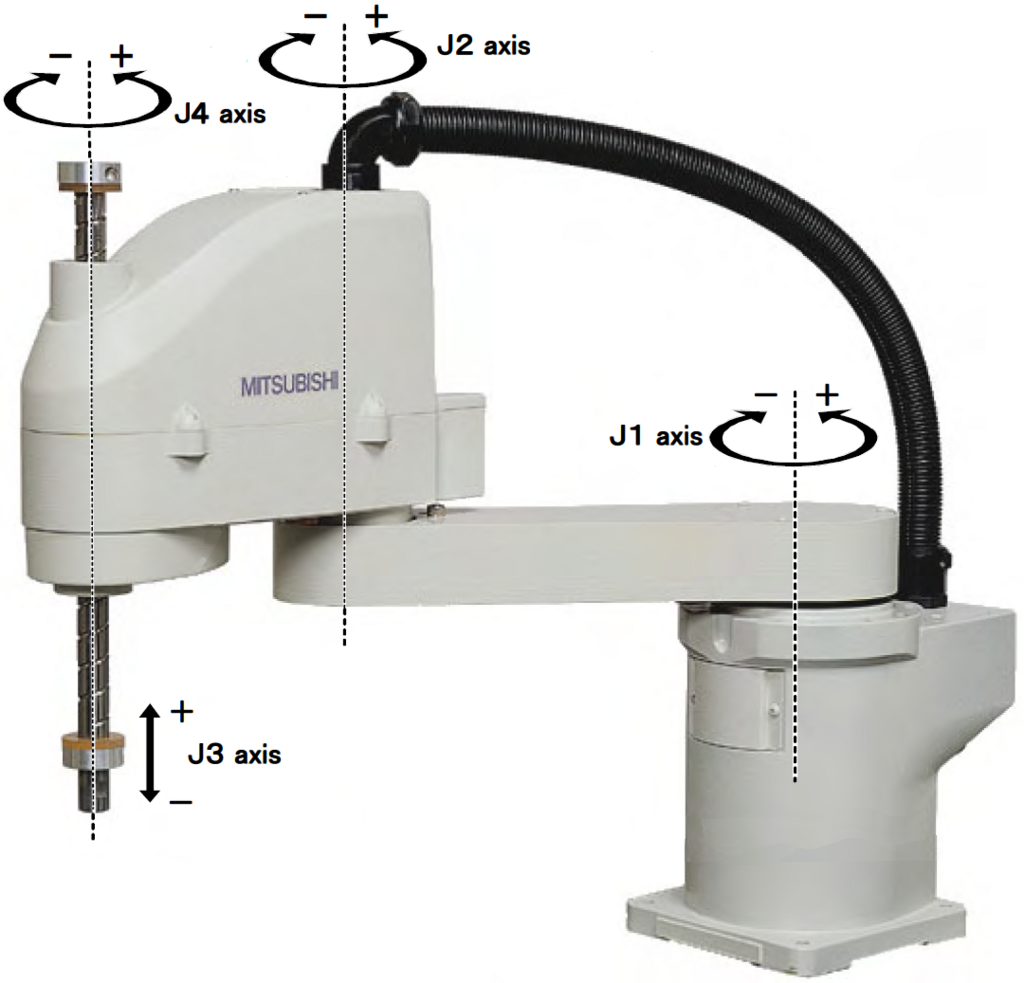
Every robot has a set number of independent ways it can move. These are its degrees of freedom. A simple robotic arm might only move up and down, and rotate at its base. A more complex one might have joints that bend and twist, much like a human arm.
Degrees of Freedom (DoF)
noun
The number of independent parameters that define the configuration of a mechanical system. In robotics, it's the number of independent joints that can be controlled.
Each degree of freedom corresponds to a joint. The two most common types are:
- Revolute joints: These rotate around an axis, like your elbow. Their parameter is an angle ().
- Prismatic joints: These slide along an axis, like a drawer. Their parameter is a distance ().
The combination of all possible joint values defines the robot's configuration space. The set of all physical points the end of the robot can reach is its workspace.
From Joints to Gripper
If you know the angle of each joint in a robotic arm, can you pinpoint the exact location and orientation of its gripper? The answer is yes, and the process is called Forward Kinematics (FK).
FK is a one-way street. You input a set of joint parameters () and get a single, unique result: the position and orientation of the end-effector, usually as coordinates () and angles (roll, pitch, yaw).
To make this calculation work, we need a way to relate each part of the robot to the next. We attach a coordinate system, or frame, to each link of the robot. Then, we use mathematics to describe how to get from one frame to the next. This process of moving between coordinate systems is called a coordinate transformation. It usually involves a rotation and a translation.
For a complex, multi-jointed arm, chaining these transformations together can get messy. To keep things organised, engineers use a standard method called the to define the geometry between joints.
By calculating the transformation matrix for each joint and multiplying them together, you can find the final position and orientation of the end-effector relative to the robot's base. .
Working Backwards
Forward kinematics is useful, but often you have the opposite problem. You know where you want the robot's gripper to be, but you need to figure out what angles to set the joints to. This is called Inverse Kinematics (IK).
IK is much harder than FK. While FK has one unique solution, IK can have multiple solutions, an infinite number of solutions, or no solution at all if the target is outside the robot's workspace.
Think about touching your nose. You can do it with your elbow high, low, or somewhere in between. Each of these is a different solution to the same inverse kinematics problem.
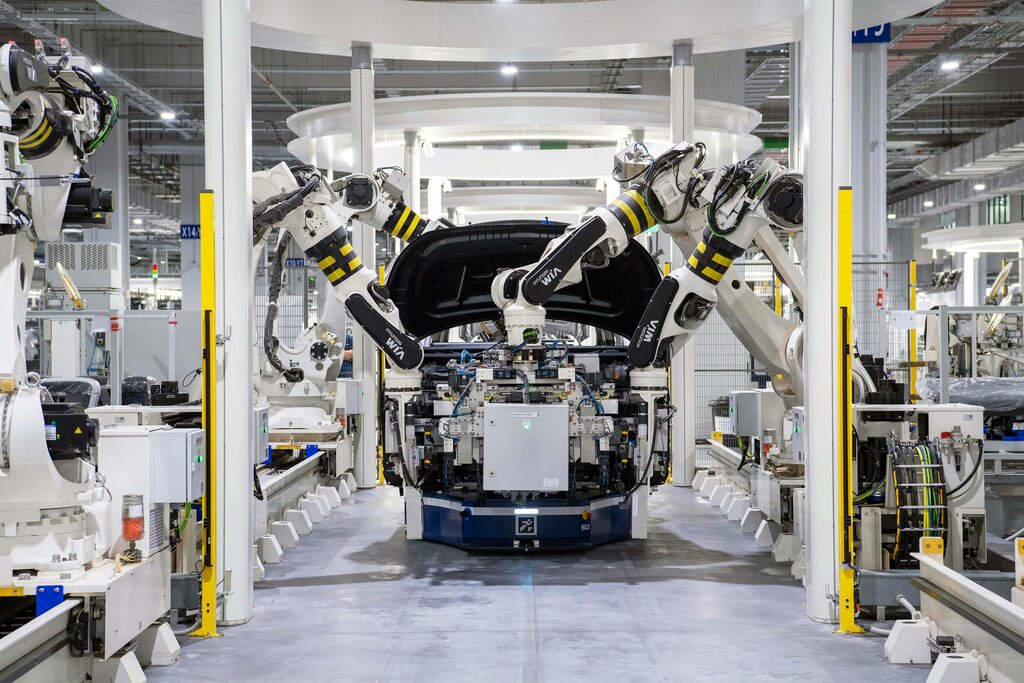
Solving is critical for practical robotics. When a robot on an assembly line needs to pick up a part, its control system is given the part's coordinates. The system must then calculate the required joint angles to move the gripper there accurately and efficiently. Because the equations are often complex and non-linear, these calculations are usually done numerically by a computer rather than by finding a neat, closed-form solution.
The Speed of Movement
Knowing the position of a robot's end-effector is one thing, but controlling its velocity is another. How fast does the gripper move if you rotate the first joint at a certain speed? This relationship between the velocities of the joints and the velocity of the end-effector is described by a powerful tool called the Jacobian matrix.
The Jacobian is not a constant; it changes depending on the robot's posture. It's the matrix of partial derivatives that links the motion of the joints to the motion of the end-effector.
It's also crucial for identifying singularities. These are configurations where the robot loses one or more degrees of freedom. For example, when a robotic arm is fully stretched out, it can't move any further outwards. At this point, the Jacobian matrix becomes singular (its determinant is zero), and certain movements become impossible. A good control system uses the to predict and avoid these problematic poses.
Understanding kinematics provides the fundamental framework for controlling a robot's movement. It allows us to command a robot to move to a specific point in space and control its path and speed along the way.
What is the core problem that Forward Kinematics (FK) solves in robotics?
A robotic joint that slides along an axis, like a drawer, is known as a: