Mastering Modern Data Science
Advanced Machine Learning Techniques
Smarter Together
The core idea behind ensemble methods is simple: many models working together are better than one working alone. Think of it like asking a panel of experts for their opinion instead of relying on a single one. Even if some experts are wrong, the collective wisdom of the group is likely to be more accurate.
Two of the most powerful ensemble techniques are Random Forests and Gradient Boosting. A Random Forest builds a large number of individual decision trees and combines their outputs. To ensure the trees are different from each other, it uses two tricks: it trains each tree on a random subset of the data, and at each split in a tree, it only considers a random subset of features.
Gradient Boosting takes a different approach. It builds models sequentially, one after another. Each new model focuses on correcting the errors made by the previous one. It's like a student who keeps practicing their mistakes until they get them right. This step-by-step refinement often leads to highly accurate predictors.
Implementing these models is straightforward with libraries like scikit-learn.
from sklearn.ensemble import RandomForestClassifier, GradientBoostingClassifier
from sklearn.model_selection import train_test_split
from sklearn.datasets import make_classification

# Generate sample data
X, y = make_classification(n_samples=1000, n_features=20, random_state=42)
X_train, X_test, y_train, y_test = train_test_split(X, y, test_size=0.3, random_state=42)

# Initialize and train a Random Forest model
rf = RandomForestClassifier(n_estimators=100, random_state=42)
rf.fit(X_train, y_train)
print(f"Random Forest Accuracy: {rf.score(X_test, y_test):.2f}")

# Initialize and train a Gradient Boosting model
gb = GradientBoostingClassifier(n_estimators=100, random_state=42)
gb.fit(X_train, y_train)
print(f"Gradient Boosting Accuracy: {gb.score(X_test, y_test):.2f}")
Going Deeper with Neural Networks
Deep learning uses neural networks with many layers (hence "deep") to learn complex patterns from data. These architectures are inspired by the structure of the human brain and have revolutionized fields like image recognition and natural language processing.
Convolutional Neural Networks (CNNs) are the specialists for visual data. They use a mathematical operation called convolution to scan images for features like edges, corners, and textures. Early layers might detect simple shapes, while deeper layers combine these to recognize more complex objects like eyes, faces, or entire cats.
Recurrent Neural Networks (RNNs) are designed for sequential data, such as text or time series. They have a kind of memory that allows them to use information from previous inputs to inform the current one. This makes them ideal for tasks like language translation, where the meaning of a word depends on the words that came before it.
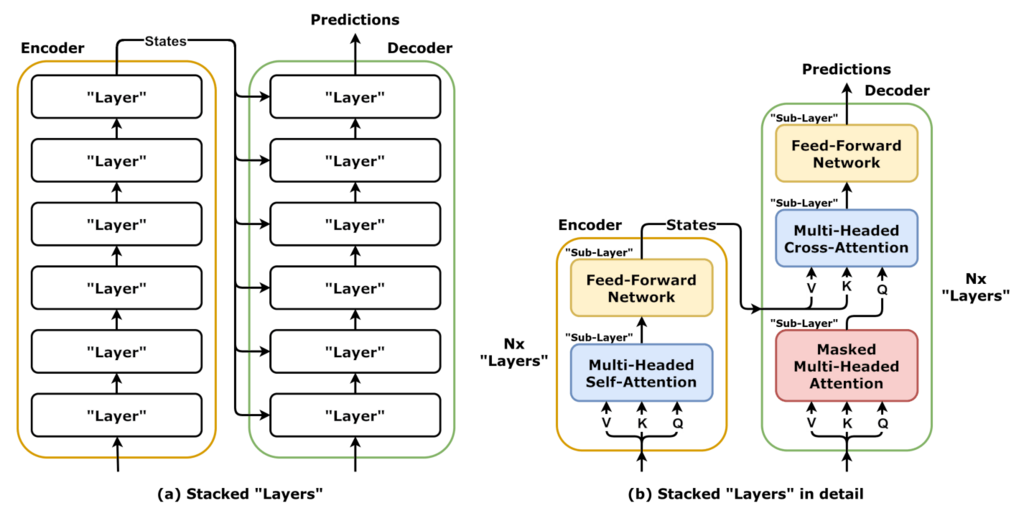
Transformers are a more recent architecture that have become the state-of-the-art for most language tasks. Instead of processing data in order like an RNN, Transformers use a mechanism called attention to weigh the importance of all input words simultaneously. This allows them to capture long-range dependencies in text much more effectively, leading to powerful models like GPT.
Fine-Tuning the Engine
Training a complex model is a delicate balancing act. We need an efficient way to adjust the model's parameters to minimize error, but we also have to avoid memorizing the training data, a problem known as overfitting. Advanced optimization and regularization techniques help us navigate this.
Overfitting is when a model learns the training data so well that it fails to generalize to new, unseen data. It's like a student who memorizes the answers to a practice test but doesn't understand the underlying concepts.
Optimization Algorithms like Adam and RMSprop are adaptive learning rate methods. Instead of using a single, fixed learning rate for all parameters, they adjust the rate for each parameter individually. Parameters that need larger updates get a higher learning rate, and those that are close to their optimal value get a smaller one. This often leads to much faster convergence during training.
Here’s the core idea behind the Adam optimizer's update rule:
Regularization techniques are designed to prevent overfitting. One popular method is Dropout, where during training, a random fraction of neurons in a layer are temporarily ignored or "dropped out." This forces the network to learn more robust features that don't depend on any single neuron. It’s like training a team where you never know who will show up, forcing everyone to be more versatile and less reliant on any one star player.
Hyperparameter Tuning is the process of finding the best set of high-level settings for a model, like the learning rate for an optimizer or the number of trees in a Random Forest. This can be a time-consuming process, but strategies like Grid Search or Randomized Search automate the exploration of different combinations to find the one that yields the best performance.
You can implement these techniques using libraries like TensorFlow or PyTorch. Here is a simplified example of building a model in PyTorch that includes Dropout for regularization.
import torch
import torch.nn as nn

class SimpleNet(nn.Module):
    def __init__(self):
        super(SimpleNet, self).__init__()
        self.layer1 = nn.Linear(784, 128) # Input layer to hidden layer
        self.dropout = nn.Dropout(p=0.5) # Dropout layer with 50% probability
        self.layer2 = nn.Linear(128, 10) # Hidden layer to output layer

    def forward(self, x):
        x = x.view(-1, 784) # Flatten the image
        x = torch.relu(self.layer1(x))
        x = self.dropout(x) # Apply dropout
        x = self.layer2(x)
        return x

# To train this model, you'd use an optimizer like Adam:
model = SimpleNet()
optimizer = torch.optim.Adam(model.parameters(), lr=0.001)
Now let's review the key concepts we've covered.
Ready to test your knowledge?
What is the primary goal of the Dropout technique in training a neural network?
How does the model-building process of Gradient Boosting differ from that of a Random Forest?
Mastering these advanced techniques allows you to build more powerful and accurate machine learning models capable of solving complex, real-world problems.