Mastering Modern Cybersecurity Defences
Network Security Architecture
Beyond the Castle Walls
For decades, network security followed the castle-and-moat model. We built a strong perimeter with firewalls and intrusion detection systems to keep attackers out. Once inside, however, users and devices were often trusted by default. This approach worked when everyone was inside the castle walls, using on-premise servers and applications.
Today, that model is broken. With cloud services, remote work, and mobile devices, there is no clear perimeter. An attacker who breaches the outer defences, perhaps with a single stolen password, can often move laterally across the network with ease. The assumption of internal trust has become a critical vulnerability.
The core problem is that traditional security trusts devices and users based on their location on the network. A new approach was needed that trusts nothing and verifies everything.
Embracing Zero Trust
Zero Trust Architecture (ZTA) isn't a single product, but a strategic shift in security design. It operates on a simple but powerful principle: never trust, always verify. Every access request is treated as if it originates from an untrusted network, regardless of where it comes from.
This philosophy is formally outlined in guidelines like . The goal is to move away from wide, location-based trust to precise, identity-based access controls. Under ZTA, access is granted based on who you are, what device you're using, and the specific resource you're trying to reach—all verified in real time.
The system works through two key components. A acts as the brain, using trust algorithms to analyse signals like user identity, device health, location, and time of day. It then makes an access decision. A Policy Enforcement Point (PEP) acts as the gatekeeper, sitting in front of a resource and enforcing the PDP's decision. If the PDP says 'no', the PEP blocks the connection.
Building the New Perimeter
Implementing ZTA requires new architectural patterns. Two of the most important are micro-segmentation and Software-Defined Perimeters (SDP).
Micro-segmentation is about creating extremely granular security zones, sometimes as small as a single application or workload. Think of it as putting a dedicated security guard and a locked door on every single room in a building, not just at the main entrance.
This dramatically limits an attacker's ability to move laterally. If a web server is compromised, micro-segmentation rules would prevent it from communicating with the database server, unless explicitly allowed by a policy. This contains the breach to a very small blast radius.
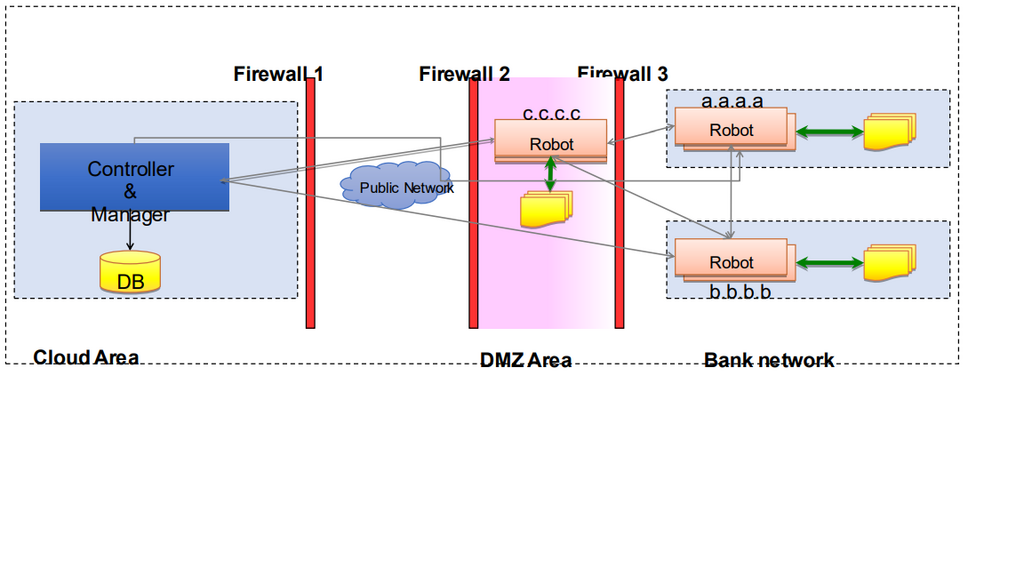
A takes this a step further by making the network infrastructure invisible to unauthorised users. It creates a dynamic, on-demand perimeter for each connection. An SDP operates on a 'deny-all' principle; no device can connect to a resource until it has been authenticated and authorised by a central controller.
Once authorised, the SDP controller establishes a temporary, encrypted, one-to-one connection between the user's device and the specific resource. All other resources remain hidden and inaccessible. This perimeter-less approach is ideal for securing access across hybrid cloud environments and for remote workers.
Weighing the Trade-Offs
Transitioning to a Zero Trust model isn't without challenges. One of the biggest trade-offs is the potential for increased latency. Every single access request must be inspected and verified by the PDP/PEP, which adds a small delay. For performance-sensitive applications, this overhead must be carefully managed through efficient policy engines and optimised network paths.
Complexity is another factor. Defining and managing granular access policies for every user, device, and application is a significant operational lift compared to setting a few broad firewall rules. It requires mature identity management systems and a deep understanding of application workflows.
| Feature | Perimeter-Based Security | Zero Trust Architecture |
|---|---|---|
| Core Idea | Trust but verify | Never trust, always verify |
| Trust Model | Based on network location | Based on identity & context |
| Access Control | Broad, network-level | Granular, per-resource |
| Attack Surface | Exposed network ports | Hidden resources (SDP) |
| Lateral Movement | Often unconstrained | Severely restricted |
| Complexity | Lower initial setup | Higher policy management |
Despite these challenges, the security benefits are substantial. By assuming a breach is not a matter of 'if' but 'when', ZTA provides a resilient framework designed to contain damage and protect an organisation's most critical data, no matter where it resides.
Ready to test your knowledge on modern network architectures?
What is the core principle of a Zero Trust Architecture (ZTA)?
In a Zero Trust system, which component is responsible for analysing signals like user identity and device health to make an access decision?
This shift towards assuming an internal threat requires a fundamental change in how we design and manage networks, focusing on continuous verification over implicit trust.