Mastering Modern AI Applications
Transformer Architecture Mechanics
The Transformer Engine
Before 2017, models that processed language, like Recurrent Neural Networks (RNNs), read text one word at a time, like a person reading a book. This sequential process was slow and made it difficult to connect words that were far apart in a sentence.
The Transformer architecture changed everything. Instead of processing words one-by-one, it looks at the entire sentence at once. This parallel processing is not only faster but also allows the model to capture complex relationships between any two words in the text, no matter how far apart they are. The mechanism that makes this possible is called self-attention.
Weighing the Words
Self-attention is the core of the Transformer. It allows the model to weigh the importance of different words when processing a specific word. For example, in the sentence "The robot picked up the ball because it was heavy," the model needs to understand that "it" refers to the "ball," not the "robot."
To do this, the model creates three vectors for each input word (or token): a Query (Q), a Key (K), and a Value (V).
- Query: Represents the current word's question, like "Who or what am I looking for information about?"
- Key: Acts like a label for other words, saying "This is the kind of information I have."
- Value: Contains the actual substance of a word.
The model compares the Query vector of the current word with the Key vectors of all other words in the sentence. The similarity between a Q and a K pair determines how much attention the current word should pay to that other word. These attention scores are then used to create a weighted sum of all the Value vectors, producing a new representation for the current word that is rich with context from the entire sentence.
This process happens for every single word in the input sequence, all at the same time.
More Than One Perspective
A single self-attention calculation allows the model to focus on one type of relationship. But language is complex. A word can relate to others in many ways—syntactically, semantically, and more.
This is where multi-head attention comes in. Instead of doing one attention calculation, the Transformer performs several in parallel. Each of these "heads" learns to focus on different types of relationships. One head might learn to connect pronouns to their antecedents, while another connects verbs to their subjects.
The outputs from all the attention heads are then combined and transformed into a single vector. This gives the model a much richer, multi-faceted understanding of the language.
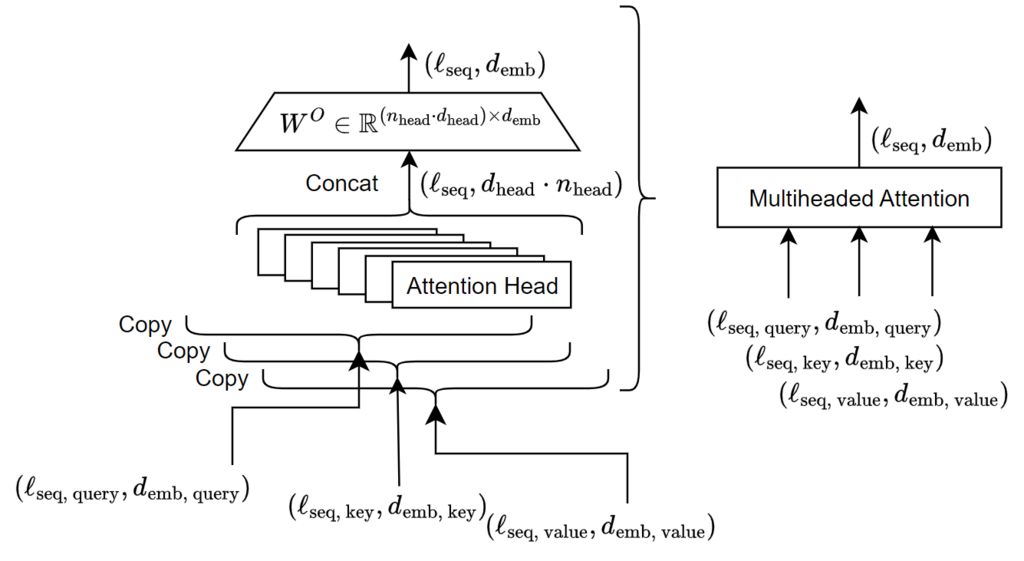
After the multi-head attention layer, the output for each word is passed through a simple Feed-Forward Neural Network (FFNN). This network processes each word's representation independently, adding further computational depth. The combination of multi-head attention and the FFNN forms a single Transformer block, and these blocks are stacked on top of each other to build the full model.
Structure and Flow
The original Transformer architecture has two main parts: an encoder and a decoder. This structure is particularly useful for tasks that transform an input sequence into an output sequence, like machine translation.
- The Encoder: Its job is to read and understand the input sequence. It's a stack of Transformer blocks where each block's self-attention mechanism allows all words in the input to interact with each other. The final output is a set of contextual representations for the entire input.
- The Decoder: Its job is to generate the output sequence, one word at a time. It also has self-attention, but it can only look at the words it has already generated in the output. Crucially, it also performs attention over the encoder's output, allowing it to base its next word choice on both the original input and what it has said so far.
This encoder-decoder framework is the foundation of models like T5 and BART.
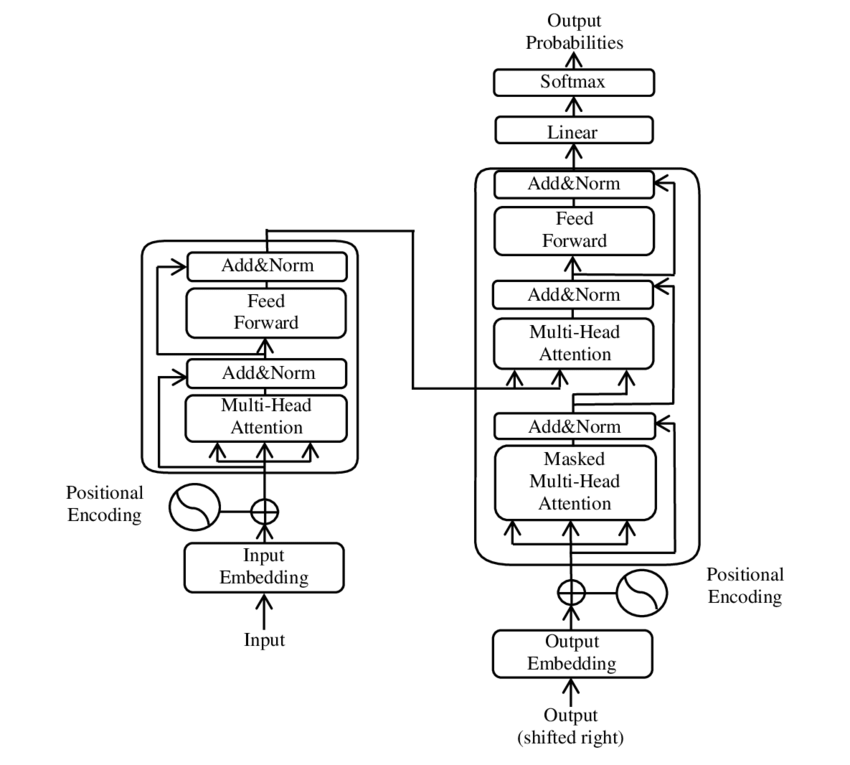
However, not all Transformers use both parts. Many modern large language models, like the GPT series, are decoder-only models. They are designed for text generation. They don't have an encoder to process a separate input sequence; instead, they are given a prompt and their only job is to predict the next word, and the next, and so on.
Because Transformers look at all words simultaneously, they have no inherent sense of word order. To fix this, we inject information about each word's position using positional encodings. These are vectors added to each word's initial representation that give the model a unique signal for each position in the sequence.
Finally, the process starts with tokenization, where the input text is broken down into smaller pieces called tokens. These tokens, which can be words, sub-words, or characters, are then converted into numerical vectors that the model can process.
What was a major limitation of models like Recurrent Neural Networks (RNNs) that the Transformer architecture was designed to overcome?
In the self-attention mechanism, which set of vectors is used to calculate a weighted sum that forms the new, context-aware representation of a word?
Understanding these core mechanics—self-attention, the encoder-decoder framework, and supporting elements like positional encoding—is key to grasping how modern AI models can process and generate language with such remarkable fluency.