Mastering MLOps
Introduction to MLOps
From Lab to Reality
A data scientist builds a fantastic machine learning model. It predicts customer churn with impressive accuracy on their laptop. The team is thrilled. But getting that model from the scientist's computer into a live application that serves millions of users is a whole different challenge. This is where MLOps comes in.
MLOps
noun
A set of practices at the intersection of Machine Learning, Data Engineering, and DevOps, which aims to deploy and maintain ML systems in production reliably and efficiently.
Think of MLOps (Machine Learning Operations) as the bridge between the experimental world of building a model and the practical world of running it. It's a discipline that applies the principles of DevOps—a philosophy that blends software development and IT operations—to the unique needs of machine learning.
MLOps, or Machine Learning Operations, integrates DevOps principles into the machine learning lifecycle, bridging the gap between model development and reliable production deployment.
Why It Matters
Without a structured MLOps approach, machine learning projects often hit a wall. A model might perform well in a controlled environment but fail in the real world due to changes in data, known as data drift. The process of deploying a model can be manual, slow, and error-prone. Updating it can be even harder.
MLOps provides a framework to manage this entire lifecycle systematically.
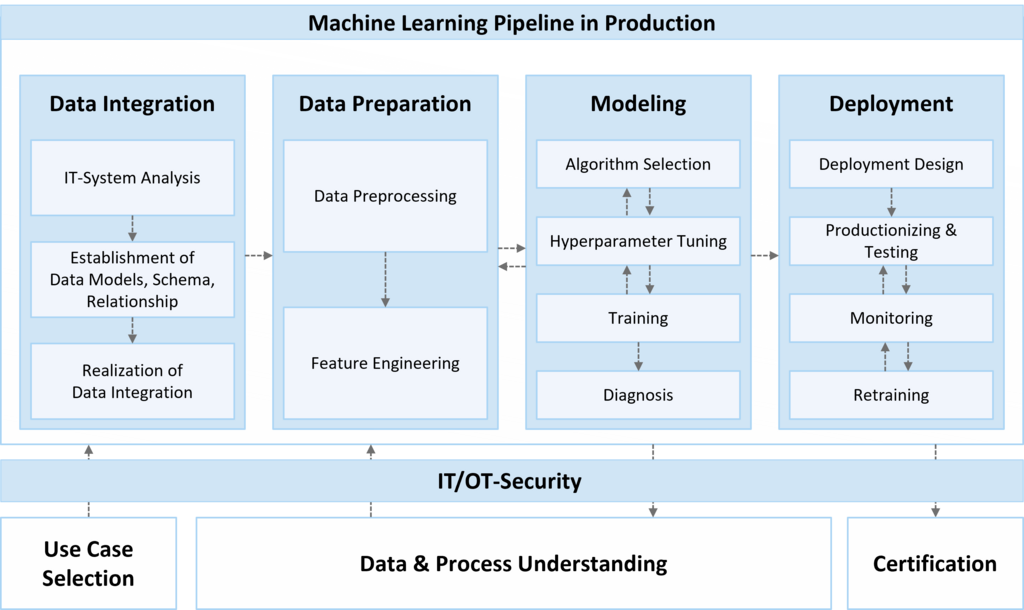
This structured process ensures that models aren't just one-off experiments but are robust, reliable products that deliver continuous value.
The Core Principles
MLOps is built on a few key ideas borrowed from modern software development and adapted for machine learning.
1. Version Control for Everything In software, developers use version control (like Git) to track changes to code. MLOps extends this idea. It’s not enough to version your code; you also need to version your data and your models. This creates an audit trail. If a model starts making strange predictions, the team can trace back exactly which data, code, and model version was used, making it easier to debug and fix.
2. Automation Manually training, testing, and deploying models is slow and invites human error. MLOps emphasizes automating this entire workflow into a pipeline. When new data is available or the code is updated, an automated process can trigger to retrain the model, run tests, and deploy it to production if it passes all the checks. This is often called a CI/CD (Continuous Integration/Continuous Deployment) pipeline for machine learning.
Automation ensures that moving from an idea to a production-ready model is a repeatable, reliable, and fast process.
3. Collaboration ML projects require a team with diverse skills: data scientists who build models, data engineers who manage data pipelines, and operations engineers who maintain the infrastructure. MLOps fosters collaboration by creating shared tools and processes. Instead of working in silos and handing work over a wall, everyone collaborates within a single, unified workflow. This breaks down communication barriers and makes the entire team responsible for the model's success in production.
The Payoff
Adopting MLOps isn't just about following best practices; it delivers real business benefits:
- Faster Time-to-Market: Automation drastically cuts the time it takes to get a model from a data scientist's notebook into the hands of users.
- Improved Reliability: Versioning and automated testing mean fewer bugs and more predictable model performance in production.
- Scalability: A solid MLOps foundation makes it easier to manage, monitor, and update dozens or even hundreds of models at once.
- Reproducibility: When every component is versioned, experiments and results can be reliably reproduced, which is crucial for compliance and debugging.
Getting started with MLOps is about shifting from a manual, experimental mindset to an automated, engineering-focused one. It turns the art of machine learning into a repeatable and scalable science.
What is the primary goal of MLOps?
In the context of MLOps, what does a CI/CD pipeline for machine learning typically automate?