Mastering Micropipette Calibration
Review Pipette Principles
Accuracy, Precision, and Why They Matter
Before we dive into the nuts and bolts of calibration, let's quickly revisit two core concepts: accuracy and precision. In everyday language, these words are often used interchangeably. In the lab, they mean very different things.
Accuracy is how close a measurement is to the true or accepted value. For a micropipette, it's a measure of how well the dispensed volume matches the volume set on the dial.
Precision is how close a series of measurements are to each other. It's about reproducibility and consistency, regardless of whether the measurements are accurate.
Think of it like throwing darts. If you aim for the bullseye and all your darts land in a tight cluster in the center, you are both accurate and precise. If your darts are tightly clustered but in the outer ring, you are precise but not accurate. If your darts are scattered all around the bullseye, you might be accurate on average, but you aren't precise.
In the lab, a pipette that is precise but inaccurate is consistently wrong by the same amount. This is a systematic error or bias. A pipette that is accurate but imprecise is correct on average, but individual measurements are unpredictable due to random error.
Sources of Error in a Pipette
These errors don't just happen. They often stem from the mechanical components of the micropipette. The internal piston's movement, controlled by the volume setting mechanism, creates the air displacement needed to draw up and dispense liquid. The seal between the pipette's tip cone and the disposable tip is also critical.
Over time, wear and tear on these parts can lead to inaccuracies. The piston seal can degrade, causing leaks. The spring mechanism can weaken, affecting the piston's travel distance. Even accidental damage from dropping a pipette can throw its mechanics out of alignment. These mechanical issues are a primary cause of systematic errors. The volume you dispense will be consistently off from the volume you set.
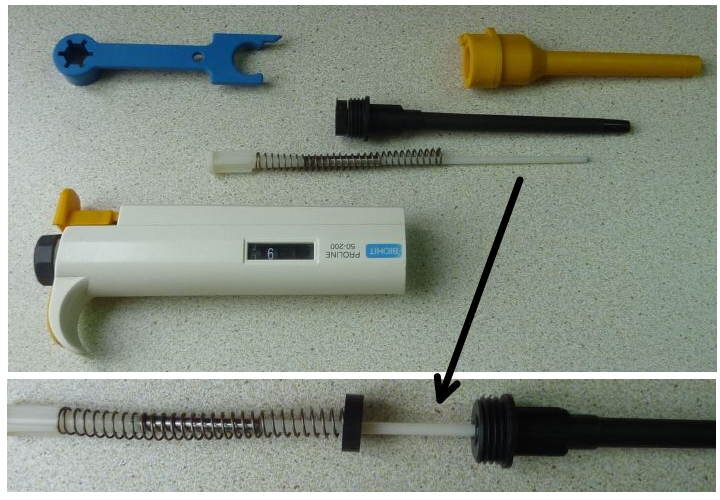
Random error, on the other hand, is the inherent variability in the system. It can come from the operator, such as slight differences in plunger pressure or immersion depth. It can also be environmental, like temperature and humidity changes affecting liquid density. While calibration can't eliminate random error, a properly functioning pipette minimizes the mechanical contributions to it.
Our goal in calibration is twofold: first, to measure the pipette's accuracy and precision, and second, to adjust the instrument to minimize systematic error, bringing it back to its specified performance. This ensures that our experimental results are not only reproducible (precise) but also correct (accurate).
From Measurement to Meaning
Why is this so important? Because the reliability of your data depends on it. If you're performing a dilution series, an inaccurate pipette will make every subsequent dilution incorrect, compounding the error. If you're running a where precise volumes of reagents are critical, poor precision can lead to failed or inconsistent results.
The easiest way to maintain accuracy is to integrate calibration into routine operations.
By understanding the difference between accuracy and precision and recognizing how a pipette's mechanics contribute to both, you see calibration not just as a routine task, but as a fundamental step in ensuring data integrity.
Now, let's get ready to test these principles in practice.
Before moving on, check your understanding of these core ideas.
An analyst aims to dispense 100 µL. The actual volumes dispensed are 102.1 µL, 102.0 µL, 102.2 µL, and 101.9 µL. How would you describe this pipette's performance?
A pipette that is consistently wrong by the same amount is said to have a ________.