Mastering Metal Artistry and Execution
Advanced Design Principles
The Logic of Metal
Moving beyond basic sketches means thinking in terms of forces, not just lines. Metal isn't a passive canvas; it's an active material with its own rules of weight, stress, and balance. A successful large-scale sculpture doesn't just look good, it stands up. This is the core of load-bearing aesthetics: the idea that a piece's structural integrity is a fundamental part of its artistic form.
Every joint, curve, and plane must serve a dual purpose: it must be visually compelling and structurally sound. One cannot exist without the other.
Consider the immense weight of steel or bronze. To create a freestanding sculpture that seems to defy gravity, you must first master it. This involves calculating the sculpture's center of gravity and understanding how its weight is distributed and transferred to the ground. A piece that leans too far without a proper counterbalance in its base will fail. The physics isn't just a technical problem to solve; it's a design constraint that can inspire creative solutions.
From Blueprint to Maquette
A 2D drawing can only tell you so much. To truly test a design's physical limits, you need a three-dimensional model. In sculpture, this is called a —a small-scale model of the final piece. Building a maquette isn't just about visualizing the final form; it's a critical step for structural problem-solving. It's where you discover that a certain angle is impossible to weld, or that a cantilevered arm puts too much stress on a joint.
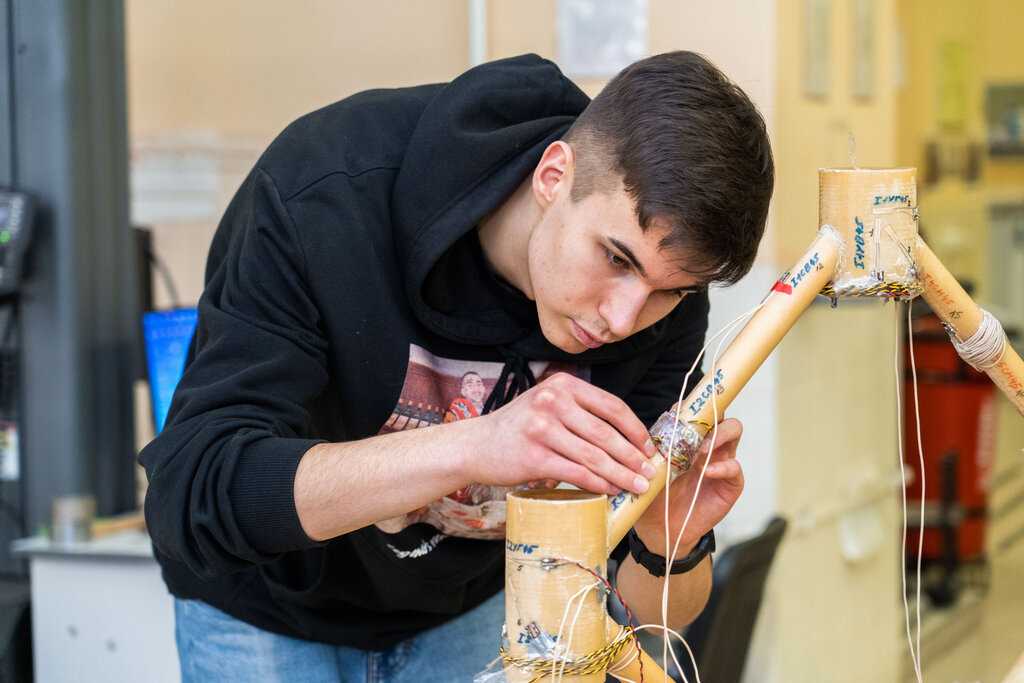
When scaling a design from a maquette to a full-size sculpture, the forces at play don't increase linearly. An object's weight increases with the cube of its scale, while its surface area (and the strength of a weld) increases only with the square. This means a design that is perfectly stable as a one-foot-tall model might collapse under its own weight when scaled to ten feet. You must plan for this by reinforcing joints, using thicker materials, or even integrating internal supports like an that aren't visible in the final piece.
| Scale Factor | Surface Area Increase | Volume (Weight) Increase |
|---|---|---|
| 2x | 4x | 8x |
| 3x | 9x | 27x |
| 10x | 100x | 1000x |
Planning for Heat and Gravity
Metal is not static during fabrication. The intense heat from welding or forging introduces massive amounts of stress into the material. As the metal cools, it contracts, and this contraction can cause warping, bending, and twisting. This phenomenon, known as heat distortion, can ruin a piece if not anticipated.
A perfectly straight line on your blueprint can become a dramatic curve in the workshop. The art is in predicting and controlling this movement.
Experienced fabricators use several techniques to manage heat distortion. They might pre-bend a component in the opposite direction of the expected warp, so it pulls itself straight as it cools. Another common method is to use a specific welding sequence, alternating from one side of the piece to the other to balance the heat input and contractile forces. Bracing and clamping the work securely during cooling is also essential. These are not just fabrication tricks; they are integral design considerations that must be planned from the beginning.
Time to test your knowledge on designing for metal.
What is the core principle of "load-bearing aesthetics" in metal sculpture?
When you double the height of a sculpture, its weight increases by a factor of eight.
By bridging the gap between a 2D sketch and a 3D structure, you move from simply drawing an object to truly designing it. Thinking with the logic of metal—anticipating the forces of weight, scale, and heat—is what separates a concept from a successful, lasting work of art.