Mastering Mechanical Relay Logic and Integration
Electromagnetic Actuation Physics
The Heart of the Relay
A relay is an electromechanical switch, using a small electrical signal to control a much larger one. The magic happens inside a coil of wire wrapped around an iron core. When current flows through this coil, it generates a magnetic field. This isn't just any field; it's a concentrated flow of magnetic energy called magnetic flux, denoted by the Greek letter phi ().
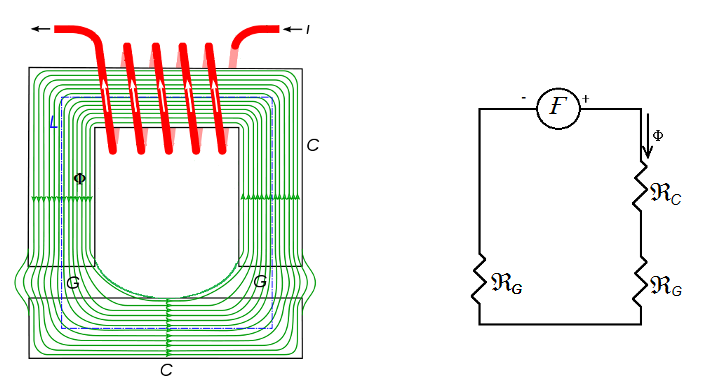
The strength of this magnetic flux is not determined by current or the number of wire turns alone. Instead, it's governed by their product, a quantity known as magnetomotive force (MMF), measured in (A-t). Think of it as the magnetic equivalent of voltage. More turns or more current both increase the MMF, creating a stronger magnetic field capable of doing mechanical work.
The Tipping Point
Generating a magnetic field is only the first step. To actuate the switch, this magnetic force must overcome the mechanical force of a pre-tensioned spring holding the switch open. It's a magnetic tug-of-war. The minimum voltage required to generate enough ampere-turns to win this tug-of-war and move the armature is called the pull-in voltage.
Once the magnetic force exceeds the spring force, the armature snaps shut, closing the electrical contacts of the secondary circuit.
Conversely, as the voltage across the coil decreases, the magnetic field weakens. The drop-out voltage is the level at which the magnetic force becomes insufficient to counteract the spring, causing the armature to release and the switch to open. These two values are rarely the same due to factors we'll explore next.
The graph above illustrates the relationship. The spring exerts a relatively constant force. The magnetic force, however, is weakest when the air gap between the core and the armature is largest. As the coil voltage increases, the magnetic force curve rises until it crosses the spring force line, causing actuation.
Imperfections in Practice
In a perfect world, the magnetic field would disappear the instant the current is cut. But the iron core of the electromagnet retains some residual magnetism, a property called This 'memory' effect is why the drop-out voltage is typically lower than the pull-in voltage. The core gives the spring a little help, holding the armature in place even as the field weakens.
The physical movement of the armature also takes time. The switching time of a relay is the total duration from applying the signal to the contacts becoming stable. This includes the delay for the magnetic field to build up and the travel time of the armature.
Furthermore, the metal contacts don't just close perfectly. Due to momentum, they often bounce one or more times before settling into a stable, closed connection. This phenomenon, known as contact bounce, can create rapid, unintended electrical pulses in the secondary circuit, which must be accounted for in sensitive electronic designs.
Ready to test your knowledge of how these physical principles come together?
What quantity, measured in Ampere-turns (A-t), determines the strength of the magnetic field generated by a relay's coil?
The minimum voltage required to generate enough magnetic force to close a relay's switch is known as the ___.
Understanding these physical dynamics is key to selecting the right relay and designing robust circuits that account for its real-world behavior.