Mastering Matrix Operations
Matrix Basics
What is a Matrix?
At its core, a matrix is just a rectangular grid of numbers, symbols, or expressions arranged in rows and columns. Think of it like a spreadsheet or a tic-tac-toe board. We use matrices to organize data in a structured way, which makes them incredibly useful in fields like computer graphics, physics, and economics.
matrix
noun
A rectangular array of numbers or other mathematical objects arranged in rows and columns.
We typically name matrices with a capital letter, like or . Each entry in a matrix is called an element. To pinpoint a specific element, we use subscripts that tell us its position. The notation refers to the element in the -th row and the -th column.
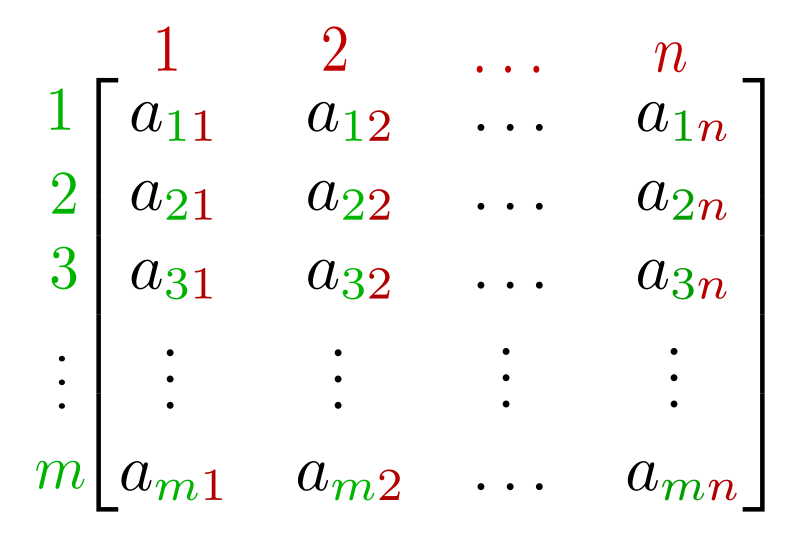
The size of a matrix is called its dimension, which is written as "rows x columns". For example, a matrix with 2 rows and 3 columns has dimensions of . So, the element would be in the first row and second column.
Common Matrix Types
Matrices come in a few special forms. Recognizing these types is the first step toward understanding how to work with them.
A row matrix (or row vector) is a matrix with only one row.
Conversely, a column matrix (or column vector) has only one column.
A square matrix has the same number of rows as columns. This is an important type because many key concepts in linear algebra, like determinants and inverses, only apply to square matrices.
Finally, a zero matrix (or null matrix) is a matrix where every single element is 0. It can be any dimension, and it acts much like the number zero does in regular arithmetic.
Now that you can identify the basic parts and types of matrices, let's review these new terms.
Time for a quick check on what you've learned.
What are the dimensions of the following matrix?
In a matrix named , the notation refers to the element in the -th column and the -th row.
Understanding these fundamental definitions is the first step. Next, you'll see how to perform calculations with matrices.