Mastering Matrix Operations
Matrix Basics
What Is a Matrix?
At its core, a matrix is just a grid of numbers, symbols, or expressions arranged in rows and columns. Think of a spreadsheet, a calendar, or even a tic-tac-toe board. They all organize information into a rectangular grid. In mathematics, we use this same idea to handle data in a structured way.
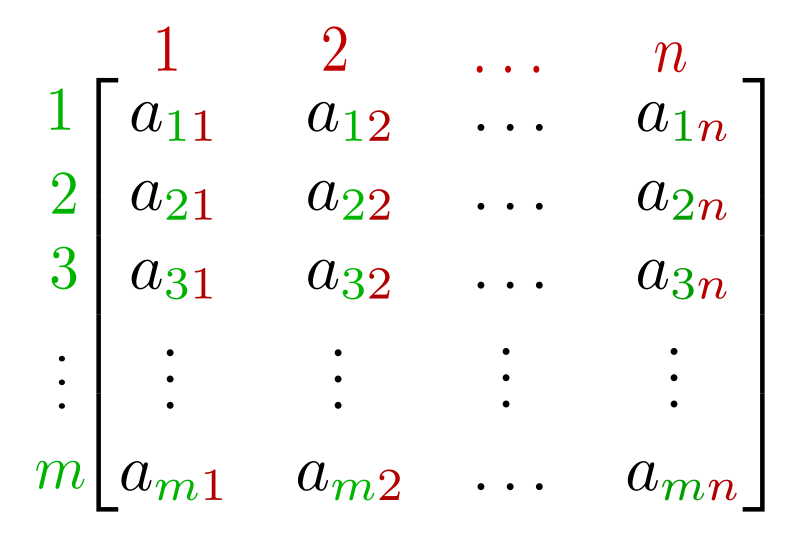
Each item in a matrix is called an element. We describe the size, or dimensions, of a matrix by its number of rows and columns. A matrix with m rows and n columns is called an matrix (read as "m by n").
To pinpoint a specific element, we use a simple address system. The notation refers to the element in the -th row and the -th column. The first number always indicates the row, and the second always indicates the column.
For example, in a matrix, the element would be the number located in the second row and the third column.
Common Matrix Types
Matrices come in various shapes and sizes. While there are many types, a few fundamental forms appear all the time. Let's look at the most common ones.
Row Matrix
noun
A matrix that has only one row. It's also sometimes called a row vector.
A row matrix can have any number of columns, but it will always have a single row. Its dimensions are always .
Similarly, a column matrix is a matrix with only one column. You might also hear this called a column vector. Its dimensions will be , meaning it can have multiple rows but only a single column.
Next up is the square matrix. This one is straightforward: it's a matrix with the same number of rows and columns. So, a matrix, a matrix, or an matrix are all square matrices.
Finally, there's the zero matrix, also known as a null matrix. This is a matrix where every single element is 0. A zero matrix can be of any size, whether it's a , a , or a square matrix. We often denote it with a bold 0.
That's it for the basics. Understanding what matrices are and recognizing these common types is the first step toward using them to solve more complex problems.