Mastering Mathematical Proofs for Edexcel
Introduction to Mathematical Proofs
The Why of Math
In mathematics, we don't just want to know what is true. We want to know why it's true. A mathematical proof is a logical argument that shows a statement is true, beyond any doubt. It’s like a detective laying out the evidence, step by step, leading to an undeniable conclusion.
Think of it this way: if a friend tells you that the sum of any two even numbers is always even, you might test it. $2 + 4 = 6$. $8 + 10 = 18$. $100 + 32 = 132$. It seems to work. But have you proven it? No. You've only shown it's true for a few examples. A proof is what takes us from 'it seems to work' to 'it must always be true'.
A proof is a rigorous, step-by-step argument that leaves no room for doubt. It's the gold standard for certainty in mathematics.
Building Blocks of a Proof
Every proof is built on a solid foundation. You can't just start making claims out of thin air. The argument has to rest on things we've already agreed are true. These foundational pieces have specific names.
axiom
noun
A statement that is accepted as true without proof. It's a starting point.
Axioms, sometimes called postulates, are the basic assumptions of a mathematical system. We don't prove them; we just agree to them. For example, we accept that . We don't need to prove it, we just define our number system to work that way.
Next, we need clear, precise language. That's where definitions come in. A definition gives a precise meaning to a mathematical term. For instance, a prime number is defined as a whole number greater than 1 that has no positive divisors other than 1 and itself. This isn't an assumption; it's just what we agree to call that concept.
With axioms and definitions in hand, a proof proceeds using logical reasoning. It connects the starting assumptions to the final conclusion through a series of small, verifiable steps. Each step must follow logically from the previous ones, like links in a chain.
Strategies for Proving
Mathematicians have developed several common strategies, or methods, for building proofs. Let's look at the big three.
1. Direct Proof
This is the most straightforward method. You start with what you know (the premises) and use a series of logical steps to arrive directly at the conclusion you want to prove. It's like following a recipe exactly as written to get the expected cake.
For example, to prove that the sum of two even numbers is even, we would start with the definition of an even number. An even number is an integer that can be written as , where is also an integer. From there, we'd add two such numbers together and show, through simple algebra, that the result is also in the form of . That's a direct proof.
2. Proof by Contradiction
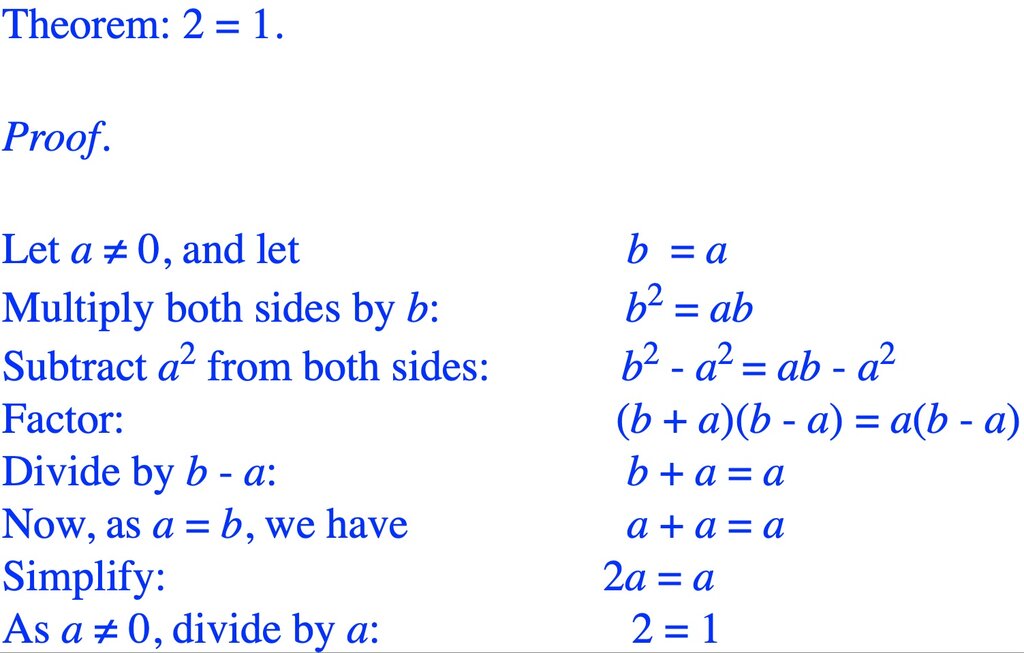
This one is a bit more clever. To prove a statement is true, you start by assuming it's false. Then, you follow the logical consequences of that assumption until you run into a contradiction—something that is impossible, like showing that $1 = 0$. Since your assumption led to an absurdity, the assumption itself must have been wrong. Therefore, the original statement must be true.
It's a powerful technique, especially when a direct path is hard to find. A famous example is the proof that the square root of 2 is an irrational number. The proof starts by assuming it is rational (meaning it can be written as a fraction) and then shows how this assumption leads to a logical impossibility.
3. Proof by Induction
This method is perfect for proving statements about all whole numbers (or any sequence of things that goes on forever). It works like a chain of dominoes. First, you prove the statement is true for the first case (knocking over the first domino). Then, you show that if the statement is true for any one case, it must also be true for the very next case (if one domino falls, it knocks over the next one).
If you can do both things, you've proven the statement is true for all cases, because the first one triggers the second, which triggers the third, and so on, in an infinite chain.
With these structures and methods, mathematicians build a solid, interconnected web of knowledge where new truths are built securely upon old ones.
Ready to check your understanding of these foundational ideas?
What is the primary purpose of a mathematical proof?
In a proof, a statement like "An even number is an integer that can be written as for some integer " is an example of a(n)...
Proofs are the bedrock of mathematics. They are how we move from observation and intuition to absolute certainty.