Mastering Mathematical Limits
Conceptualizing Limits
Beyond Static Points
In algebra, you solve problems by finding a function's value at a specific point. Given , you can find by plugging in the number: . It's a static calculation. You ask for a value, you get a value.
Calculus introduces a more dynamic question: What value does a function approach as its input gets incredibly close to a certain point? We're not asking what happens at the point, but in its immediate vicinity. This concept is the limit, and it’s the bedrock of calculus.
A limit is the value a function approaches as the input gets arbitrarily close to some value.
This idea is captured in a simple, powerful notation.
Neighborhoods and Approaching Values
Think of the 'approaching' part as exploring a function's behavior within a tiny neighborhood around a point, without ever landing on the point itself. We look at the function's output as we inch closer to our target input from both the left side (values slightly smaller) and the right side (values slightly larger).
If the function approaches the same output value from both directions, we say the limit exists.
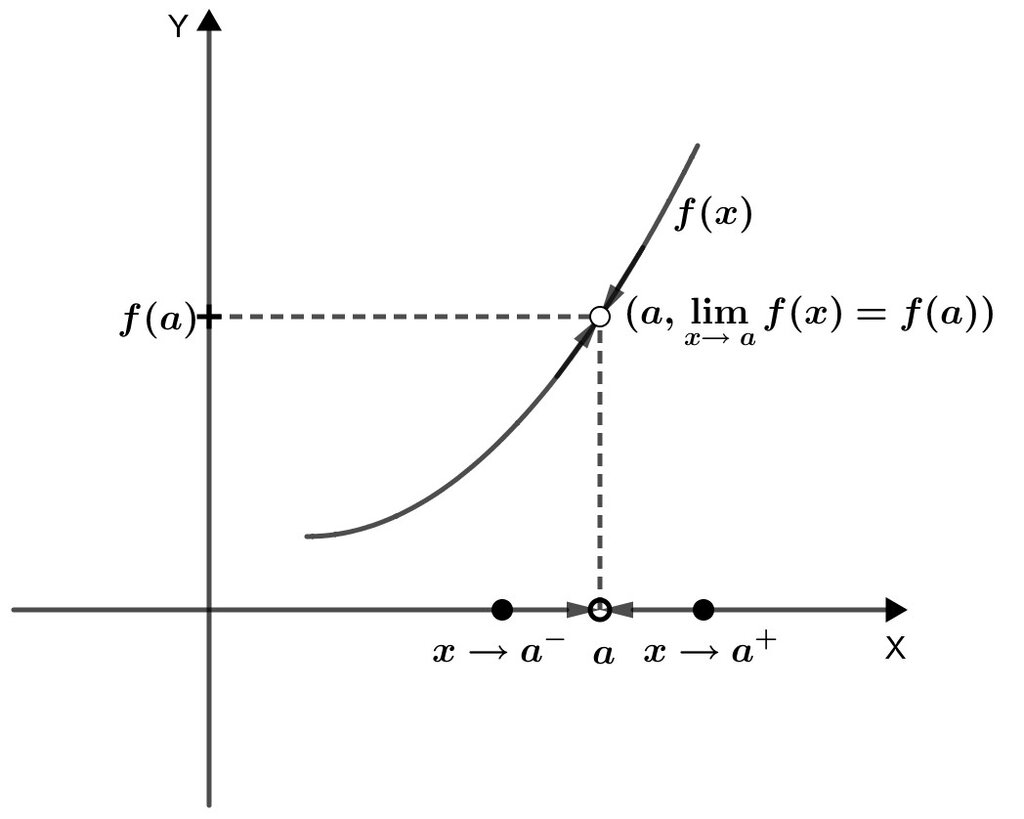
For many simple functions, the limit at a point is just the function's value there. But limits become truly essential when a function has a gap or a hole. Consider a function with a at a certain point. We can't calculate the function's value at that exact spot, but we can still determine what value it's heading towards.
In the graph above, the function is undefined at . There is a hole in the line. However, as you trace the line from the left towards , the -value gets closer and closer to 2. As you trace it from the right towards , the -value also gets closer to 2. Since the function approaches the same value from both sides, the limit exists.
When Limits Don't Exist
A limit only exists if the function approaches the same finite value from both the left and the right. If it approaches different values, or if it increases or decreases without bound, the limit does not exist.
One common case is a where the function abruptly jumps from one value to another.
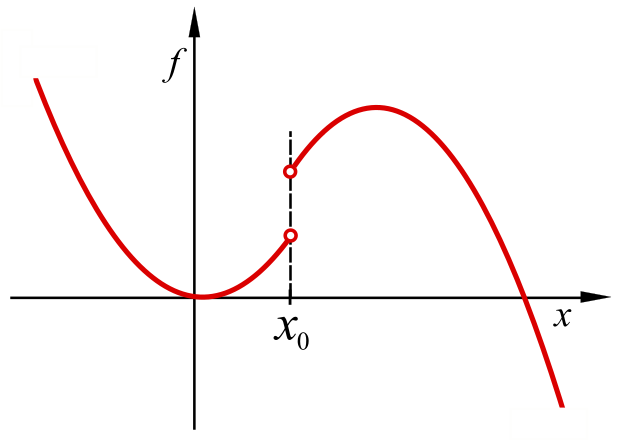
In this graph, as approaches the point from the left, the function's value approaches the lower open circle. But as approaches from the right, the value approaches the upper open circle. Since the left-hand journey and the right-hand journey lead to different destinations, we say the overall limit at does not exist.
Another case is an , typically seen with vertical asymptotes, where the function's value shoots up to positive infinity or down to negative infinity. Since the function doesn't approach a specific, finite number, the limit does not exist.
Understanding when and why a limit exists is the first major step in calculus. It shifts your thinking from static points to the dynamic behavior of functions, opening the door to analyzing change.