Mastering Mathematical Integrals
Antiderivatives
The Reverse of Differentiation
So far, we’ve focused on differentiation: finding the derivative of a function. Now, let's flip that process on its head. Given a derivative, can we find the original function it came from? This reverse process is called finding the antiderivative.
An antiderivative of a function is another function, , whose derivative is . In other words, if , then is an antiderivative of .
Let's take a simple example. If our function is , what function, when differentiated, gives us ? You might quickly recognize this from our work with the power rule. The derivative of is . So, is an antiderivative of .
The Family of Antiderivatives
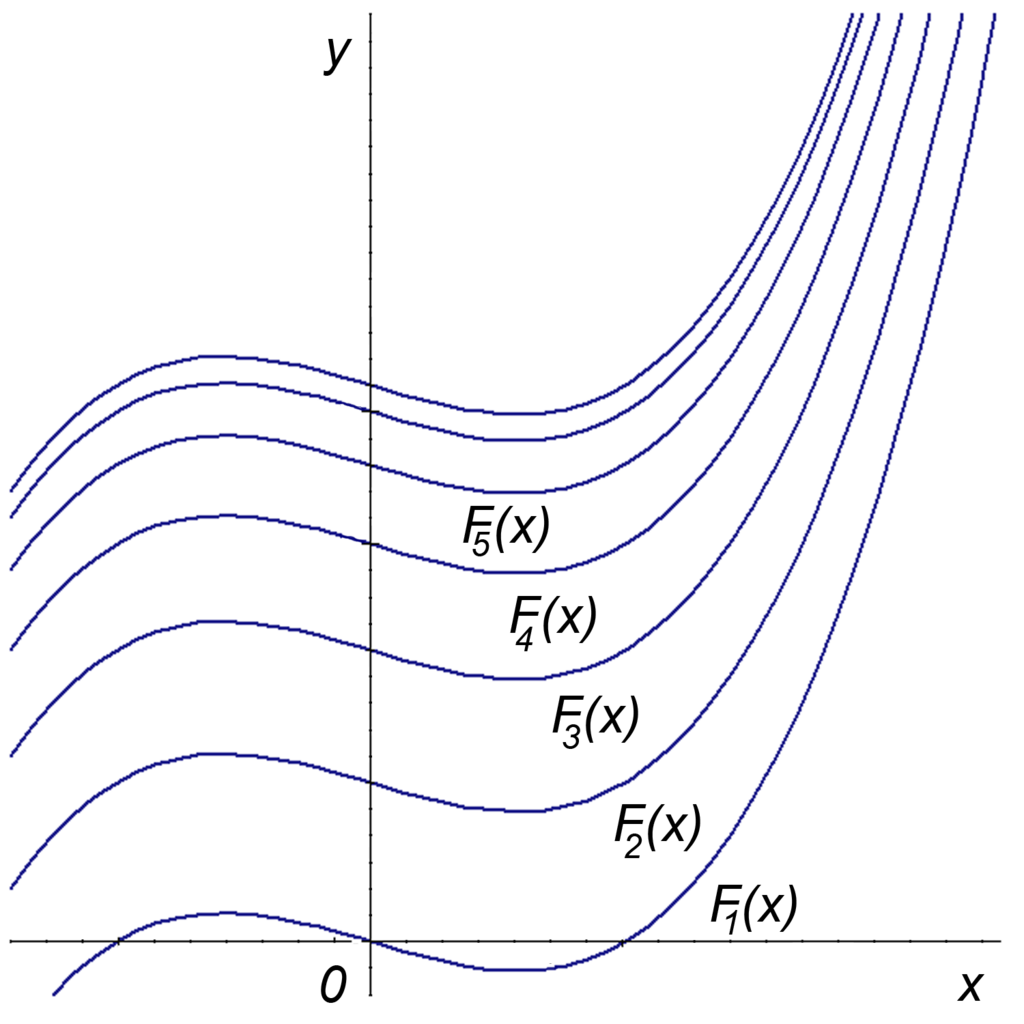
But is the only answer? Consider the function . What's its derivative? It's also , since the derivative of the constant 5 is zero. What about ? The derivative is still .
It seems there are infinitely many antiderivatives for any given function. They all share the same form but differ by a constant. This is because the derivative of any constant is zero, so it vanishes during differentiation. When we reverse the process, we have to account for this potentially lost constant.
We call the set of all antiderivatives of a function its indefinite integral. We use a special symbol, the integral sign ( ), to denote this.
Basic Rules and Examples
Finding antiderivatives often involves reversing the differentiation rules we already know. The most fundamental of these is the reverse power rule.
Reverse Power Rule
other
To find the integral of a power of x, you increase the exponent by one and then divide by the new exponent.
Let's apply this. What is the indefinite integral of ?
Here, . We add 1 to the exponent to get 4, then divide by 4. So, the antiderivative is . To check our work, we can differentiate our answer: the derivative of is , which simplifies to . It works.
Just like with derivatives, the integral of a sum is the sum of the integrals. We can integrate functions term by term.
For example, to find the integral of :
Applying the reverse power rule to each term:
Notice that we only need to write one constant of integration, , at the end. This single constant accounts for all the individual constants from each term.
Ready to test your understanding?
Why is the constant of integration, often denoted as 'C', added when finding an indefinite integral?
What is the indefinite integral of ?
Understanding antiderivatives is the first major step into the world of integral calculus. It's the foundation for calculating areas, volumes, and much more.