Mastering Mathematical Functions and Formulas
Understanding Functions
What Is a Function?
At its core, a function is a rule that connects inputs to outputs. Think of it like a machine: you put something in, the machine follows a specific rule, and something new comes out. The crucial part is that for any given input, you will always get the exact same output. The machine is consistent and predictable.
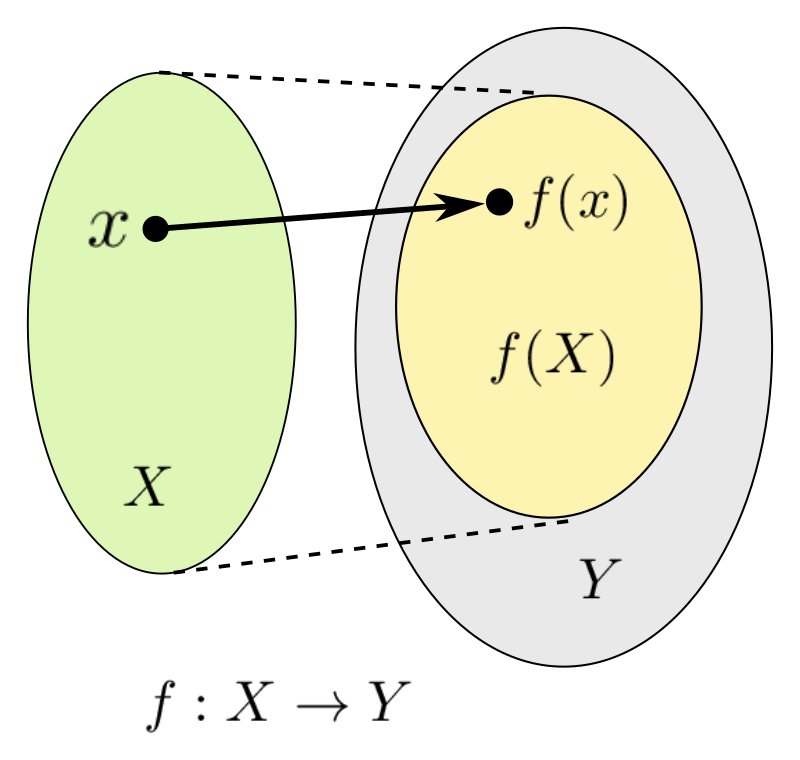
A function links each item from a starting set to exactly one item in an ending set.
This relationship is fundamental in mathematics. It allows us to describe and predict how one quantity changes in relation to another. The starting set of all possible inputs is called the domain, and the set of all possible outputs is the codomain.
domain
noun
The complete set of possible input values for a function.
codomain
noun
The complete set of possible output values for a function.
So, the domain is what you can put into the function, and the codomain is what you might get out of it. Every input from the domain has one, and only one, corresponding output in the codomain.
Common Functions
Functions can represent simple or incredibly complex rules. Let's look at a basic one. Consider the rule "Double the number."
| Input (Domain) | Output (Codomain) |
|---|---|
| 1 | 2 |
| 3 | 6 |
| 5 | 10 |
| -4 | -8 |
For any number you put in, you know exactly what you'll get out. This simple rule is a function.
Mathematicians classify functions based on the type of rule they follow. Two of the most common types are linear and quadratic functions.
A linear function changes at a constant rate. Its rule involves simple addition, subtraction, multiplication, or division. For example, a rule like "Multiply the input by 3 and then add 5" describes a linear function.
A quadratic function involves squaring the input. A simple example is the rule "Multiply the input by itself." These functions describe things like the path of a thrown ball.
Why Functions Matter
Functions are the building blocks of higher mathematics. They are essential tools for modeling the world around us. Scientists use functions to describe the relationship between variables, like how the pressure of a gas changes with its temperature. Economists use them to model supply and demand.
By understanding the basic concept of a function as a rule that maps inputs to unique outputs, you gain a powerful framework for thinking about relationships. This foundation is crucial for exploring more advanced mathematical ideas.