Mastering Math Skills
Arithmetic Fundamentals
The Building Blocks
Arithmetic is the foundation of all math. It’s built on four basic operations: addition, subtraction, multiplication, and division. Think of them as the essential tools in your mathematical toolkit. You use them every day, whether you're splitting a dinner bill with friends or figuring out if you have enough time to watch one more episode before bed.
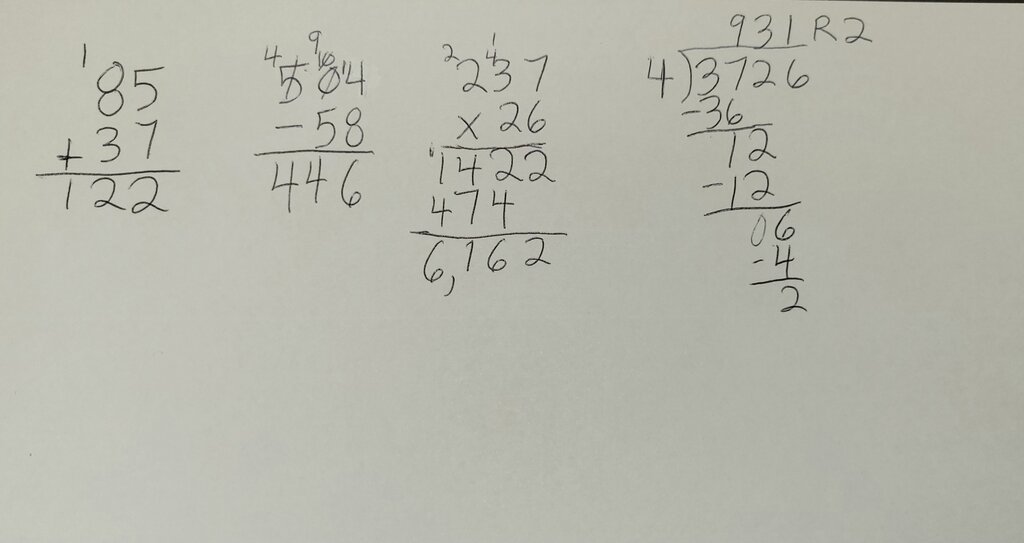
Addition (+) is about combining things. If you have 3 apples and get 2 more, you have 5 apples in total.
Subtraction (-) is the opposite; it's about taking things away. If you start with 5 apples and eat 2, you have 3 left.
Multiplication (×) is a shortcut for repeated addition. Instead of adding 4 + 4 + 4, you can just multiply 4 × 3 to get 12. It’s faster and more efficient.
Division (÷) is about splitting things into equal groups. If you have 12 apples and want to share them among 3 friends, each friend gets 4 apples. It's the inverse of multiplication.
Rules of the Road
Just like grammar has rules for sentences, arithmetic has rules for numbers. These properties make calculations predictable and consistent. They work behind the scenes to keep math orderly.
The three most important properties are the Commutative, Associative, and Distributive properties.
The Commutative Property says that you can swap numbers around in addition and multiplication, and the answer stays the same. Think of it like putting on socks. It doesn’t matter if you put the left or right sock on first, you end up with the same result.
The Associative Property is about grouping. For addition and multiplication, it doesn't matter how you group the numbers. If you're adding three friends to a group chat, it doesn't matter who you add first.
The Distributive Property is the link between multiplication and addition. It tells us that multiplying a number by a group of numbers added together is the same as doing each multiplication separately. Imagine you're handing out 2 cookies each to a group of 3 boys and 4 girls. You could either count all 7 kids and multiply by 2 (getting 14), or you could give 2 cookies to each of the 3 boys (6 cookies) and 2 to each of the 4 girls (8 cookies) and then add those amounts (6 + 8 = 14). The result is the same.
A Tour of Number Types
Numbers come in different flavors. The ones we learn first are whole numbers: 0, 1, 2, 3, and so on. They’re perfect for counting things that are complete, like dogs or books.
But what about when things go below zero, like temperatures in winter? For that, we need integers.
integer
noun
A whole number, its negative counterpart, or zero.
Sometimes we need to deal with parts of a whole. That's where fractions come in. If you slice a pizza into 8 pieces and eat one, you've eaten 1/8 of the pizza. The top number (numerator) tells you how many parts you have, and the bottom number (denominator) tells you how many parts make up the whole.
Decimals are just another way to write fractions. Specifically, they're fractions based on powers of 10. The decimal 0.5 is the same as the fraction 1/2. They are often easier to use with calculators and for measurements.
Fractions and decimals are two different ways of expressing the same idea: a value that is not a whole number.
Converting between the two is a useful skill. To turn a fraction into a decimal, you just divide the numerator by the denominator. For example, 3/4 becomes 3 ÷ 4, which equals 0.75.
To turn a decimal into a fraction, you use place value. The decimal 0.75 means 75 hundredths, so you can write it as 75/100, which simplifies to 3/4.
| Fraction | Decimal |
|---|---|
| 1/2 | 0.5 |
| 1/4 | 0.25 |
| 3/4 | 0.75 |
| 1/5 | 0.2 |
| 1/10 | 0.1 |
Keeping Things in Order
When you see a problem with multiple operations like , which part do you solve first? If you add first, you get . If you multiply first, you get . Different answers can cause a lot of confusion.
To make sure everyone gets the same answer, we use a standard order of operations. A common way to remember this order is with the acronym PEMDAS.
Parentheses Exponents Multiplication and Division (from left to right) Addition and Subtraction (from left to right)
Multiplication and division are partners; you do whichever one comes first as you read the problem from left to right. The same is true for addition and subtraction.
Let's revisit our problem, . According to PEMDAS, we do multiplication before addition. So, we first calculate . Then we do the addition: . The correct answer is 13.
Now that we've covered the basics, let's test your knowledge.
Which arithmetic operation is a shortcut for repeated addition?
The fact that you can calculate or and get the same result is an example of which property?
Mastering these fundamental concepts is the first and most important step in your math journey. With a solid grasp of these building blocks, you'll be ready to tackle any mathematical challenge that comes your way.