Mastering Martial Arts Systems
Striking Biomechanics
The Kinetic Chain
Powerful strikes don't start in the fist or the foot. They begin with the floor. Every high-impact technique is the result of a chain reaction, a sequence of movements that transfers energy from the ground, up through your body, and into your opponent. This sequence is called the kinetic chain and mastering it is the difference between a light tap and a heavy blow.
Think of it like cracking a whip. The energy starts at the handle (your feet) and accelerates as it moves up the whip (your body) until it reaches maximum velocity at the tip (your limb).
This chain is only as strong as its weakest link. A slight misalignment in your ankle, a failure to fully rotate your hips, or a soft core will cause energy to leak out. Effective striking isn't about raw strength; it's about efficient energy transfer.
Levers and Rotational Force
Your body generates maximum power through rotation. The hips and torso act as the engine for almost every significant strike. Let's look at the Muay Thai roundhouse kick, a perfect example of the 'long-lever' principle.
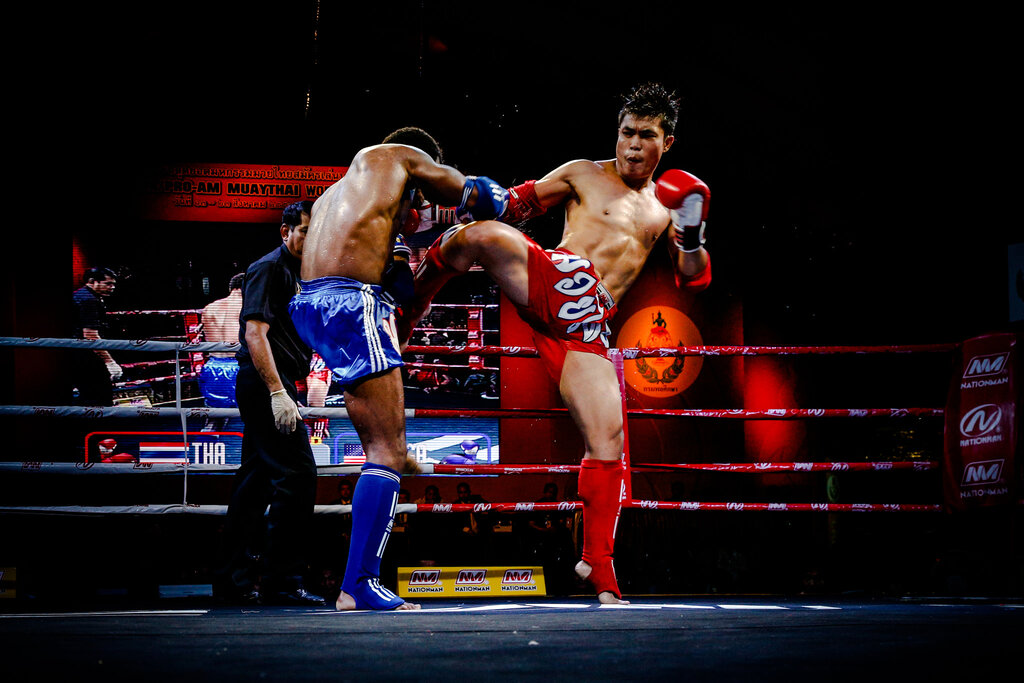
In this kick, the leg is kept relatively straight, creating a long lever. The power isn't generated by snapping the knee, as seen in Karate or Taekwondo. Instead, the practitioner pivots on their standing foot and rotates their entire body, turning the hip over to swing the leg like a baseball bat. This massive rotation of the body's center of mass generates enormous momentum and force.
Effective roundhouse kicking performance was characterized by rapid pelvic axial rotation, hip abduction, hip flexion and knee extension velocities, combined with rapid movements of the COM towards the target.
The trade-off is clear. A long-lever kick is slower to execute than a short, snapping kick. However, the impact is significantly greater due to the larger mass being put into motion. This brings us to the physics of impact. The force of a strike can be simplified with a classic formula.
Speed, Power, and Combinations
While Muay Thai emphasizes singular, powerful strikes, other systems like focus on overwhelming an opponent with rhythmic, high-volume combinations. This style blends Western boxing hand techniques with powerful low kicks.
The biomechanical goal here is different. Instead of loading up for a single massive blow, the fighter maintains a constant flow of kinetic energy. A quick boxing combination forces a defensive reaction, often causing the opponent to shift their weight. This moment of instability creates the perfect opening for a powerful low kick. The combination isn't just a series of strikes; it's a tactical tool to manipulate the opponent's balance and structure.
This highlights the constant tactical dilemma in striking: speed versus power. A fast, snapping strike might score points or create an opening, but it carries less mass and therefore less force. A powerful, rotational strike can end a fight, but it's slower and requires a larger commitment of movement, leaving the striker momentarily exposed.
| Technique Style | Primary Principle | Advantage | Disadvantage |
|---|---|---|---|
| Karate/Taekwondo Snap Kick | Rapid Knee Extension (Short Lever) | Speed, Quick Recovery | Lower Impact Force |
| Muay Thai Roundhouse | Hip & Torso Rotation (Long Lever) | High Impact Force | Slower, More Committed |
| Dutch Kickboxing Combo | Rhythmic Flow & Weight Manipulation | Overwhelms Defense | Relies on chaining moves |
Ultimately, understanding these biomechanical principles allows a martial artist to choose the right tool for the job, adapting their strikes to the tactical situation at hand.
Time to test your understanding of how fighters generate force.
According to the principles of efficient striking, where does the power for a strong blow primarily originate?
What is the main purpose of using quick boxing combinations to set up a low kick, as is common in Dutch Kickboxing?
By moving beyond simple movements and analyzing the transfer of energy, you can see the deep science behind every effective strike.