Mastering Martial Arts Mechanics and Strategy
Striking Power Generation
The Body as a Whip
Powerful strikes don't start in the arms or legs. They begin from the ground up. Think of a martial artist's body as a complex whip. The handle is the foot planted on the ground, and the tip of the whip is the fist or shin. To make the tip crack, energy must flow sequentially through each part of the body. This sequence of movement is called the kinetic chain.
It all starts with ground reaction force, the force the ground exerts back on you when you push off it. A fighter initiates a strike by pushing into the floor with their feet. This energy travels up through the ankles, knees, and into the hips. The powerful rotation of the hips and torso acts like the wave travelling down the whip, multiplying the speed at each stage. This wave of energy flows through the shoulder and finally accelerates the striking limb towards the target. A break anywhere in this chain, like wobbly ankles or a weak core, bleeds power. A strong, connected chain ensures that the force generated by the largest muscles in the body—the glutes and legs—is efficiently transferred to the point of impact.
Torque and Angular Momentum
The engine of the kinetic chain is the rotation of the hips and torso. This rotation generates torque, the rotational equivalent of force. By pivoting on the ball of the supporting foot, a fighter can rapidly turn their entire body, converting the linear push from the ground into powerful angular momentum. The faster the rotation, the more momentum is generated.
Think of an ice skater pulling their arms in to spin faster. A martial artist does something similar. As they initiate the strike, their limbs are relatively close to their body. As the striking limb extends, the angular momentum is conserved, resulting in a massive increase in the limb's velocity. This is why a quick, sharp rotation of the hips can produce a devastatingly fast kick or punch. It’s not about muscle alone; it’s about channelling physics.
Snap vs. Thrust
Different martial arts use the kinetic chain in distinct ways. This is most obvious when comparing the kicks of Karate and Muay Thai The traditional Karate or Taekwondo roundhouse kick is a 'snapping' technique. It relies on rapid extension of the knee just before impact. The goal is maximum velocity of the foot, treating the lower leg like the final section of a whip. It’s incredibly fast and precise.
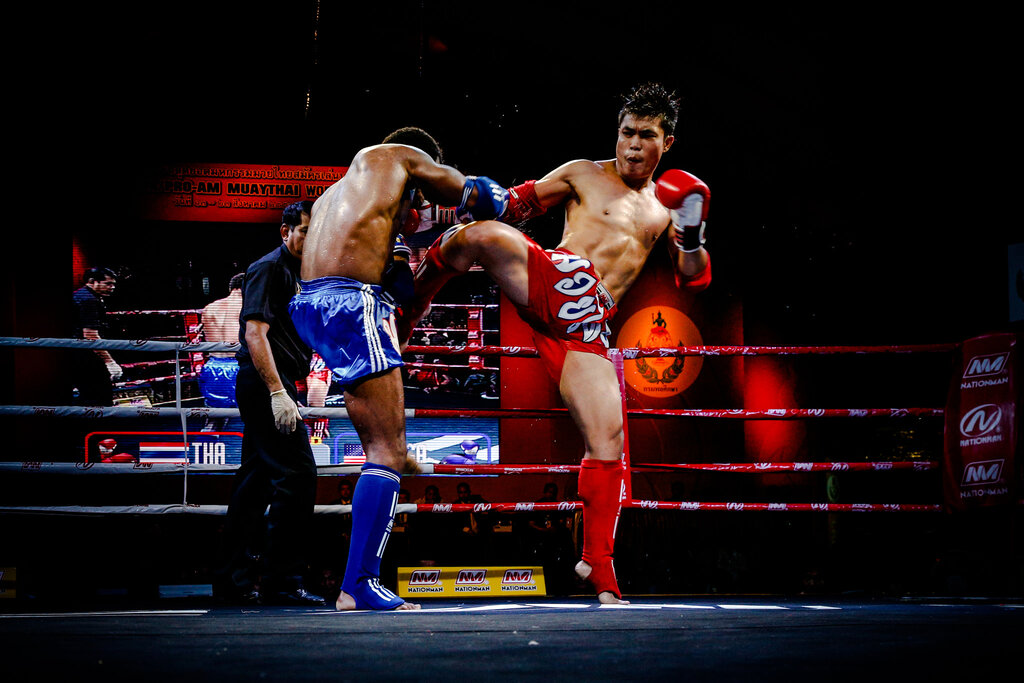
In contrast, the Muay Thai roundhouse kick is a 'thrusting' or 'penetrating' technique. Instead of snapping the knee, the practitioner swings their entire leg as a single, solid lever, powered by a full and committed hip rotation. The goal is to drive the shin through the target. This brings the full body mass into the equation.
Both styles use the same physics principle, but they optimize for different variables. Karate prioritizes acceleration for a whip-like impact, while Muay Thai prioritizes mass for a crushing, penetrating blow.
Delivering these powerful rotational strikes without losing balance requires immense core and posterior chain strength. The core muscles—abdominals, obliques, and lower back—act as a stabilizer, preventing energy from leaking out during the violent rotation. The posterior chain—glutes, hamstrings, and lower back—provides the foundational power that the core then channels. Without this stability, a fighter would simply spin themselves off balance instead of delivering force to the target.
What is the initial source of power for a strike, according to the kinetic chain principle?
A fighter has very powerful legs but a weak core. How would this most likely affect their punch?
Understanding these biomechanics is the key to unlocking true striking power. It's not just about strength, but about the efficient transfer of energy through a perfectly timed sequence of movements.