Mastering Martial Arts Integration
Biomechanical Striking Mechanics
Power From the Ground Up
Every powerful strike begins with the floor. Whether you're throwing a punch or a kick, you are pushing against the ground to initiate a chain reaction of movement. This sequence of energy transfer, from your feet up through your legs, hips, torso, and finally out through your limb, is called the An effective strike harnesses this ground reaction force efficiently.
In a traditional Karate reverse punch, the power generation is explosive and linear. The hips snap forward violently, but the feet often remain relatively planted to allow for a quick retraction and defensive posture. The energy travels a direct path, aiming for speed and penetration.
A Muay Thai cross, by contrast, involves a much more significant pivot on the rear foot. This rotation allows the entire body mass to swing behind the punch. It's less of a straight line and more of a rotational arc, sacrificing some speed for a massive increase in impact force. The commitment is greater, leaving the fighter momentarily more exposed, but the potential for damage is higher.
The Kicking Trade-Off
Nowhere is the difference in striking philosophy clearer than in kicking mechanics. It’s a classic trade-off between power and recovery speed, essentially comparing a whip to a baseball bat.
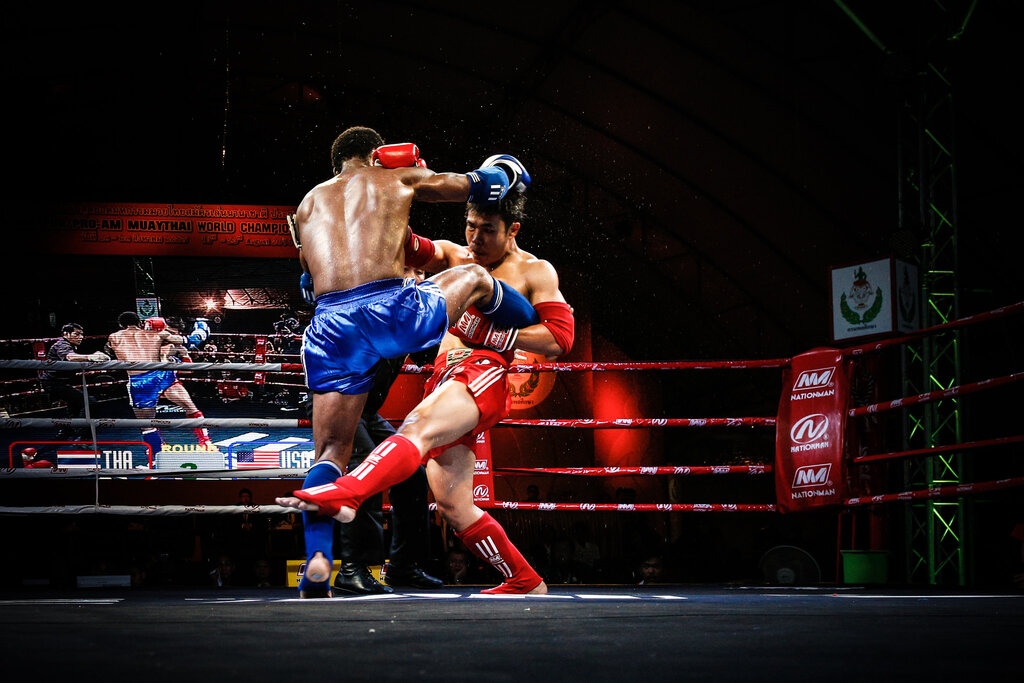
The Karate roundhouse kick is whip-like. It relies on bringing the knee up high into a "chambered" position before rapidly extending the lower leg. This chamber is crucial; from this position, a fighter can disguise their intent, launching a kick to the leg, body, or head with little telegraphing. The power comes from the sheer velocity of the knee extension. After impact, the leg can be retracted just as quickly, allowing the fighter to return to a stable defensive stance.
In contrast, the Muay Thai roundhouse is like swinging a bat. The practitioner pivots on their standing foot, turns their hip completely over, and swings their entire leg—from hip to shin—as a single, solid unit. There is no chamber. The power is generated by centrifugal force as the body rotates, transferring the fighter's entire body weight into the target. The goal is to kick through the opponent, not just at them.
Karate snaps the leg like a whip for speed and deception. Muay Thai swings the leg like a bat for raw power.
This difference in mechanics dictates the tactical application. The snapping kick is excellent for scoring points, managing distance, and setting up combinations without over-committing. The rotating kick is a fight-ender. The trade-off is recovery; a missed Muay Thai kick can leave a fighter off-balance and vulnerable to a counter-attack, a risk the Karate practitioner largely avoids.
For example, our data indicates that the typical Karate and Taekwondo snap-like kick is based heavily on rapid knee extension, while Muay Thai uses a technique that places greater emphasise on COM movements to develop high impact forces.
What is the term for the sequence of energy transfer from the ground up through the body to deliver a powerful strike?
Which statement best describes the primary mechanical difference between a Karate roundhouse kick and a Muay Thai roundhouse kick?
Understanding these biomechanical principles allows a martial artist to adapt their striking for different goals. Do you need maximum impact, or do you need to stay mobile and safe? The answer determines whether you swing a bat or crack a whip.