Mastering Martial Arts Disciplines
Striking Systems Mechanics
From the Ground Up
Every powerful strike, whether it's a boxer's jab or a karateka's reverse punch, starts from the same place: the floor. The force doesn't originate in the fist. It's generated by pushing against the ground and travels up through the body in a sequence known as kinetic linking or the kinetic chain. Think of it like cracking a whip. The handle moves first, and that energy accelerates and multiplies as it travels to the tip.
In a punch, your legs push off the ground, initiating a rotation in your hips and torso. This rotation whips the shoulder forward, followed by the arm, and finally the fist. Each link in the chain adds momentum, ensuring the fist is moving at maximum velocity upon impact. This principle is why a well-executed punch involves the entire body, not just the arm. It's the art of turning potential energy from your stance into kinetic energy at the point of contact.
The Art of Eight Limbs
While boxing perfects two points of contact (the fists), Muay Thai expands the arsenal to eight. Known as the "art of eight limbs," it incorporates punches, kicks, elbows, and knees. This versatility changes the entire dynamic of a fight, allowing a practitioner to launch powerful attacks from various ranges and angles. A punch might be followed by an elbow, or a kick might be used to set up a knee strike.
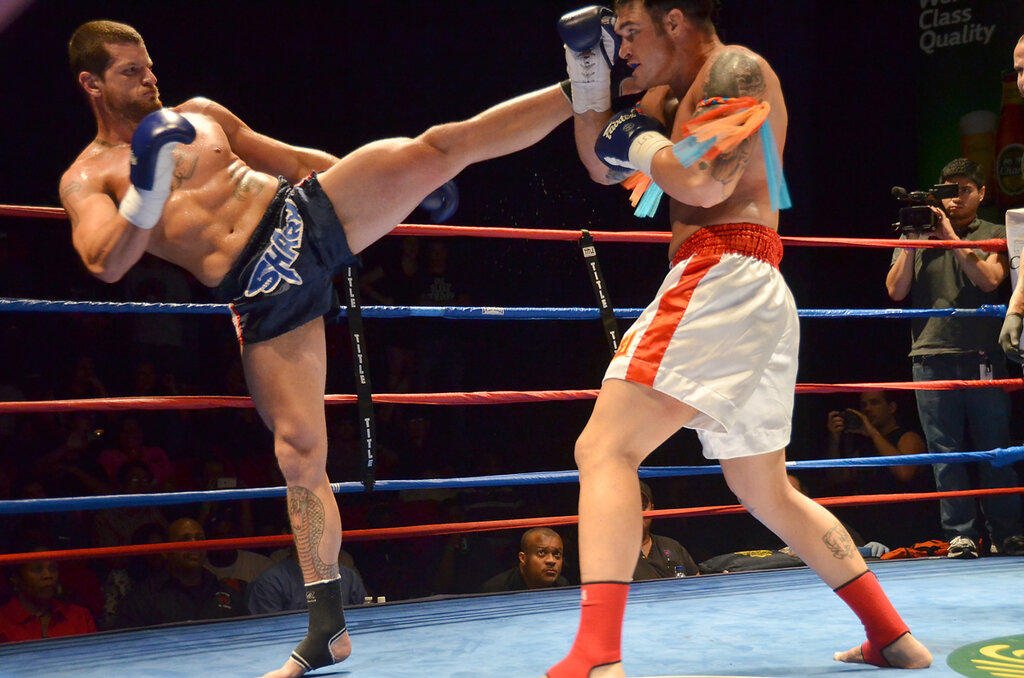
This leads to a fundamental difference in striking paths. Boxing and many Karate styles favor linear strikes—jabs, crosses, and straight kicks that travel in a direct line to the target. These are fast and efficient. Muay Thai, however, excels with circular strikes. The roundhouse kick is a prime example. Instead of a simple leg extension, the fighter pivots on their standing leg and rotates their entire body, swinging the kicking leg like a baseball bat. This circular motion generates immense centrifugal force, resulting in devastating impact, though it takes slightly longer to execute than a linear strike.
Linear strikes are often faster and more direct, while circular strikes generate more power by engaging more of the body's mass in a rotational movement.
Controlling the Distance
Effective striking isn't just about power; it's about range. Footwork is the tool for managing distance. Boxers use precise, shuffling steps and pivots to stay on the outside, darting in to land combinations and moving out before the opponent can counter. Their goal is to maintain a range where their punches are effective but their opponent's are not.
Muay Thai fighters are also adept at long-range kicks, but they have a specialized answer for close-quarters combat: a form of stand-up grappling. Instead of creating distance, a fighter will intentionally close in, wrapping their arms around the opponent's neck or head. From this dominant position, they can control the opponent's posture and balance, leaving them vulnerable to powerful knee strikes to the body and head, or sharp elbow strikes.
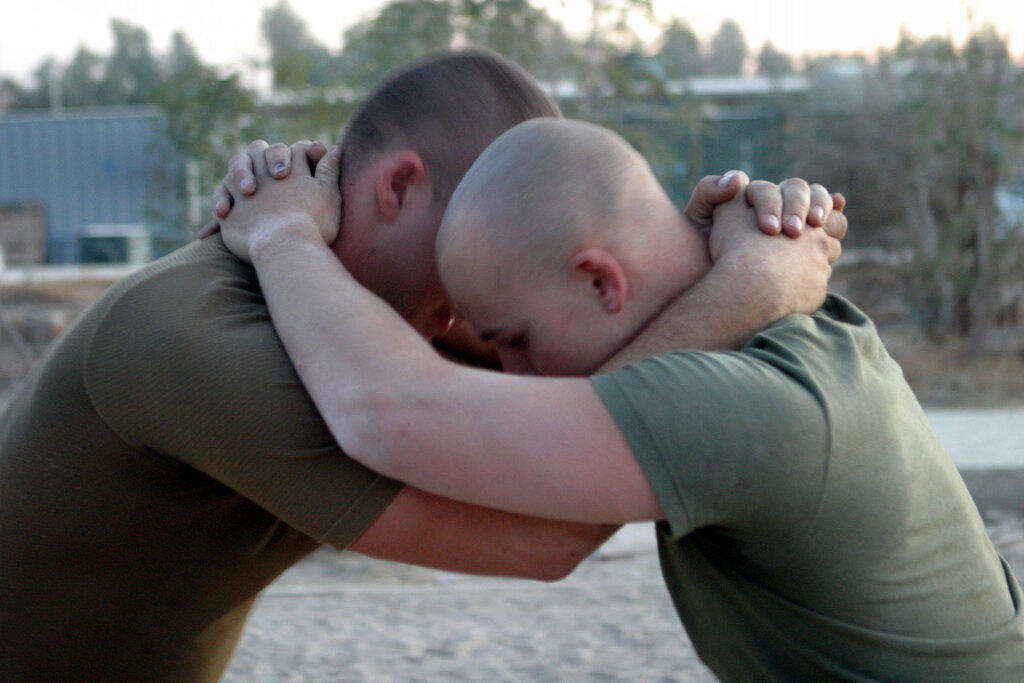
The mechanics of the clinch completely alter the fight. It nullifies the long-range weapons of a boxer or a kicker, forcing them into a grueling, close-range battle where knees and elbows reign supreme. Mastering the transition between long-range striking and clinch-work is essential for any well-rounded fighter.
According to the principle of the kinetic chain, where does the force for a powerful punch originate?
Which style is referred to as the "art of eight limbs" due to its use of punches, kicks, elbows, and knees?
Understanding these mechanical and strategic differences highlights how each striking art is a specialized solution to the problem of combat. Whether it's the efficient, linear power of boxing or the versatile, eight-limbed arsenal of Muay Thai, the principles of power generation and range control are universal.