Mastering Maritime Hydraulics
Wave Fundamentals
The Ocean's Pulse
The ocean surface is never still. It's a complex tapestry of waves, ranging from tiny ripples to massive swells, all overlapping and interacting. To make sense of this chaos, scientists and engineers need a way to describe the sea state with a single, representative number. The most important characteristic is wave height.
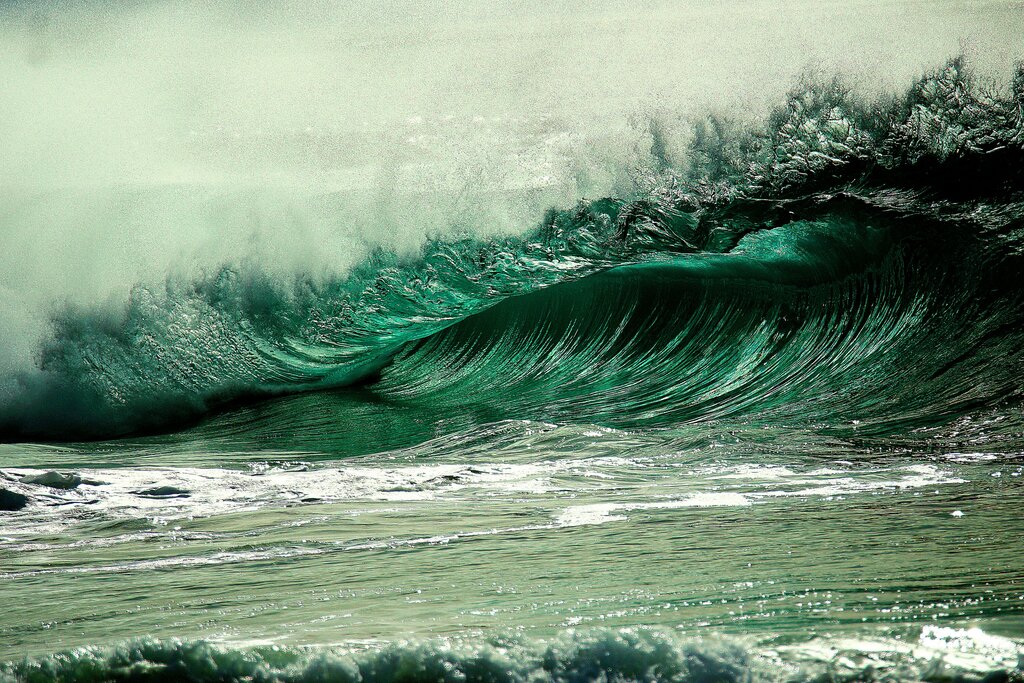
Imagine you're on a ship, watching the waves go by. Some are small, some are large. If you were asked to describe how “big” the waves are, you probably wouldn't average all of them. The tiny ripples don't matter much. Instead, you'd likely focus on the larger, more significant waves. This is exactly what mariners did for centuries, and it led to a concept called significant wave height, or .
Significant wave height () is the average height of the highest one-third of waves in a specific time period. It's a statistical measure that closely matches what an experienced observer would report as the wave height.
While visual estimation is useful, modern oceanography relies on precise instruments like buoys and satellites. These instruments don't just see the waves; they measure the energy they carry. This leads to a more technical but powerful way of looking at the sea.
A Spectrum of Waves
A seemingly messy sea state can be understood as the sum of many simple, clean sine waves, each with its own height, period, and direction. Think of it like a musical chord. A chord is made of several individual notes playing at once. Our ears hear a single, rich sound, but we can also pick out the individual notes that form it.
Spectral analysis is the tool that lets us do this for ocean waves. It takes the complex signal from a wave buoy and breaks it down into its constituent waves, creating a wave spectrum. This spectrum shows how the total wave energy is distributed among different wave frequencies.
From this spectrum, we can calculate the spectral significant wave height, or . This is derived from the total energy of the entire wave field. The total energy is represented by a value called the "zeroth spectral moment," or . It is essentially the total area under the energy spectrum curve.
For practical purposes, especially in deep water, and are considered equivalent. is the modern standard because it's calculated directly from instrumental data, removing the subjectivity of human observation.
From Wind to Waves
Waves are born from wind blowing over the water's surface. As the wind pushes on the water, it transfers energy, creating ripples. If the wind keeps blowing, these ripples grow into larger waves.
Three main factors determine how large the waves will become:
- Wind speed: Faster winds transfer more energy and create bigger waves.
- Wind duration: The length of time the wind blows over the water. A strong wind blowing for only a few minutes won't generate large waves.
- Fetch: The distance over water that the wind blows in a single direction. A long fetch allows waves to grow to their maximum potential size for a given wind speed.
Once generated, waves don't just stay in one place. They propagate, or travel, across the ocean. Waves with longer periods travel faster than waves with shorter periods. This causes the waves to sort themselves out as they travel away from the storm that created them. The long-period, organized waves that arrive at a coastline long before the storm are what we call swell.
Coming Ashore
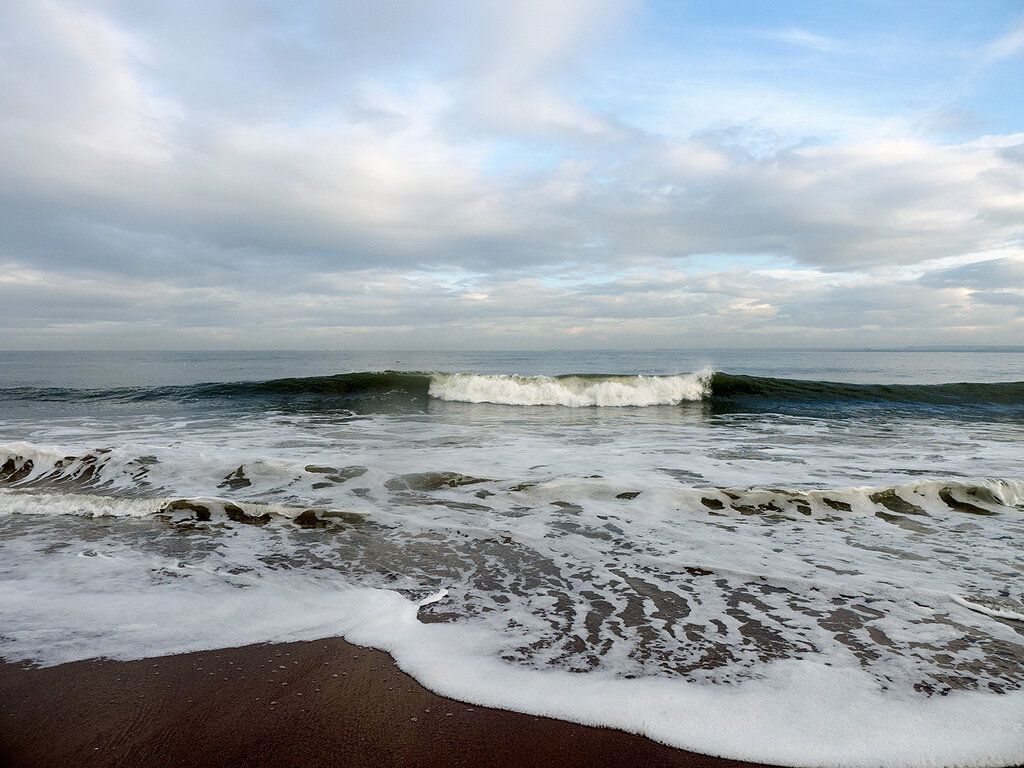
As waves travel from the deep ocean into shallower coastal waters, their behavior changes dramatically. This process is called wave transformation.
The most important change happens when the water depth becomes less than about half the wave's length. At this point, the wave starts to "feel" the seabed. This interaction with the bottom slows the wave down.
This slowing has several consequences:
- Shoaling: As the wave slows, its energy gets compressed into a smaller volume of water. To conserve energy, the wave height must increase. This is why waves get taller as they approach the beach.
- Refraction: If waves approach the shore at an angle, the part of the wave in shallower water slows down first, while the part in deeper water continues at a faster speed. This causes the wave crest to bend and become more parallel to the shoreline.
- Breaking: Eventually, the wave becomes too steep to support itself. The top of the wave (the crest) is moving much faster than the bottom (the trough). The crest outruns the base, and the wave breaks, dissipating its energy onto the shore.
Understanding these fundamental concepts—how we measure waves, how they are generated, and how they transform—is the first step in analyzing their powerful and complex effects on our coastlines.
Time to check your understanding of these core wave concepts.
Which of the following best describes the modern, instrument-based definition of significant wave height, known as ?
An offshore storm generates large waves. As these waves travel hundreds of miles across the open ocean, they sort themselves out, with the faster, longer-period waves arriving at a distant coast first. What is the term for these organized, long-period waves?
By breaking down the chaos of the ocean into understandable parts, we can better predict and work with its immense energy.